


Womandla Health: development and rationale of a behavioral intervention to support HIV treatment adherence among postpartum women in South Africa
- PMID: 38057777
- PMCID: PMC10701937
- DOI: 10.1186/s12905-023-02817-y
Womandla Health: development and rationale of a behavioral intervention to support HIV treatment adherence among postpartum women in South Africa
Abstract
Background: While Option B + has made great strides in eliminating vertical transmission of HIV and improving access to lifelong antiretroviral therapy (ART) for women, the postpartum period remains a risk period for disengagement from HIV care and non-adherence.
Methods: Longitudinal qualitative data was collected from 30 women living with HIV in Cape Town, South Africa from pregnancy through 1 year postpartum to examine key barriers and facilitators to HIV treatment adherence across this transition. Participants were also asked about their preferences for behavioral intervention content, format, and scope. The intervention development process was guided by Fernandez et al.'s Intervention Mapping process and was informed by the qualitative data, the wider literature on ART adherence, and Transition Theory.
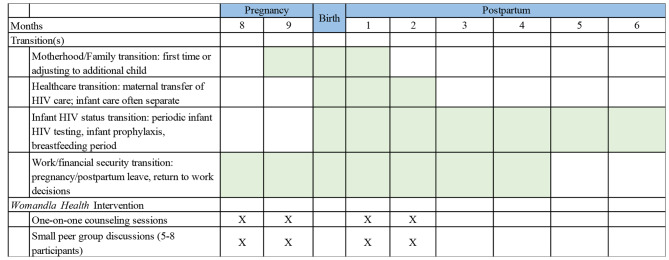
Results: The Womandla Health Intervention is a multicomponent intervention consisting of four individual sessions with a lay health worker and four peer group sessions, which span late pregnancy and early postpartum. These sessions are guided by Transition Theory and utilize motivational interviewing techniques to empower women to ascertain their own individual barriers to HIV care and identify solutions and strategies to overcome these barriers.
Conclusions: This intervention will be tested in a small scale RCT. If successful, findings will provide an innovative approach to HIV treatment by capitalizing on the transition into motherhood to bolster self-care behaviors, focusing on ART adherence and also women's overall postpartum health and psychosocial needs.
Keywords: Behavioral intervention; HIV; Postpartum; Pregnancy.
© 2023. The Author(s).
Conflict of interest statement
The authors declare that they have no competing interests.
Figures
References
-
- Woldesenbet SA, Lombard C, Manda S, Kufa T, Ayalew K, Cheyip M et al. The 2019 National Antenatal Sentinel HIV Survey. In: Health NDo, editor. South Africa.2021.
-
- UNAIDS, South Africa. 2020 Factsheet 2021 [Available from: https://www.unaids.org/en/regionscountries/countries/southafrica.
-
- Zaba B, Calvert C, Marston M, Isingo R, Nakiyingi-Miiro J, Lutalo T, et al. Effect of HIV Infection on pregnancy-related mortality in sub-saharan Africa: secondary analyses of pooled community-based data from the network for Analysing Longitudinal Population-based HIV/AIDS data on Africa (ALPHA) Lancet. 2013;381(9879):1763–71. doi: 10.1016/S0140-6736(13)60803-X. - DOI - PMC - PubMed
-
- Nachega JB, Uthman OA, Anderson J, Peltzer K, Wampold S, Cotton MF, et al. Adherence to antiretroviral therapy during and after pregnancy in low-income, middle-income, and high-income countries: a systematic review and meta-analysis. AIDS. 2012;26(16):2039–52. doi: 10.1097/QAD.0b013e328359590f. - DOI - PMC - PubMed
Publication types
MeSH terms
Substances
Grants and funding
LinkOut - more resources
Full Text Sources
Medical
Miscellaneous
