


Defining the Time-limited Trial for Patients with Critical Illness: An Official American Thoracic Society Workshop Report
- PMID: 38063572
- PMCID: PMC10848901
- DOI: 10.1513/AnnalsATS.202310-925ST
Defining the Time-limited Trial for Patients with Critical Illness: An Official American Thoracic Society Workshop Report
Abstract
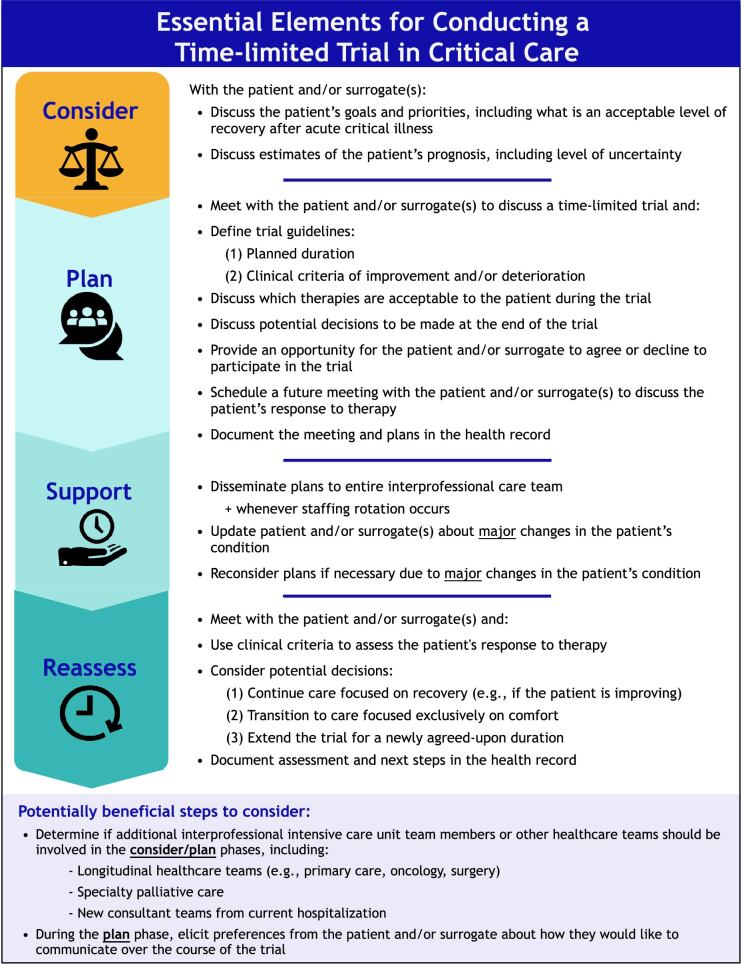
In critical care, the specific, structured approach to patient care known as a "time-limited trial" has been promoted in the literature to help patients, surrogate decision makers, and clinicians navigate consequential decisions about life-sustaining therapy in the face of uncertainty. Despite promotion of the time-limited trial approach, a lack of consensus about its definition and essential elements prevents optimal clinical use and rigorous evaluation of its impact. The objectives of this American Thoracic Society Workshop Committee were to establish a consensus definition of a time-limited trial in critical care, identify the essential elements for conducting a time-limited trial, and prioritize directions for future work. We achieved these objectives through a structured search of the literature, a modified Delphi process with 100 interdisciplinary and interprofessional stakeholders, and iterative committee discussions. We conclude that a time-limited trial for patients with critical illness is a collaborative plan among clinicians and a patient and/or their surrogate decision makers to use life-sustaining therapy for a defined duration, after which the patient's response to therapy informs the decision to continue care directed toward recovery, transition to care focused exclusively on comfort, or extend the trial's duration. The plan's 16 essential elements follow four sequential phases: consider, plan, support, and reassess. We acknowledge considerable gaps in evidence about the impact of time-limited trials and highlight a concern that if inadequately implemented, time-limited trials may perpetuate unintended harm. Future work is needed to better implement this defined, specific approach to care in practice through a person-centered equity lens and to evaluate its impact on patients, surrogates, and clinicians.
Keywords: critical care; life-sustaining therapy; palliative care; shared decision making.
Figures
References
-
- Quill TE, Holloway R. Time-limited trials near the end of life. JAMA . 2011;306:1483–1484. - PubMed
-
- Siropaides CH, Arnold RM. Time-limited trials for serious illness #401. J Palliat Med . 2020;23:1540–1541. - PubMed
-
- Vink EE, Azoulay E, Caplan A, Kompanje EJO, Bakker J. Time-limited trial of intensive care treatment: an overview of current literature. Intensive Care Med . 2018;44:1369–1377. - PubMed
