Review
. 2023 Nov 23;13(23):3006.
doi: 10.3390/nano13233006.

Advanced Flame Spray Pyrolysis (FSP) Technologies for Engineering Multifunctional Nanostructures and Nanodevices

Affiliations
Review

Advanced Flame Spray Pyrolysis (FSP) Technologies for Engineering Multifunctional Nanostructures and Nanodevices

Christos Dimitriou et al. Nanomaterials (Basel). .

Abstract

Flame spray pyrolysis (FSP) is an industrially scalable technology that enables the engineering of a wide range of metal-based nanomaterials with tailored properties nanoparticles. In the present review, we discuss the recent state-of-the-art advances in FSP technology with regard to nanostructure engineering as well as the FSP reactor setup designs. The challenges of in situ incorporation of nanoparticles into complex functional arrays are reviewed, underscoring FSP's transformative potential in next-generation nanodevice fabrication. Key areas of focus include the integration of FSP into the technology readiness level (TRL) for nanomaterials production, the FSP process design, and recent advancements in nanodevice development. With a comprehensive overview of engineering methodologies such as the oxygen-deficient process, double-nozzle configuration, and in situ coatings deposition, this review charts the trajectory of FSP from its foundational roots to its contemporary applications in intricate nanostructure and nanodevice synthesis.

Keywords: TRL; complex assemblies; double nozzle; flame spray pyrolysis; multifunctional nanomaterials/nanodevices; nanofilms; non-oxides; oxygen-deficiency process; perovskites; plasmonics; quantum dots.


Conflict of interest statement

The authors declare no conflict of interest.

Figures

Figure 13
Figure 13
(a) Predicted normalized gas-phase mass fractions, the ZrO2 formation profile (brown), and volume concentration (green). (b) Schematic of FSP two-phase atomizer geometry. Reprinted (adapted) with permission from [117]. Copyright 2014 American Chemical Society. (c) A flame spray pyrolysis (FSP) pilot plant is designed to produce multiple kg h−1 of nanoparticles, incorporating a baghouse filter for nanoparticle collection with an approximate filtration area of ~50 m2. Reprinted from [108].
Figure 16
Figure 16
(a,b) TEM images illustrating necked particles of BiVO4. Reprinted (adapted) with permission from [122]. Copyright 2011 American Chemical Society. (c) TEM images of necked-sintered BiFeO3 particles. Reprinted from [124], with permission from Elsevier. (df) HRTEM micrographs of SrTi1−xCoxO3 and the miller planes. (g) EDX element mapping of SrTi1−xCoxO3 for the Ti, Co, and Sr atoms. Reprinted (adapted) with permission from [129]. Copyright 2021 American Chemical Society.
Figure 19
Figure 19
(a) A diagrammatic representation of the diverse nanoscale structures that can be engineered by the FSP method. (b) TEM depicts the hexagonal FSP-made NaYF4:Yb,Tm nanostructures. (c) XRD data of NaYF4:Yb,Tm nanoparticles obtained under varying fuel/oxygen flow ratios. Reprinted from [145].
Figure 28
Figure 28
(a) A photodetector substrate and (b,c) the synthesis via flame spray pyrolysis and subsequent aerosol self-assembly, resulting in (d) ultraporous films composed of electron-depleted ZnO nanoparticles at a 20 cm height above the burner (HAB). These films are uniformly structured and predominantly consist of spherical particles with an average TEM size of 19 nm (d). Reproduced with permission from ref. [93] Copyright 2015 Wiley-VCH. (e) SEM cross-sectional (i) and top views (ii–iv) of a SnO2 nanoparticle film, aerosol-deposited with a precursor concentration of 0.5 mol/L, for a duration of 4 min. Reproduced with permission from ref. [98] Copyright 2012 Wiley-VCH. (f,g) SEM images of an as-deposited LSC thin film produced by flame spray deposition on a sapphire substrate: (f) top view and (g) cross-sectional view. The film was deposited over a duration of 15 min at 200 °C during the flame spray deposition process. Reprinted from [223], with permission from Elsevier.
Figure 32
Figure 32
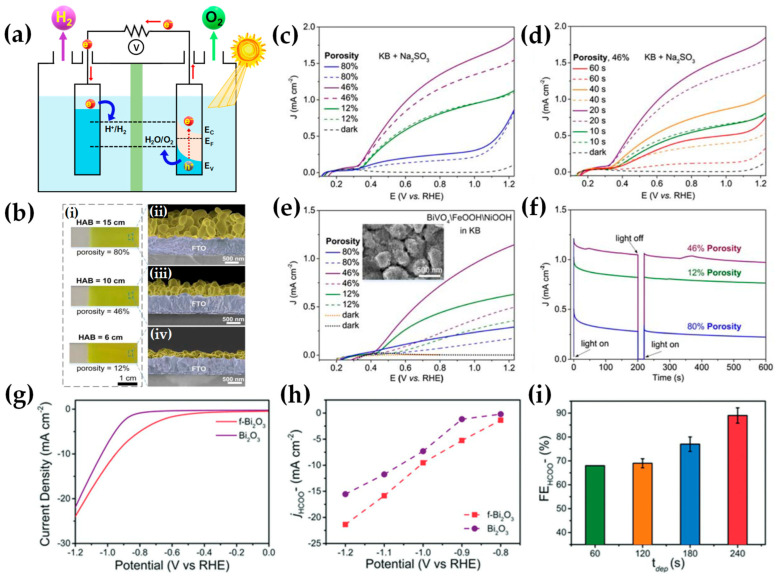
(a) Schematic representation of a photoelectrochemical (PEC) cell’s fundamental mechanism, featuring an n-type semiconductor photoanode for oxygen evolution and a platinum sheet photocathode for hydrogen generation in water splitting. (b) Optical (i) and SEM (ii–iv) imaging of flame-made BiVO4 films on FTO substrates demonstrate variations based on differing HAB settings, with cross sections at (ii) 15 cm, (iii) 10 cm, and (iv) 6 cm HAB corresponding to 60, 20, and 5 s deposition times, ensuring uniform absorbance in each film. (cf) BiVO4 photoanode PEC metrics were assessed in relation to (c) porosity, (d) thickness during oxidation in air-saturated 1 M KB (pH 9.3) with 0.2 M Na2SO3 as a hole scavenger under FTO-side (solid), and BiVO4-side (dashed) illumination. (e) PEC responses in 1 M KB (pH 9.3) were measured with (solid) and without (dashed) FeOOH/NiOOH electrocatalyst modification under FTO-side illumination. The SEM inset of (e) displays the morphology post-FeOOH/post FeOOH/NiOOH application on a 12% porosity sample. Dark current densities were logged for the 12% porosity sample with (dark dot) and without (yellow dot) electrocatalyst overlay. Measurements were taken via voltammetry at 0.010 V s−1 ascending potential in 1 sun equivalent light (AM 1.5 G, 100 mW cm−2). (f) Longevity trials were conducted on FeOOH/NiOOH-modified samples in 1 M KB (pH 9). Reproduced with permission from ref. [227]. Copyright 2019 Wiley-VCH. (gi) CO2RR efficacy of f-Bi2O3 catalysts was evaluated in CO2-saturated 0.1 M KHCO3. (g) f-Bi2O3 exhibited specific voltammetry profiles at 5 mV s−1, with comparative data for filter-collected Bi2O3. (h) The current density for formate production on f-Bi2O3 and Bi2O3 varied with potential during CO2RR. (i) The Faradaic efficiency for formate generation during CO2RR correlated with aerosol deposition duration, with measurements taken at −1.2 V vs. RHE. Reproduced with permission from ref. [251]. Copyright 2019 Wiley-VCH.
Figure 33
Figure 33
(a) Simplified fuel cell’s schematic representation. (b) Methanol oxidation and (c) CO stripping processes utilizing carbon-supported Pt-Ru catalyst produced via FSP in contrast to the performance of standard E-TEK catalysts. (d) Schematic figure depicting the apparatus used for the flame aerosol synthesis of Pt-Ru/C catalysts, with an accompanying TEM image of the synthesized Pt-Ru/C catalysts in the inset. Reprinted from [254], with permission from Elsevier. (e) Schematic of a Li-ion battery illustrating its constituent components. Reprinted from [255]. (f) The LTO battery cell fabrication involves setting KaCu substrates in an FSP reactor for LTO deposition, followed by compression and transfer to a glove box for sputtering LiPON, lithium, and copper, leading to the final cell assembly. (g,h) Nyquist diagrams for battery cells featuring fully lithiated rock-salt-type Li7Ti5O12 (g) and completely delithiated (initial state) spinel Li4Ti5O12 (h) thin films. (i) Morphological analysis of compressed LTO thin films includes (i) photographs, (ii) SEM imaging on KaCu substrates, (iii) 2D LSM color and laser imaging, and (iv) 3D surface profiling. Reprinted from [256], with permission from Elsevier.
Figure 1
Figure 1
Figure illustrating the complex assemblies in flame spray pyrolysis (FSP) discussed in this review. These include double-nozzle, sequential deposition, oxygen-deficiency process, ring deposition, sequential/thin-film deposition, and scale-up methods. The resultant advanced nanomaterials/nanodevices encompass perovskites, non-oxides, quantum dots, plasmonics, nanofilms, and sensors.
Figure 2
Figure 2
(a) Temporal scales in the fabrication of ZrO2 nanoparticles via FSP. A time-evolving analysis encompasses the dynamics of the droplet mass ratio, the rate of product formation, nanoparticle diameter, and gas temperature, serving to demarcate distinct phases within the manufacturing process. Reprinted (adapted) with permission from [1]. Copyright 2021 American Chemical Society. (b) Visualization of actual FSP flame, depicting the synthesis parameters (pilot flame, precursor solution, dispersion, sheath gas). Concurrently, a graphical representation of the flame’s temperature distribution, congruent with that depicted in (a), is presented. Below the flame, a comprehensive elucidation of the droplet-to-particle transformation process in the production of nanoparticles is provided.
Figure 3
Figure 3
Timeline of the flame spray pyrolysis (FSP) technology, and some pertinent review articles. The bar graph depicts the annual publication frequency (1365 documents in total) from 1977 to 2023, sourced from Scopus using the keyword ‘Flame Spray Pyrolysis’ [1,2,30,31,34,35,36,37,38,39,40,41,42,43].
Figure 4
Figure 4
(a) Conventional FSP (left) and our reducing FSP (right), where the anoxic flame is produced by in situ introduction of reducing dispersion gas, e.g., CH4. (b) An anoxic FSP reactor, used by Stark, with the whole reactor enclosed in a glove box filled with an inert atmosphere. By adjusting the gas flow rates, it is possible to achieve highly reduced conditions (O2 < 100 ppm). Used with permission of Royal Society of Chemistry from [45]; permission conveyed through Copyright Clearance Center, Inc. (c) Schematic depiction of the step-by-step transformation from precursor to oxide, metal, and carbon-coated metal nanoparticles during the reducing flame synthesis process: Initially, the precursor undergoes evaporation and combustion, resulting in oxide nanoparticles. These particles can then be further reduced to their metallic form by H2 and CO. Throughout this procedure, the nanoparticles increase in size due to aggregation and sintering. By introducing acetylene, these metal nanoparticles can acquire a carbon coating layer. Reproduced with permission from ref. [47,48]. Copyright 2007 Wiley-VCH.
Figure 5
Figure 5
(a) Experimental setup of laminar, inverse diffusion flame stabilized on a burner for the synthesis of magnetic iron oxide nanoparticles with reduced oxidation state. Reprinted from [52], with permission from Elsevier. (b) The concept of the novel anoxic FSP, as developed by our lab, for ZrO2−x production. Reprinted from [54]. (c) (i) Schematic representation of anoxic FSP reactor used for the synthesis of C@Cu2O/Cu0 nanoparticles. Reprinted from [55]. (ii) Anoxic FSP reactor configuration utilized for creating CuO and Cu2O nanomaterials. Reprinted from [55,56].
Figure 6
Figure 6
Symmetric and asymmetric DN-FSP configuration for two particle formation regarding the (i) atomic, (ii) particle, or (iii) agglomeration scale.
Figure 7
Figure 7
(a) Schematic example of SN-FSP where two precursors are mixed before being fed to the flame. (b) Geometry parameters of DN-FSP. (c) Example of a symmetrical DN-FSP, used for engineering of La-doped SrTiO3, with surface deposition of CuO. Reprinted from [58]. (d) Example of asymmetrical DN-FSP.
Figure 8
Figure 8
(a) TEM images revealing the local distribution of cobalt and oxygen for Pt-Al2O3/Co3O4, (b) EDX measurements for chemical composition. Reprinted from [64]. DΝ-FSP-prepared (c) SiO2/Co, (d) SiO2-TiO2/Co, (e) and TiO2/Co; left images show STEM-HAADF and right images show EDX mappings of the elements Co (blue), Si (red) and Ti (yellow). (f) Particle size distributions of Co3O4 for the materials SiO2, SiO2-TiO2, and TiO2. Reproduced with permission from ref. [65]. Copyright 2022 Wiley-VCH. (g) STEM-HAADF of the nano-mixed CeO2:Eu3+/Y2O3:Tb3+ and its elemental mapping for Ce in red and Y in green, (h) dTEM distribution of CeO2:Eu3+ and Y2O3:Tb3+. Reprinted from [66], with permission from Elsevier.
Figure 9
Figure 9
(a) Overhead perspective of the stainless steel segment in the quench ring according to the research work of Hansen et al. [74]; every nozzle is angled at 10° compared with a hypothetical line passing through the central axis. Reproduced with permission from ref. [74]. Copyright 2001 Wiley-VCH. (b) Experimental configuration for in situ SiO2 coating of TiO2 nanoparticles produced by Teleki et al. [75], using a toroidal pipe ring with 16 gas exits to inject HMDSO-laden N2. At burner ring distances (BRD) of (c) 5 cm and (d) 30 cm, this leads to distinct SiO2/Al2O3/TiO2 or SiO2-layered Al/TiO2 particles, each containing 4 wt% Al2O3 and 20 wt% SiO2, respectively. Reprinted (adapted) with permission from [75]. Copyright 2008 American Chemical Society. (e) Toroidal pipe ring equipped with 8 outlets for injection of the HMDSO-laden N2. (f) Impact of the ring N2 flow rate (along with the associated jet Reynolds number at 300 K) under standard coating conditions on SSA (depicted by circles), rutile weight percentage (represented by triangles), anatase (shown as squares), and rutile (illustrated by diamonds) crystallite sizes of 20Si-coated Al/TiO2. (g) Graphical representations of the (a) N2 volume percentage for 16 jets with a combined volume flow of 15.8 L/min N2 (v0 = 58 m/s). The related cross-sectional views are displayed at heights of 0 (b), 0.2 (c), 1 (d), and 3 cm (e) above the outlet level. The logarithmic color gradient extends from <1 (in blue) to 100 (in red) % v/v of N2. Reprinted (adapted) with permission from [77]. Copyright 2009 American Chemical Society.
Figure 10
Figure 10
(a) (i) Illustration of the enclosed FSP setup for producing Ag@SiO2 nanoparticles, originally developed by Sotiriou et al. [78]. The ring situated between the two tubes aids in swirling the SiO2 precursor vapor, ensuring the precise control of the SiO2 core. (ii) Adjustment of the crystallite size of nanosilver can be achieved by varying the SiO2 content in the final nanosilver particles and by altering the injection height of the SiO2 precursor vapor to 30 (circles), 25 (triangles), or 20 cm (squares) above the flame spray burner. Enhancing the SiO2 content helps to prevent the agglomeration and crystal growth of Ag nanoparticles. Additionally, introducing HMDSO (the SiO2 precursor) at reduced heights cools the flame aerosol, further inhibiting Ag crystal growth. Reproduced with permission from ref. [78]. Copyright 2010 Wiley-VCH. (b) (i) Schematic depiction of the enclosed FSP reactor where the one-step Ag coating SiO2 particles occur in-flight [80]. Contrary to Sotiriou et al.’s findings [78], the metal ring was at the top of the FSP-enclosed flame. (ii) XRD patterns of SiO2@Ag0 nanoparticles with variations in size and shell thickness. Reprinted (adapted) with permission from [80]. Copyright 2019 American Chemical Society. (c) Schematic illustration of FSP reactor configurations: (i) designed for high-temperature nano-SiO2 production, (ii) tailored for the hybrid rSiO2@SiO2 nanosilica, and (iii) set up for low-temperature nano-rSiO2 synthesis. Reprinted (adapted) with permission from [82]. Copyright 2022 American Chemical Society. (d) FSP apparatus for creating core-shell CuOx@SiO2 nanoparticles. Reprinted from [85], with permission from Elsevier.
Figure 11
Figure 11
(a) The concept of sequential deposition technique, as originally exemplified by Sahm et al. [89], for the engineering of multilayer films. Cross-sectional SEM images of a SnO2 layer are shown (i); a Pd/Al2O3 layer over a SnO2 layer (ii); a Pd/SnO2 layer (iii); and a Pd/Al2O3 layer on the top of a Pd/SnO2 layer (iv)—all of which were deposited on ceramic bases. Reprinted from [89], with permission from Elsevier. (b) A schematic depiction of the FSP process employed for the deposition of Pd onto the TiO2 surface in two stages (sequential deposition, SD-FSP). Reprinted (adapted) with permission from [91]. Copyright 2020 American Chemical Society.
Figure 12
Figure 12
(a) Schematic illustration of the creation of porous or solid films through the flame deposition of droplets, vapors, or particles. (b) Illustrative diagram of the flame spray pyrolysis deposition setup; the embedded image displays an external mix atomizer for film deposition. Reprinted from [96], with permission from Elsevier. (c) FSP burner combined with a temperature-regulated substrate holder designed for nanofilm creation and deposition. Reproduced with permission from ref. [98] Copyright 2012 Wiley-VCH. (d) Diagrammatic representation: (i) Flame-made nanoparticle layers, exhibiting a high porosity of 98%, are methodically deposited onto a silicon wafer using a shadow mask. Subsequently, (ii) these layers undergo in situ mechanical stabilization via an impinging xylene flame devoid of particles. Reproduced with permission from ref. [99] Copyright 2008 Wiley-VCH.
Figure 14
Figure 14
The ideal cubic perovskite structure exemplified by SrTiO3. (a) The cubic structure with the Ti4+ at the cell center. (b) The octahedral polyhedron structure TiO6. (c) Sr2+ at the cubic center with the octahedral structure surrounding the strontium. Different perovskite structures: (d) the ideal cubic perovskite, axis X, Y, and Z of the octahedral BX6 have a 180-degree separation. (e) Tetragonal perovskite structure, the octahedral BX6 tilted in only one of the three axes at an angle Θ1. (f) The orthorhombic structure, the octahedral, is titled in all three of the axes, in accordance with the angles Θ1, Θ2, and Θ3.
Figure 15
Figure 15
FSP formation of perovskite structure ABO3 requires avoidance of the formation of the two separate oxides (A-oxide, B-oxide).
Figure 17
Figure 17
(a) Reducing FSP configuration for engineering Fe3C or C/Fe3C nanostructures. (b) Controlling the process atmosphere in flame spray synthesis enables the production of diverse iron-based nanoparticles. The resultant composition aligns with the relevant phase diagrams for Fe/O (left side) under oxidizing conditions. Subsequent reduction processes yield iron and iron carbide nanoparticles in accordance with the predictions derived from the Fe/C phase diagram (right side). Reprinted (adapted) with permission from [140]. Copyright 2009, American Chemical Society.
Figure 18
Figure 18
(a) In a one-step process, a liquid precursor containing lead, titanium, and sulfur is transformed into composite nanoparticles using a high-temperature flame reactor. Precise control of oxygen content enables fine-tuning of the system’s chemistry, facilitating the selective formation of titania support particles (oxides) and lead sulfide quantum dots (sulfides). (b) TEM analysis of a PbS−TiO2 heterojunction. The light contrast TiO2 nanoparticles serve as a support for PbS (darker contrast). Reprinted (adapted) with permission from [142]. Copyright 2012 American Chemical Society. (c) A schematic representation is presented depicting the operation of enclosed single-droplet (SD) combustion and enclosed reactive spray (RS) flame reactors for the production of metal sulfide particles. Emphasis is placed on elucidating the involvement of micro-explosions in the gas-to-particle pathway, observed in both SD and RS configurations. (d) From top to bottom in the column, the images depict the following: an overview of the particles, a high-resolution image of the particles, and a representative single crystalline particle—each of Cu2S, CoS, In2S3, Ag2S, MnS, and ZnS. Reproduced with permission from ref. [143]. Copyright 2023 Wiley-VCH.
Figure 20
Figure 20
(a) Illustration of an enclosed FSP configuration, comprising a particle formation zone (1), an acetylene carbon black (ACB)-coating region (2), and a quenching zone (3). The precise regulation of O2 stoichiometry within the ACB-coating area is achieved by enclosing the unit with quartz tubes. Subsequently, the coated particles are subjected to cooling using nitrogen (N) at the conclusion of the coating zone to prevent carbon black combustion upon exposure to ambient air during the filtration process. (b) TEM image of as-prepared segregated ACB and LiFePO4 nanostructures. Reprinted from [149], with permission from Elsevier. (c) The XRD pattern of the calcium phosphate (CaP) nanoparticles is presented. Depending on the FSP synthesis conditions employed, the resultant nanoparticles manifest either crystalline or amorphous characteristics. Predominant diffraction peaks are attributed to hydroxyapatite; Ca5(PO4)3OH, though the presence of CaO, is also detected. TEM micrographs of the freshly synthesized (d) CaPL and (e) CaPS materials are provided. The CaPL nanoparticles display a spherical morphology characterized by a loosely agglomerated structure. In contrast, the CaPS particles are evidently fused, with discernible sintered necks. Reprinted from [153]. (f,g) TEM images for as-synthesized vanadium phosphate (VOPO4) particles from (f) sucrose-based solutions and (g) DMF-based solutions. Reprinted from [146].
Figure 21
Figure 21
(a) XRD pattern of the as-synthesized barium carbonate (BaCO3) is presented. Reflections not labeled are attributable to the monoclinic phase of BaCO3. Only minute traces of the orthorhombic phase (O) have been detected. (b) TEM showcasing nanoparticles of BaCO3 synthesized via flame-based methods. The inset provides a representation of the corresponding electron diffraction pattern. Reprinted from [155], with permission from Elsevier.
Figure 22
Figure 22
(a) Illustration depicting the experimental arrangement employed for FSP synthesis of magnetic nanoparticles. Specifically, the reducing flame spray synthesis (RFSP) was executed under a controlled nitrogen atmosphere, with the pilot flame constituted of an O2/H2/air mixture. (b) TEM image of flame-made Fe/Fe3O4 nanostructures. Reprinted from [156], with permission from Elsevier.
Figure 23
Figure 23
(a) A HR-TEM image of as-prepared mixed silica-ZnO crystallites. This image prominently displays the crystalline lattice structure of the ZnO component. Additionally, an inset is provided, offering a lower magnification view that elucidates the overall morphology of the powder under investigation. Reprinted from [188], with the permission of AIP Publishing. (b) Combustion flame of the SiO2-metal oxide solution with all the produced colored metal oxide QDs and the TEM image of CuO QDs. Reprinted from [189]. (c) TEM analysis of CuO-SrTiO3 nanostructures, where the CuO QDs are distinctly delineated by dashed yellow circles. Inset: elemental mapping of CuO QDs within a specific region of interest. Reprinted (adapted) with permission from [130]. Copyright 2021 American Chemical Society. (d,e) HR-TEM images and the locally enlarged HR-TEM images of CQDs/TiO2-C. Reprinted from [190], with permission from Elsevier.
Figure 24
Figure 24
(a) STEM image of the 2Ag/SiO2 composite material EDX analysis: area 1, containing silver, and area 2, representing pure SiO2. (b) Diffuse reflectance ultraviolet/visible (UV/vis) spectra for various xAg/SiO2 compositions, where x denotes the silver concentration. A consistent plasmon absorption band of Ag metal at 410 nm was observed in all Ag-containing samples. TEM image, shown as an inset, depicted Ag nanoparticles (dark dots) dispersed on nanostructured silica support (gray) in the 6Ag/SiO2 nanostructure. Reprinted (adapted) with permission from [202]. Copyright 2010, American Chemical Society. (c,d) TEM images of the nanosilver coated with 7.8 wt% SiO2 are presented. Reproduced with permission from ref. [78]. Copyright 2010 Wiley-VCH. (e,f) TEM images of (e) 5–25 SiO2@Ag0 NPs (SiO2 thickness = 5 nm), and (f) 1–25 SiO2@Ag0 NPs (SiO2 thickness = 1 nm). (g) UV/vis spectra were recorded for suspensions of SiO2@Ag0 NPs with uniform particle size across three distinct variants: 1–15, 25 (SiO2: 1 nm), 3–15, 25 (SiO2: 3 nm), and 5–15, 25 (SiO2: 5 nm). The inset of the figure presents photos of these particle suspensions. Additionally, schematic representations of the particles are provided to visually convey the influence of shell thickness. Reprinted (adapted) with permission from [80]. Copyright 2019 American Chemical Society.
Figure 25
Figure 25
(a) HR-TEM image depicting nanoparticles consisting of Au/Fe2O3 cores enveloped by amorphous SiO2 shells, measuring 2.6 nm in thickness with the SiO2 content in these shells quantified at 5.7 wt%. Inset: Elemental EDXS mapping for all three elements (Au, Fe, Si) together in a merged image. Reproduced with permission from ref. [203]. Copyright 2014 Wiley-VCH. (b) A HAADF-STEM image, characterized by Z-contrast, displaying the uncoated 50Ag/Fe2O3 sample. In addition, TEM images are presented for (c) the SiO2-coated 10Ag/Fe2O3 sample and (d) the SiO2-coated 35Ag/Fe2O3 sample. Above these visual representations, schematic diagrams are included, illustrating the structural characteristics of both uncoated and SiO2-coated particles. Reprinted (adapted) with permission from [204]. Copyright 2011 American Chemical Society.
Figure 26
Figure 26
(a) A schematic figure illustrating the FSP setup employed in the synthesis of silica-coated silver nanoparticles. (b) The Raman spectra analysis encompassed two distinct samples: pure rhodamine R6G powder and R6G molecules at a concentration of 10−6 mol L−1, both with and without the presence of 5 wt% SiO2-coated Ag nanoparticles. The presence of plasmonic particles induces the surface-enhanced Raman scattering (SERS) effect. Reprinted (adapted) with permission from [211]. Copyright 2013, American Chemical Society.
Figure 27
Figure 27
(a) TEM image of 20Ag/TiO2, synthesized under the condition X/Y = 8/5 (precursor feed rate/dispersion gas) accompanied by selected (b) high-resolution images for detailed examination. Notably, disordered titanium oxide, observable on both the nanosilver and TiO2, is highlighted using blue arrows and red dashed lines. (c) An illustrative diagram is included, depicting the formation of titanium suboxide (Magnéli phases) on nanosilver and TiO2, resulting from robust metal–support interactions (SMSI). Reprinted from [212], with permission from Elsevier.
Figure 29
Figure 29
(a) Using flame aerosol deposition and mechanical stabilization (in situ annealing), nanostructured films are produced in a single step. Nanoparticles formed in the flame are thermophoretically deposited onto substrates like Si, glass, or polymer-coated materials. By infusing a polymer, such as through spin coating, these films gain mechanical stability. Incorporating a sacrificial layer, like polyvinylpyrrolidone (PVP), enables the creation of free-standing polymer nanocomposite films. (b) HRTEM image of Ag/TiOx nanoparticles illustrates the pronounced crystallinity of both Ag and TiOx within the synthesized nanoparticles. (c) Cross-sectional scanning electron microscopy (SEM) representation of the Ag/TiOx polymer nanocomposite film with a deposition time (td) of 15 s and a composition of 50% Ag/Ti. Reprinted from [230].
Figure 30
Figure 30
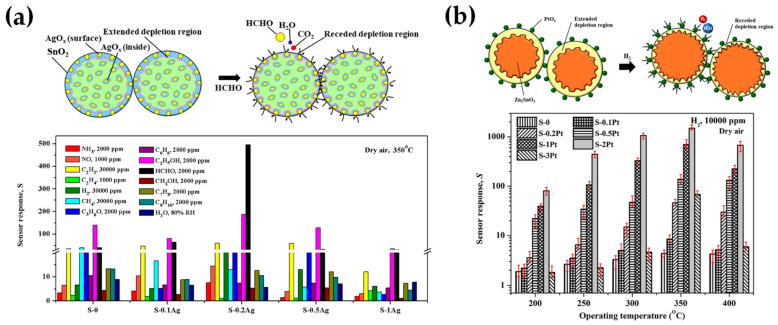
(a) HCHO-sensing models of SnO2 nanoparticles with AgOx-doping at a moderate content (0.2 wt%), and the response histogram of the AgOx-doped SnO2 sensors with different Ag contents (S-0 to S-1Ag) for toxic gases (NH3 and NO), flammable gases (C2H2, C2H4, H2 and CH4), and VOCs (C3H6O, C6H6, C2H5OH, HCHO, CH3OH, C7H8, and C8H10) at 350 °C. Reprinted from [236], with permission from Elsevier. (b) H2-sensing models of PtOx-loaded Zn2SnO4 nanoparticles with optimum Pt contents, and the sensor response to 10,000 ppm H2 of 0–3 wt% PtOx-loaded Zn2SnO4 (S-0 to S-3Pt) as a function of operating temperature in the range of 200–400 °C. Reprinted from [237], with permission from Elsevier.
Figure 31
Figure 31
(a) Schematic diagrams for FSP synthesis of La2O3-loaded WO3 nanoparticles. (b) Areal-view SEM images of S-2La (two spin-coating cycles). (c) Sensor responses toward 5000 ppb NO2 of 0–2 wt% La2O3-loaded WO3 two-cycle spin-coated films (S-0 to S-2La) in terms of temperature (25–350 °C). Reprinted (adapted) with permission from [242]. Copyright 2023, American Chemical Society.

References

    1. Meierhofer F., Fritsching U. Synthesis of Metal Oxide Nanoparticles in Flame Sprays: Review on Process Technology, Modeling, and Diagnostics. Energy Fuels. 2021;35:5495–5537. doi: 10.1021/acs.energyfuels.0c04054. - DOI
    1. Teoh W.Y., Amal R., Mädler L. Flame Spray Pyrolysis: An Enabling Technology for Nanoparticles Design and Fabrication. Nanoscale. 2010;2:1324–1347. doi: 10.1039/c0nr00017e. - DOI - PubMed
    1. Ulrich G.D. Special Report. Chem. Eng. News Arch. 1984;62:22–29. doi: 10.1021/cen-v062n032.p022. - DOI
    1. Liu S., Mohammadi M.M., Swihart M.T. Fundamentals and Recent Applications of Catalyst Synthesis Using Flame Aerosol Technology. Chem. Eng. J. 2021;405:126958. doi: 10.1016/j.cej.2020.126958. - DOI
    1. Leskelä M., Ritala M. Atomic Layer Deposition (ALD): From Precursors to Thin Film Structures. Thin Solid Films. 2002;409:138–146. doi: 10.1016/S0040-6090(02)00117-7. - DOI

LinkOut - more resources