. 2023 Dec 8;46(12):126.
doi: 10.1140/epje/s10189-023-00379-3.

Mosquito swarms shear harden

Affiliations

Mosquito swarms shear harden

Andy M Reynolds. Eur Phys J E Soft Matter. .

Abstract

Recently Cavagna et al. (Sci Rep 13(1): 8745, 2023) documented the swarming behaviors of laboratory-based Anopheles gambiae mosquitoes. Here key observations from this 3D-video tracking study are reproduced by a minimally structured (maximum entropy) stochastic trajectory model. The modelling shows that in contrast with midge swarms which are a form of collective behavior, unperturbed mosquito swarms are more like collections of individuals that independently circulate around a fixed location. The modelling predicts the observed response Anopheles gambiae mosquitoes in wild swarms to varying wind speeds (Butail et al. in J Med Entomol 50(3): 552-559, 2013). It is shown that this response can be attributed to shear hardening. This is because mosquitoes are found to be attracted to the centre of the swarm by an effective force that increases with increasing flight speed. Mosquitoes can therefore better resist the influence of environmental disturbances by increasing their flight speeds. This contrasts with other emergent mechanical-like properties of swarming which arise accidentally without a change in an individual's behavior. The new results add to the growing realization that perturbations can drive swarms into more robust states.


Figures

Fig. 1
Fig. 1
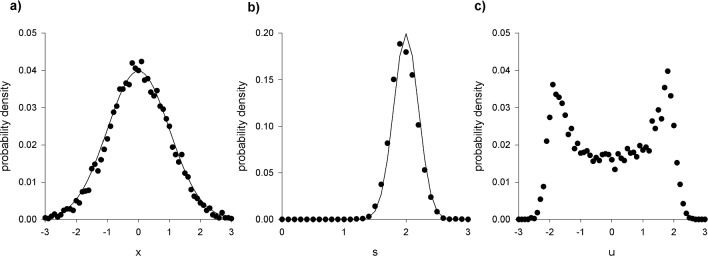
Model trajectories have the prescribed statistics. (a) and (b) The predicted positions and speeds of individual mosquitoes (•) match the prescribed distributions (solid lines) which encapsulate observations [4]. (c) In accordance with observations [4], the distribution of a single component of velocity is predicted to have two peaks. The apparent asymmetry is due to statistical noise and varies across simulations. Consequently, as observed [4] the two velocity components, u and v, lie within a narrow ring in u-v space. Predictions were obtained using the stochastic trajectory model, Eq. 2, with s¯=2,σs=15,σr=1 and T=1 a.u
Fig. 2
Fig. 2
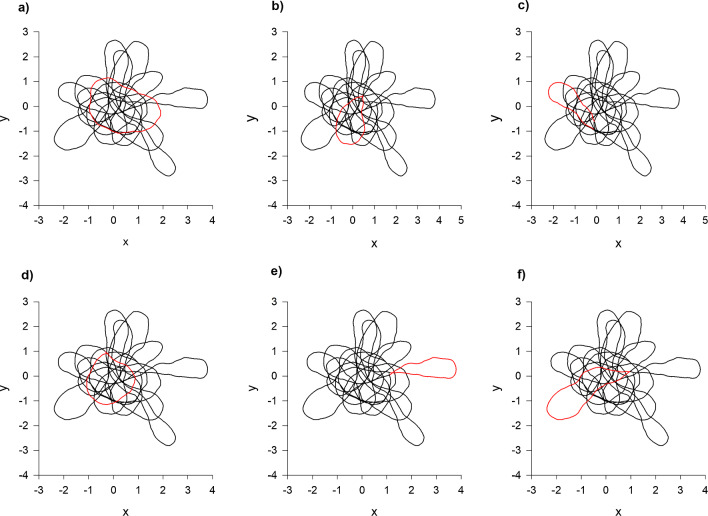
As observed [4], simulated individuals perform consecutive pseudo-circular motions. Here these are highlighted in red and are superimposed on the complete simulated trajectory for the same individual. Letters in the top corned of each sub-panel represent the temporal order of the ring-like movements. Predictions were obtained using the stochastic trajectory model, Eq. 2, with s¯=2,σs=15,σr=1 and T=1 a.u
Fig. 3
Fig. 3
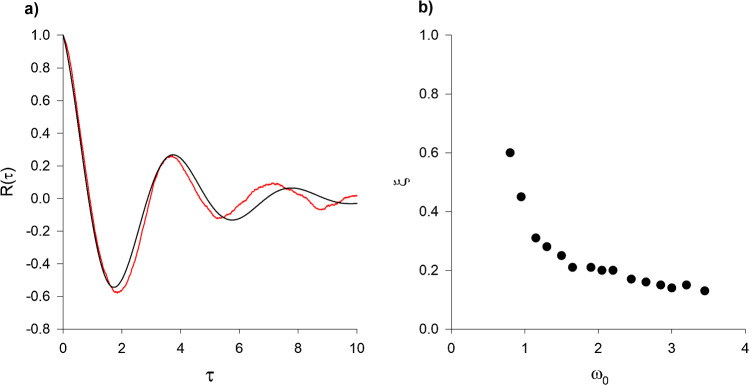
(a) As observed [4], velocity autocorrelations are oscillatory (black line). They can be accurately parameterized by Eq. 3 (red line). Predictions were obtained s¯=2,σs=15,σR=1 and T=1 a.u. (b) The predicted relationship between natural frequency, ω0, and the damping ratio, ξ, mirrors the observations of Butail et al. [3]. Predictions were obtained σs=15,σr=1, T=1 a.u. and with mean speed s¯ ranging between 1 and 4

References

    1. Attanasi A, et al. Collective Behaviour without collective order in wild swarms of midges. PLoS Comp. Biol. 2014;10:e1003697. doi: 10.1371/journal.pcbi.1003697. - DOI - PMC - PubMed
    1. N.S. Banas, D-P. Wang & J. Yen. Experimental validation of an individual-based model for zooplankton swarming. In Handbook of Scaling Methods in Aquatic Ecology: Measurement, Analysis, Simulation. Edited by P.G. Strutton and L. Seuront. CRC Press pp161–180 (2003).
    1. Butail S, et al. The dance of male Anopheles gambiae in wild mating swarms. J. Med. Entomol. 2013;50(3):552–559. doi: 10.1603/ME12251. - DOI - PMC - PubMed
    1. Cavagna A, et al. Characterization of lab-based swarms of Anopheles gambiae mosquitoes using 3D-video tracking. Sci. Rep. 2023;13:8745. doi: 10.1038/s41598-023-34842-0. - DOI - PMC - PubMed
    1. Devereux HL, et al. Whirligig beetles as corralled active Brownian particles. J. R. Soc. Int. 2021;18:20210114. doi: 10.1098/rsif.2021.0114. - DOI - PMC - PubMed

LinkOut - more resources