Review
. 2023 Dec 8;21(1):892.
doi: 10.1186/s12967-023-04772-6.

The role of AMPK in macrophage metabolism, function and polarisation

Affiliations
Review

The role of AMPK in macrophage metabolism, function and polarisation

Yinxing Cui et al. J Transl Med. .

Abstract

AMP-activated protein kinase (AMPK) is a ubiquitous sensor of energy and nutritional status in eukaryotic cells. It plays a key role in regulating cellular energy homeostasis and multiple aspects of cell metabolism. During macrophage polarisation, AMPK not only guides the metabolic programming of macrophages, but also counter-regulates the inflammatory function of macrophages and promotes their polarisation toward the anti-inflammatory phenotype. AMPK is located at the intersection of macrophage metabolism and inflammation. The metabolic characteristics of macrophages are closely related to immune-related diseases, infectious diseases, cancer progression and immunotherapy. This review discusses the structure of AMPK and its role in the metabolism, function and polarisation of macrophages. In addition, it summarises the important role of the AMPK pathway and AMPK activators in the development of macrophage-related diseases.

Keywords: AMPK; Macrophage; Macrophage-related diseases; Metabolism; Polarisation.


Conflict of interest statement

The authors declare that they have no competing interests.

Figures
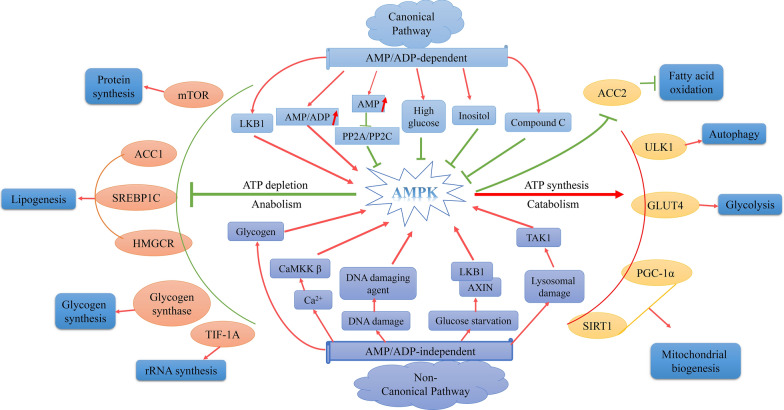
Fig. 1
Fig. 1
AMPK activation pathways and their regulatory effects on various metabolic processes. AMPK is activated via canonical (AMP/ADP-dependent) and non-canonical (AMP/ADP-independent) pathways. In canonical pathways, AMPK is activated in response to increased levels of AMP or ADP, and the upstream kinase LKB1 phosphorylates AMPK upon activation. AMP/ADP can directly activate AMPK through conformational modification and inhibit PP2A/C-mediated dephosphorylation of AMPK. In non-canonical pathways, AMPK is activated through other mechanisms instead of responding to an increase in AMP/ADP levels. AMPK can respond to an increase in Ca2+ levels and is phosphorylated by the upstream kinase CaMKKβ. Under lysosomal damage, the upstream kinase TAK1 activates AMPK. Under glucose starvation, the lysosomal adapter protein AXIN1 or AXIN2 binds to LKB1, leading to the phosphorylation of AMPK. In addition, AMPK can be activated by glycogen, DNA damage agents and AMPK activators. Upon activation, AMPK inhibits ATP-consuming biosynthetic pathways, such as mTOR, ACC1/SREBP1C/HMGCR and TIF-1 A pathways and glycogen synthesis, to inhibit protein synthesis, lipogenesis, glycogen synthesis and rRNA synthesis. In addition, AMPK activates the catabolic pathways that produce ATP, such as ACC2, ULK1, GLUT4 and PGC-1α/SIRT1, to enhance fatty acid oxidation, autophagy, glycolysis and mitochondrial biogenesis. Under normal circumstances, inositol inhibits AMPK activation by binding to AMPK subunits. High glucose and ATP competitive AMPK inhibitor compound C can also inhibit the activity of AMPK. The red arrow is meant to activate. The green arrow is meant to inhibit LKB1 liver kinase B1, PP2A/C protein phosphatase 2 A/C, CaMKKβ calmodulin-dependent protein kinase kinase-β, TAK1 transforming growth factor kinase 1, AXIN1 axis inhibition protein 1, SREBP1 sterol regulatory element-binding protein 1, HMGCR HMG-CoA reductase, ACC1 acetyl coenzyme A carboxylase 1, TIF-1 A transcriptional intermediary factor 1 A, mTOR mammalian target of rapamycin, PGC-1 peroxisome proliferator-activated receptor-gamma coactivator, ULK1 UNC-51-like kinase 1, GLUT4 glucose transporter 4, SIRT1 sirtuin 1
Fig. 2
Fig. 2
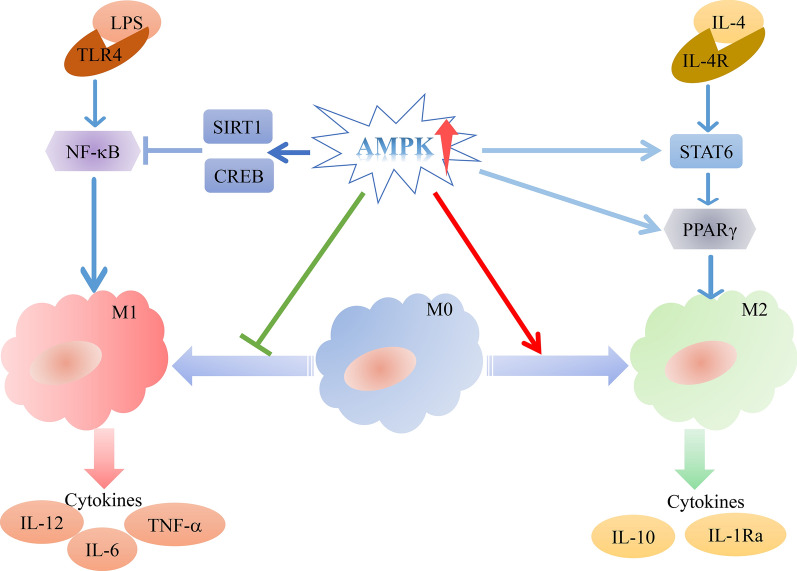
AMPK is the important trigger for macrophage polarisation. On the one hand, LPSs promote M1 polarisation through the NF-κB pathway and the secretion of inflammatory factors such as IL-12, IL-6 and TNF-α. On the other hand, activation of AMPK inhibits the NF-κB pathway by upregulating the expression of SIRT1 and CREB, thereby inhibiting M1 polarisation. AMPKα-knockout macrophages display M1 hyperpolarisation. IL-4 promotes the polarisation of M2 macrophages by activating the downstream STAT6/PPARγ pathway and the secretion of the anti-inflammatory factors IL-10 and IL-1Ra. STAT6 is akey transcription factor involved in IL-4-mediated M2 polarisation. On the other hand, activation of AMPK promotes the upregulation of STAT6 and PPARγ, thereby affecting the polarisation of M2 macrophages. LPS lipopolysaccharide, TLR toll-like receptor, SIRT1 sirtuin 1, CREB cAMP-response element-binding protein, NF-κB nuclear factor κB, IL interleukin, IL-4R interleukin-4 receptor, PPAR peroxisome proliferator-activated receptor, STAT signal transducers and activators of transcription, TNF tumour necrosis factor

References

    1. Judge A, Dodd MS. Metabolism. Essays Biochem. 2020;64(4):607–647. doi: 10.1042/EBC20190041. - DOI - PMC - PubMed
    1. Ross FA, MacKintosh C, Hardie DG. AMP-activated protein kinase: a cellular energy sensor that comes in 12 flavours. FEBS J. 2016;283(16):2987–3001. doi: 10.1111/febs.13698. - DOI - PMC - PubMed
    1. Li Y, Chen Y. AMPK and autophagy. Adv Exp Med Biol. 2019;1206:85–108. doi: 10.1007/978-981-15-0602-4_4. - DOI - PubMed
    1. Carling D. AMPK signalling in health and disease. Curr Opin Cell Biol. 2017;45:31–37. doi: 10.1016/j.ceb.2017.01.005. - DOI - PubMed
    1. Russell FM, Hardie DG. AMP-activated protein kinase: do we need activators or inhibitors to treat or prevent cancer? Int J Mol Sci. 2020;22(1):186. doi: 10.3390/ijms22010186. - DOI - PMC - PubMed

Publication types

Substances

LinkOut - more resources