


Emergency Department Length of Stay for Older Adults With Dementia
- PMID: 38069967
- PMCID: PMC11032237
- DOI: 10.1016/j.annemergmed.2023.09.022
Emergency Department Length of Stay for Older Adults With Dementia
Abstract
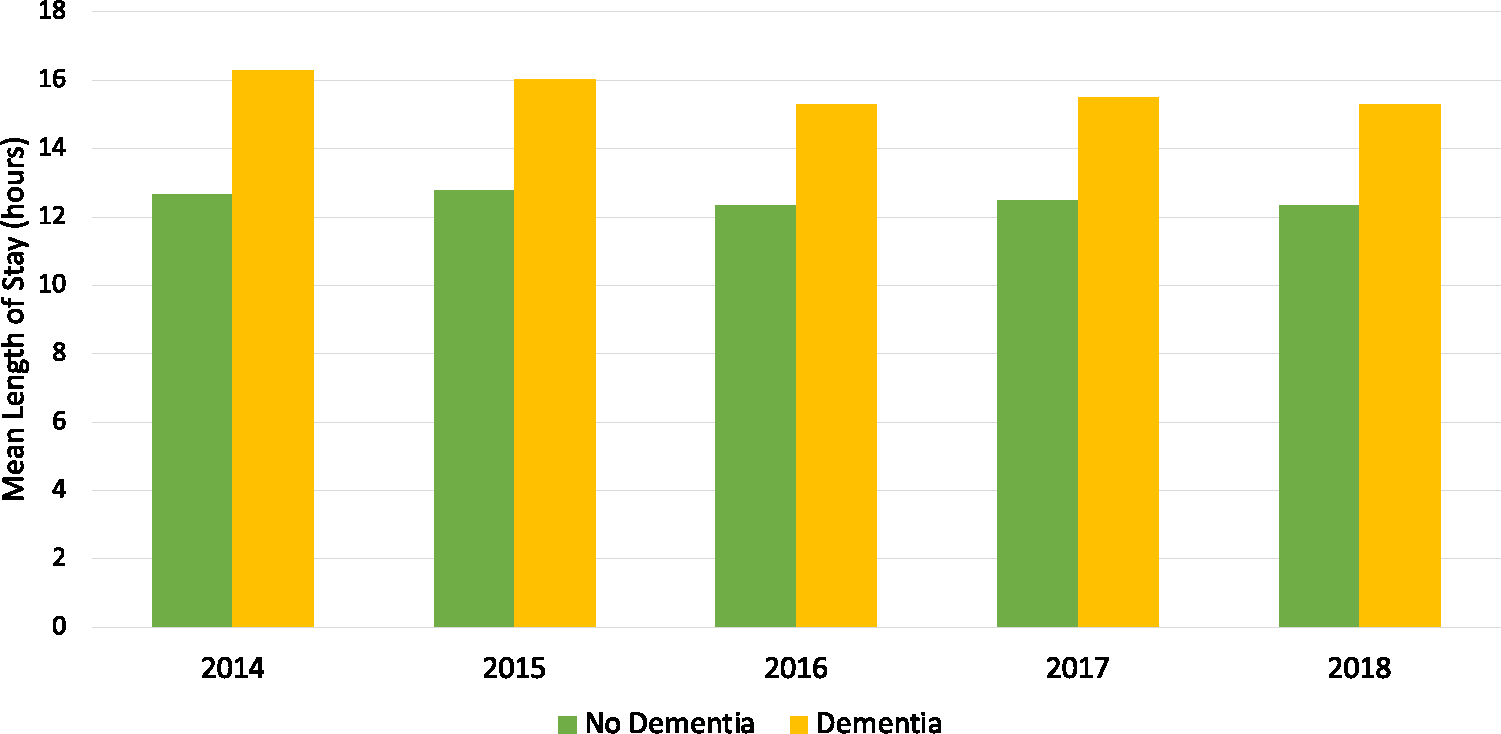
Study objective: The emergency department (ED) poses unique challenges and risks to persons living with dementia. A longer ED length of stay is associated with the risk of death, delirium, and medication errors. We sought to determine whether ED length of stay differed by dementia status and trends in ED length of stay for persons living with dementia from 2014 to 2018 and whether persons living with dementia were at a higher risk for prolonged ED length of stay (defined as a length of stay > 90th percentile).
Methods: In this observational study, we used data from the Healthcare Cost and Utilization Project State Emergency Department Database from Massachusetts, Arkansas, Arizona, and Florida. We included ED visits resulting in discharge for adults aged ≥65 years from 2014 to 2018. We used inverse probability weighting to create comparable groups of visits on the basis of dementia status. We used generalized linear models to estimate the mean difference in ED length of stay on the basis of dementia status and logistic regression to determine the odds of prolonged ED length of stay.
Results: We included 1,039,497 ED visits (mean age: 83.5 years; 64% women; 78% White, 12% Hispanic). Compared with visits by persons without dementia, ED length of stay was 3.1 hours longer (95% confidence interval [CI] 3.0 to 3.3 hours) for persons living with dementia. Among the visits resulting in transfer, ED length of stay was on average 4.1 hours longer (95% CI 3.6 to 4.5 hours) for persons living with dementia. Visits by persons living with dementia were more likely to have a prolonged length of stay (risk difference 4.1%, 95% CI 3.9 to 4.4).
Conclusion: ED visits were more than 3 hours longer for persons living with versus without dementia. Initiatives focused on optimizing ED care for persons living with dementia are needed.
Copyright © 2023 American College of Emergency Physicians. Published by Elsevier Inc. All rights reserved.
Figures


References
-
- Pines JM, Mullins PM, Cooper JK, et al. National trends in emergency department use, care patterns, and quality of care of older adults in the United States. J Am Geriatr Soc. 2013;61:12–17. - PubMed
-
- Feng Z, Coots LA, Kaganova Y, et al. Hospital and ED use among medicare beneficiaries with dementia varies by setting and proximity to death. Health Aff. 2014;33:683–690. - PubMed
-
- Gerson L, Counsell SR, Fontanarosa PB, et al. Case finding for cognitive impairment in elderly emergency department patients. Ann Emerg Med. 1994;23:813–817. - PubMed
-
- Schumacher JG, Deimling GT, Meldon S, et al. Older adults in the emergency department: predicting physicians’ burden levels. J Emerg Med. 2006;30:455–460. - PubMed
Publication types
MeSH terms
Grants and funding
LinkOut - more resources
Full Text Sources
Medical
