


Exfoliation and physico-chemical characterization of novel bioplasticizers from Nelumbo nucifera leaf for biofilm application
- PMID: 38076077
- PMCID: PMC10709406
- DOI: 10.1016/j.heliyon.2023.e22550
Exfoliation and physico-chemical characterization of novel bioplasticizers from Nelumbo nucifera leaf for biofilm application
Abstract
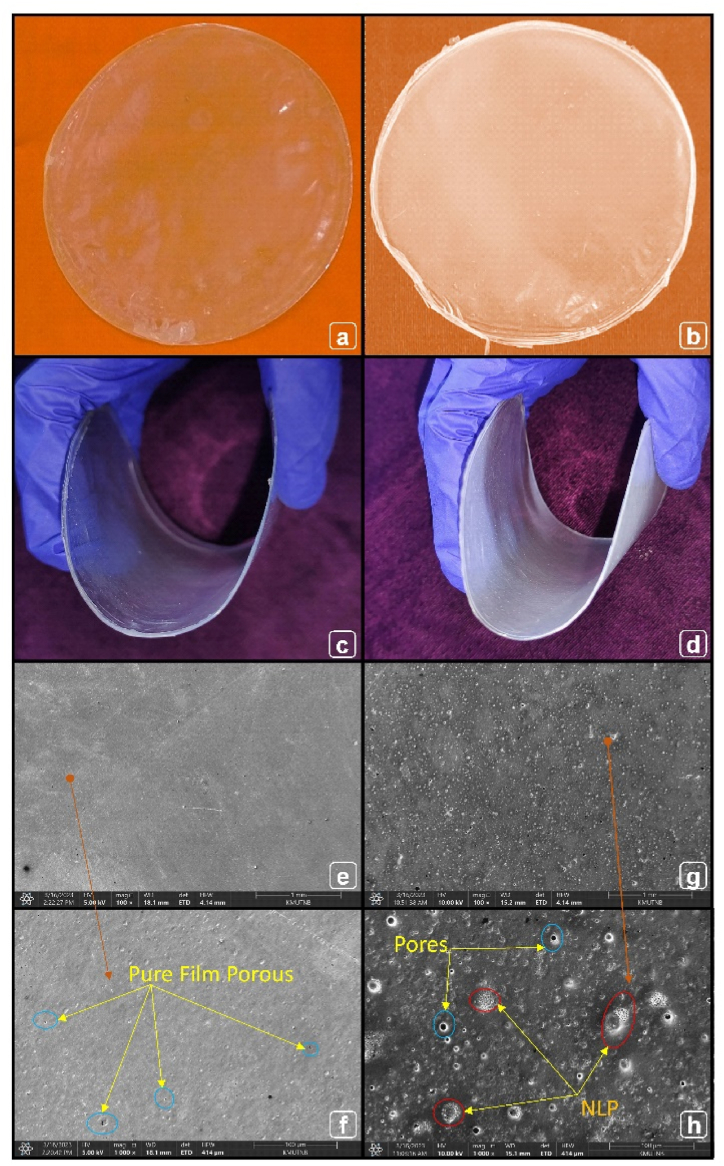
Due to the extreme threats as environmental and health issues caused by the petroleum-based leachable plasticizers, researchers among different domains are more interested in finding unique biodegradable plasticizers from natural sources. The present study used Nelumbo nucifera leaf to extract novel biopolymers as viable substitutes for chemical plasticizers. The biopolymers extraction was carried out through chemical means and its physico-chemical and morphological characterization were carried out to confirm its plastic nature. The polymers extracted possess a low glass transition temperature (77.17 °C), good thermal stability (230 °C), low density (0.94 g/cc), good surface roughness (34.154 μm), low crystallinity index (25.1%) and moderate crystallite size (16.36 nm). The presence of an organic polymer with specific chemical groups as olefinic alkenes, epoxide, imino/azo groups, and hydrophobic organic siloxane groups, signify that the material is a condensed phenolic derivative. Furthermore, bio-film was formulated using NLP and poly lactic acid (PLA) matrix to evaluate its plasticizing effect and film-forming ability. Variation in specific properties of film was noted after bio-plasticizer addition, where tensile strength (20.94 ± 1.5 MPa to 19.22 ± 1.3 MPa) and Young's modulus (1.462 ± 0.43 GPa to 1.025 ± 0.52 GPa) was found to be decreased whereas increased the percentage of elongation at break (26.30 ± 1.1% to 39.64 ± 1.6%). In addition, decreased glass transition temperature (Tg) (59.17 °C), good surface compatibility, and increased flexibility of NLP-PLA film in contrast to pure PLA film authorizes the plasticizing effect of bio-plasticizers on PLA. Since the extracted bio-plasticizers could be a suitable replacement to harmful synthetic plasticizers for lightweight packaging applications in bioplastics sector.
Keywords: Bio-plasticizers; Characterization; Composites; Extraction; Nelumbo nucifera leaf; Polymers.
© 2023 The Authors.
Conflict of interest statement
The authors declare that they have no known competing financial interests or personal relationships that could have appeared to influence the work reported in this paper.
Figures


References
-
- Rangappa S.M., Siengchin S., Parameswaranpillai J., Jawaid M., Ozbakkaloglu T. Lignocellulosic fiber reinforced composites: progress, performance, properties, applications, and future perspectives. Polym. Compos. 2022;43:645–691. doi: 10.1002/pc.26413. - DOI
-
- Hassan A.A., Abbas A., Rasheed T., Bilal M., Iqbal H.M.N., Wang S. Development, influencing parameters and interactions of bioplasticizers: an environmentally friendlier alternative to petro industry-based sources. Sci. Total Environ. 2019;682:394–404. doi: 10.1016/J.SCITOTENV.2019.05.140. - DOI - PubMed
-
- Gapsari F., Purnowidodo A., Setyarini P.H., Hidayatullah S., Suteja Izzuddin H., Subagyo R., Mavinkere Rangappa S., Siengchin S. Properties of organic and inorganic filler hybridization on Timoho Fiber-reinforced polyester polymer composites. Polym. Compos. 2022;43:1147–1156. doi: 10.1002/pc.26443. - DOI
-
- Narayana Perumal S., Suyambulingam I., Divakaran D., Siengchin S. Extraction and physico-mechanical and thermal characterization of a novel green bio-plasticizer from Pedalium murex plant biomass for biofilm application. J. Polym. Environ. 2023 doi: 10.1007/s10924-023-02898-8. - DOI
-
- Zhang Q., Liu X., Ren Y., Li Y. Phosphorated cellulose as a cellulose-based filler for developing continuous fire resistant lyocell fibers. J. Clean. Prod. 2022;368 doi: 10.1016/J.JCLEPRO.2022.133242. - DOI
LinkOut - more resources
Full Text Sources
Miscellaneous
