Review
. 2023 Oct 30;7(12):102026.
doi: 10.1016/j.cdnut.2023.102026. eCollection 2023 Dec.

Role of Bifidobacterium in Modulating the Intestinal Epithelial Tight Junction Barrier: Current Knowledge and Perspectives

Affiliations
Review

Role of Bifidobacterium in Modulating the Intestinal Epithelial Tight Junction Barrier: Current Knowledge and Perspectives

Raz Abdulqadir et al. Curr Dev Nutr. .

Abstract

The intestinal tight junction (TJ) barrier is a crucial defense mechanism that prevents the passage of intestinal content into the intestinal wall, tissue, and systemic circulation. A compromised intestinal TJ barrier has been identified as a significant factor in inflammatory bowel disease (IBD), necrotizing enterocolitis, and other gut-related inflammatory conditions. Recent studies have revealed the importance of the probiotic bacterial strains of Bifidobacterium in protecting against intestinal inflammation and IBD pathogenesis via the regulation of intestinal TJ barrier function. Numerous species and strains of Bifidobacterium have been found to regulate TJ proteins and the signaling pathways responsible for maintaining intestinal barrier integrity and permeability. In this review, we provide a summary of recent studies that highlight the regulatory role of Bifidobacterium species and the strain effect on the intestinal TJ barrier. We also discuss the intracellular mechanisms involved in Bifidobacterium modulation of the intestinal barrier and the potential therapeutic efficacy of targeting the barrier function to regulate intestinal inflammation.

Keywords: Bifidobacterium; cytokines; gastrointestinal inflammation; gut microbiota; intestinal tight junction barrier.


Conflict of interest statement

The authors report no conflict of interest.

Figures
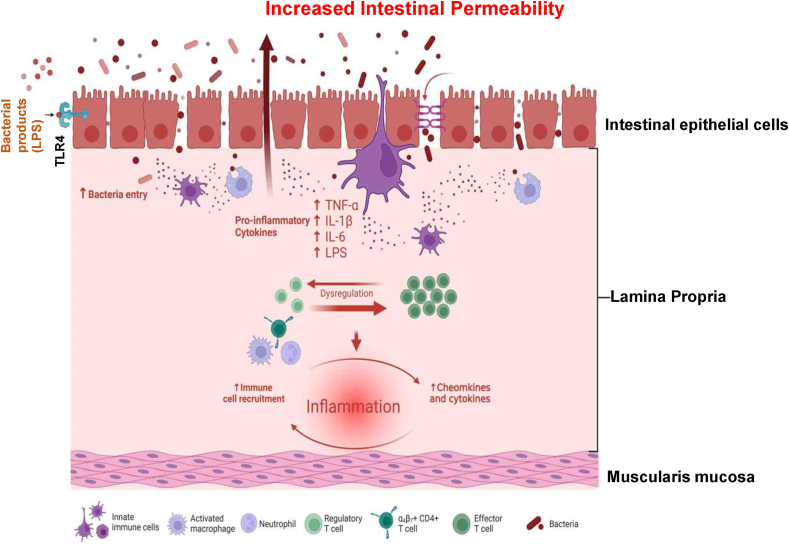
FIGURE 1
FIGURE 1
The impaired tight junction barrier plays a crucial role in the pathology of inflammatory bowel disease. When this barrier is compromised within the intestinal tract, it facilitates the passage of antigens and large molecules such as bacteria and their byproducts into the lamina propria. This breach in intestinal integrity subsequently leads to increased intestinal permeability and triggers an uncontrolled and dysregulated inflammatory response. Abbreviation: TLR, toll-like receptor. (Created with BioRender).
FIGURE 2
FIGURE 2
Schematic overview of the bifidobacterial surface structure. The bacterial surface molecules responsible for bifidobacterial-host cross-talk encompass a range of molecules, including exopolysaccharides, cell wall polysaccharides, lipoteichoic acid, surface protein, peptidoglycan and proteins such as CSGG. Abbreviation: CSGG, cell surface β-glucan/galactan. (Created with BioRender).
FIGURE 3
FIGURE 3
Metabolic capacities of Bifidobacterium microbial metabolites are relevant to the microbe-host interaction network. These capacities do not necessarily imply species-specificity or universality among all strains; instead, they suggest a more complex interaction and mechanism involving the metabolites [75,77,79]. Abbreviation: TJ, tight junction. (Created with Setworks v1).
FIGURE 4
FIGURE 4
Schematic representation of Bifidobacteria targeting TJ barrier function via TLRs signaling pathways. Abbreviations: IκB, inhibitor of nuclear factor kappa B; MLCK, myosin light-chain kinase; MYD88, myeloid differentiation primary response protein 88; NFκB, nuclear factor kappa-light-chain-enhancer of activated B cells; PGE2, prostaglandin E2, PI3K, phosphatidylinositol 3-kinase; P-MLC, phosphorylated myosin light chain; PPAR-γ, peroxisome proliferator-activated receptor gamma; TGF, transforming growth factor; TLR, toll-like receptor, TNFR, tumor necrosis factor receptor; TOLLIP, toll-interacting protein. (Created with BioRender).

References

    1. Ma T.Y., Nighot P., Al-Sadi R. In: Physiology of the Gastrointestinal Tract. 6th ed. Said H.M., editor. Elsevier; 2018. Tight junctions and the intestinal barrier; pp. 587–639. Available from: - DOI
    1. Cordenonsi M., D’Atri F., Hammar E., Parry D.A.D., Kendrick-Jones J., Shore D., et al. Cingulin contains globular and coiled-coil domains and interacts with Zo-1, Zo-2, Zo-3, and myosin. J. Cell Biol. 1999;147(7):1569–1582. doi: 10.1083/jcb.147.7.1569. - DOI - PMC - PubMed
    1. Odenwald M.A., Choi W., Kuo W.T., Singh G., Sailer A., Wang Y., et al. The scaffolding protein ZO-1 coordinates actomyosin and epithelial apical specializations in vitro and in vivo. J. Biol. Chem. 2018;293(45):17317–17335. doi: 10.1074/jbc.RA118.003908. - DOI - PMC - PubMed
    1. Buschmann M.M., Shen L., Rajapakse H., Raleigh D.R., Wang Y., Wang Y., et al. Occludin OCEL-domain interactions are required for maintenance and regulation of the tight junction barrier to macromolecular flux. Mol. Biol. Cell. 2013;24(19):3056–3068. doi: 10.1091/mbc.E12-09-0688. - DOI - PMC - PubMed
    1. Turner J.R. ‘Putting the squeeze’ on the tight junction: understanding cytoskeletal regulation, Semin. Cell Dev. Biol. 2000;11(4):301–308. doi: 10.1006/scdb.2000.0180. - DOI - PubMed

LinkOut - more resources
