[Preprint]. 2024 Feb 2:arXiv:2311.17640v3.

Community recommendations on cryoEM data archiving and validation: Outcomes of a wwPDB/EMDB workshop on cryoEM data management, deposition and validation

Affiliations

Community recommendations on cryoEM data archiving and validation: Outcomes of a wwPDB/EMDB workshop on cryoEM data management, deposition and validation

Gerard J Kleywegt et al. ArXiv. .

Update in

  • Community recommendations on cryoEM data archiving and validation.
    Kleywegt GJ, Adams PD, Butcher SJ, Lawson CL, Rohou A, Rosenthal PB, Subramaniam S, Topf M, Abbott S, Baldwin PR, Berrisford JM, Bricogne G, Choudhary P, Croll TI, Danev R, Ganesan SJ, Grant T, Gutmanas A, Henderson R, Heymann JB, Huiskonen JT, Istrate A, Kato T, Lander GC, Lok SM, Ludtke SJ, Murshudov GN, Pye R, Pintilie GD, Richardson JS, Sachse C, Salih O, Scheres SHW, Schroeder GF, Sorzano COS, Stagg SM, Wang Z, Warshamanage R, Westbrook JD, Winn MD, Young JY, Burley SK, Hoch JC, Kurisu G, Morris K, Patwardhan A, Velankar S. Kleywegt GJ, et al. IUCrJ. 2024 Mar 1;11(Pt 2):140-151. doi: 10.1107/S2052252524001246. IUCrJ. 2024. PMID: 38358351 Free PMC article.

Abstract

In January 2020, a workshop was held at EMBL-EBI (Hinxton, UK) to discuss data requirements for deposition and validation of cryoEM structures, with a focus on single-particle analysis. The meeting was attended by 47 experts in data processing, model building and refinement, validation, and archiving of such structures. This report describes the workshop's motivation and history, the topics discussed, and consensus recommendations resulting from the workshop. Some challenges for future methods-development efforts in this area are also highlighted, as is the implementation to date of some of the recommendations.

Keywords: Cryogenic-specimen Electron Microscopy; Electron Microscopy Data Bank; Protein Data Bank; data archiving; quality control; validation.


Figures
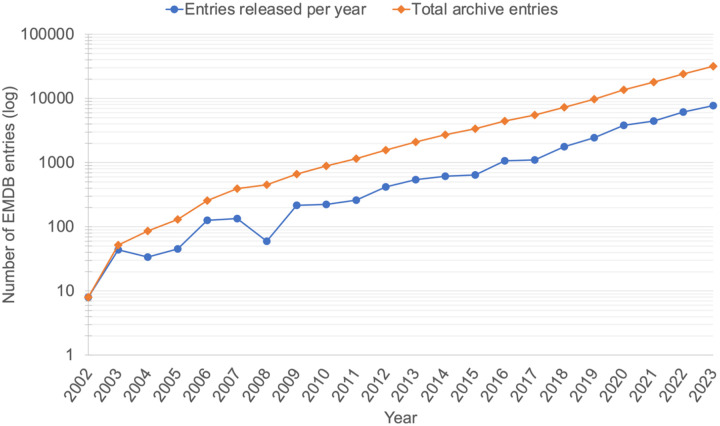
Figure 1.
Figure 1.
The “resolution revolution” was largely catalysed by new detector technologies in EM that had particular utility in cryoEM (Kühlbrandt, 2014). These developments have in subsequent years been bolstered by software developers, instrument manufacturers and the complementary investment of a large part of the scientific workforce utilising cryoEM. All together this has generated a sustained and approximately logarithmic growth in the number of 3DEM depositions to EMDB (panel a). Further, the technological improvements to the SPA workflow in particular have resulted in a steady increase in the number of 3DEM maps determined and deposited at resolutions sufficient for building an atomic model, in particular <3 and 3–4 Å (panel b). This is further reflected in the number of structures based on cryoEM data deposited to the PDB (panel c). (a) The number of released EMDB entries (on a logarithmic scale), per year (blue) and cumulatively (orange). Data as of December 2023 from: https://www.ebi.ac.uk/emdb/statistics/emdb_entries_year. (b) The number of released EMDB entries per year in a number of resolution bins, from 2010 until December 2023 (data from: https://www.ebi.ac.uk/emdb/statistics/emdb_resolution_trends_2). (c) The annually released (dark blue) and cumulative (light blue) number of EM-based structures in the PDB as a function of year, from 2010 until December 2023 (data from: https://www.rcsb.org/stats/growth/growth-em).
Figure 1.
Figure 1.
The “resolution revolution” was largely catalysed by new detector technologies in EM that had particular utility in cryoEM (Kühlbrandt, 2014). These developments have in subsequent years been bolstered by software developers, instrument manufacturers and the complementary investment of a large part of the scientific workforce utilising cryoEM. All together this has generated a sustained and approximately logarithmic growth in the number of 3DEM depositions to EMDB (panel a). Further, the technological improvements to the SPA workflow in particular have resulted in a steady increase in the number of 3DEM maps determined and deposited at resolutions sufficient for building an atomic model, in particular <3 and 3–4 Å (panel b). This is further reflected in the number of structures based on cryoEM data deposited to the PDB (panel c). (a) The number of released EMDB entries (on a logarithmic scale), per year (blue) and cumulatively (orange). Data as of December 2023 from: https://www.ebi.ac.uk/emdb/statistics/emdb_entries_year. (b) The number of released EMDB entries per year in a number of resolution bins, from 2010 until December 2023 (data from: https://www.ebi.ac.uk/emdb/statistics/emdb_resolution_trends_2). (c) The annually released (dark blue) and cumulative (light blue) number of EM-based structures in the PDB as a function of year, from 2010 until December 2023 (data from: https://www.rcsb.org/stats/growth/growth-em).
Figure 1.
Figure 1.
The “resolution revolution” was largely catalysed by new detector technologies in EM that had particular utility in cryoEM (Kühlbrandt, 2014). These developments have in subsequent years been bolstered by software developers, instrument manufacturers and the complementary investment of a large part of the scientific workforce utilising cryoEM. All together this has generated a sustained and approximately logarithmic growth in the number of 3DEM depositions to EMDB (panel a). Further, the technological improvements to the SPA workflow in particular have resulted in a steady increase in the number of 3DEM maps determined and deposited at resolutions sufficient for building an atomic model, in particular <3 and 3–4 Å (panel b). This is further reflected in the number of structures based on cryoEM data deposited to the PDB (panel c). (a) The number of released EMDB entries (on a logarithmic scale), per year (blue) and cumulatively (orange). Data as of December 2023 from: https://www.ebi.ac.uk/emdb/statistics/emdb_entries_year. (b) The number of released EMDB entries per year in a number of resolution bins, from 2010 until December 2023 (data from: https://www.ebi.ac.uk/emdb/statistics/emdb_resolution_trends_2). (c) The annually released (dark blue) and cumulative (light blue) number of EM-based structures in the PDB as a function of year, from 2010 until December 2023 (data from: https://www.rcsb.org/stats/growth/growth-em).
Figure 2.
Figure 2.
The participants in the workshop (not in the photo: S. Abbott and S.J. Ganesan).

References

    1. Abdul Ajees A., Gunasekaran K., Volanakis J. E., Narayana S. V. L., Kotwal G. J. & Murthy H. M. K. (2006). Nature 444, 221–225. - PubMed
    1. Baldwin P. R. & Lyumkis D. (2021). Prog. Biophys. Mol. Biol. 160, 53–65. - PMC - PubMed
    1. Barad B. A., Echols N., Wang R. Y.-R., Cheng Y., DiMaio F., Adams P. D. & Fraser J. S. (2015). Nat. Methods 12, 943–946. - PMC - PubMed
    1. Berman H., Henrick K. & Nakamura H. (2003). Nat. Struct. Biol. 10, 980. - PubMed
    1. Borrell B. (2009). Nature 462, 970. - PubMed

Publication types

LinkOut - more resources