[Preprint]. 2023 Dec 2:2023.12.02.569726.
doi: 10.1101/2023.12.02.569726.

Small-molecule activators of a bacterial signaling pathway inhibit virulence

Affiliations

Small-molecule activators of a bacterial signaling pathway inhibit virulence

Kathryn E Mansour et al. bioRxiv. .

Abstract

The Burkholderia genus encompasses multiple human pathogens, including potential bioterrorism agents, that are often extensively antibiotic resistant. The FixLJ pathway in Burkholderia is a two-component system that regulates virulence. Previous work showed that fixLJ mutations arising during chronic infection confer increased virulence while decreasing the activity of the FixLJ pathway. We hypothesized that small-molecule activators of the FixLJ pathway could serve as anti-virulence therapies. Here, we developed a high-throughput assay that screened over 28,000 compounds and identified 11 that could specifically active the FixLJ pathway. Eight of these compounds, denoted Burkholderia Fix Activator (BFA) 1-8, inhibited the intracellular survival of Burkholderia in THP-1-dervived macrophages in a fixLJ-dependent manner without significant toxicity. One of the compounds, BFA1, inhibited the intracellular survival in macrophages of multiple Burkholderia species. Predictive modeling of the interaction of BFA1 with Burkholderia FixL suggests that BFA1 binds to the putative ATP/ADP binding pocket in the kinase domain, indicating a potential mechanism for pathway activation. These results indicate that small-molecule FixLJ pathway activators are promising anti-virulence agents for Burkholderia and define a new paradigm for antibacterial therapeutic discovery.

Keywords: Burkholderia; anti-virulence; drug-discovery; two-component systems.


Figures

Figure 1.
Figure 1.. A high-throughput screen identifies 84 small molecules that activate the Burkholderia FixLJ pathway, 11 of which are fixLJ-specific.
(A.) Schematic of the screen. Created with BioRender. (B.) Scatter plot from high-throughput screen of 28,100 compounds for activators of GFP activity in B. multivorans strain VC7102 carrying a GFP reporter for FixLJ pathway activity. GFP fluorescence and growth OD600 values are normalized based on plate-specific benserazide treated wells. Dots are averages of two replicate wells treated with same compound. Hits (red dots) have that GFP activity more than 3 standard deviations above the plate-specific mean negative control wells (DMSO, black dots). (C.) Scatter plot of 84 hits from primary screen chosen for follow-up assays measuring the GFP signal in B. dolosa and its fixLJ deletion mutant to assess dependence on FixLJ pathway. The GFP as percent of negative control (DMSO-treated) for each compound is plotted as GFP seen the fixLJ deletion mutant vs. parental strain. Type 1 hits (red) have that GFP activity more than 3 standard deviations above the plate-specific mean negative control wells in the parental strain, but not in the fixLJ deletion mutant. Type 2 hits (blue) are categorically greater hits in strength in the parental strain compared to the hit strength in the fixLJ deletion mutant. (D.) Structures of the 10 of the 11 fixLJ-dependent hits. These ten compounds were available from ChemDiv.
Figure 2.
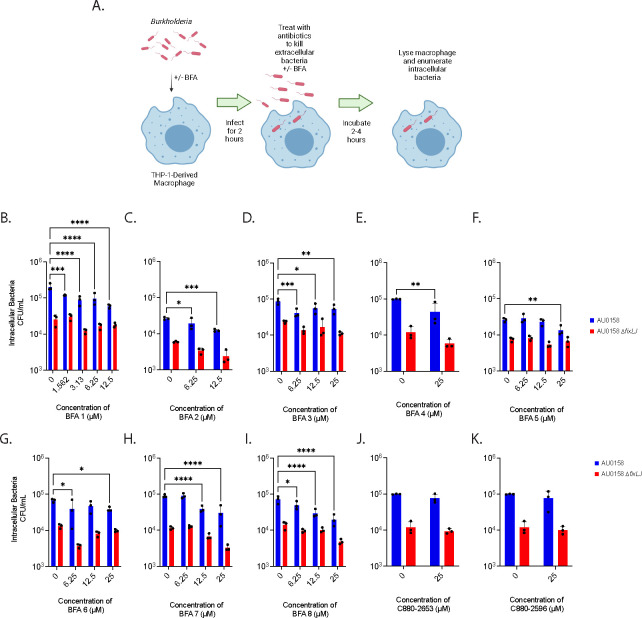
Figure 2.. BFA (Burkholderia Fix Activator) compounds inhibit B. dolosa virulence in THP-1-derived macrophages in a fixLJ-specific manner.
The intracellular survival (and/or uptake) of B. dolosa strain AU0158 in THP-1-derived human macrophages was measured using an antibiotic exclusion assay in the presence of varying concentrations BFA compounds. Created with BioRender. (A). The number of intracellular bacteria was determined by lysing the macrophages and enumerating CFU after incubation for 2 hours (B,D) or 4 hours (C,E,F,F,G,H,I,J,K). *, **, and *** denote p<0.05, 0.01, and 0.001, respectively, by two-way ANOVA with Dunnett’s multiple comparisons test using 0 μM (DMSO vehicle) as control.
Figure 3.
Figure 3.. BFA compounds inhibit the virulence of multiple pathogenic Burkholderia species.
THP-1-derived macrophages were infected with B. multivorans strain VC7102 (A&D), B. cenocepacia strain K56–2 (B&E), or B. thailandensis strain e264 (C&F) in the presence of 25 μM of BFA compounds (A-C) or a dose range of BFA1 (D-F). Intracellular bacteria were determined using antibiotic exclusion after 2 (F) or 4 (A-E) hour exposure to antibiotic. P value determined by ANOVA with Dunnett’s multiple comparisons test, *, **,***,**** denotes p value < 0.05,0.01, 0.001, 0.0001, respectively.
Figure 4.
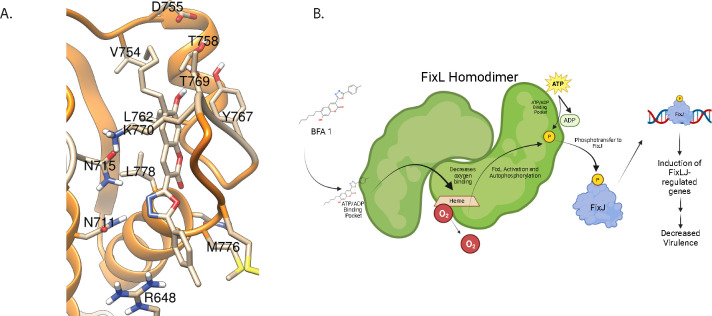
Figure 4.. BFA1 is predicted to bind to FixL at the ATP/ADP-binding pocket of the histidine kinase domain.
(A) Predicted binding of BFA1 to first binding pocket of B. dolosa strain AU0158 FixL using AutoDockFR. (B) Proposed mechanism of action for BFA1 activating Burkholderia FixLJ pathway. Created with BioRender.

References

    1. Gibson RL, Burns JL, Ramsey BW. Pathophysiology and management of pulmonary infections in cystic fibrosis. Am J Resp Crit Care Med. 2003;168(8):918–51. - PubMed
    1. Lipuma JJ. The changing microbial epidemiology in cystic fibrosis. Clin Microbiol Rev. 2010;23(2):299–323. - PMC - PubMed
    1. Marciano BE, Spalding C, Fitzgerald A, Mann D, Brown T, Osgood S, et al. Common severe infections in chronic granulomatous disease. Clin Infect Dis. 2015;60(8):1176–83. - PMC - PubMed
    1. Dolan SA, Dowell E, LiPuma JJ, Valdez S, Chan K, James JF. An outbreak of Burkholderia cepacia complex associated with intrinsically contaminated nasal spray. Infect Control Hosp Epidemiol. 2011;32(8):804–10. - PubMed
    1. Souza Dias MB, Cavassin LG, Stempliuk V, Xavier LS, Lobo RD, Sampaio JL, et al. Multi-institutional outbreak of Burkholderia cepacia complex associated with contaminated mannitol solution prepared in compounding pharmacy. Am J Infect Control. 2013;41(11):1038–42. - PubMed

Publication types