


A Decade in Review: Trends in Female Authorship in Peer-Reviewed Toxicology Journals
- PMID: 38078994
- PMCID: PMC10774494
- DOI: 10.1007/s13181-023-00975-x
A Decade in Review: Trends in Female Authorship in Peer-Reviewed Toxicology Journals
Abstract
Background: Gender diversity in both emergency medicine and medical toxicology has grown over the last decade. However, disparities in promotion, awards, and speakership still exist. No studies have examined gender disparities in authorship in medical toxicology journals.
Research questions: Does the proportion of female first authors and female senior authors in medical toxicology publications increase over time? What factors predict female authorship in the first author or last author positions in two major medical toxicology journals?
Methods: We performed a retrospective review of all non-abstract publications in two medical toxicology journals, Clinical Toxicology and Journal of Medical Toxicology, between 2011 and 2020. We collected author names, number of authors, publication type, and publication year. Author names were used to identify author gender using Gender-API integrative tool. Data on the percentages of female medical toxicology fellows and medical toxicologists was provided by the American Board of Emergency Medicine (ABEM).
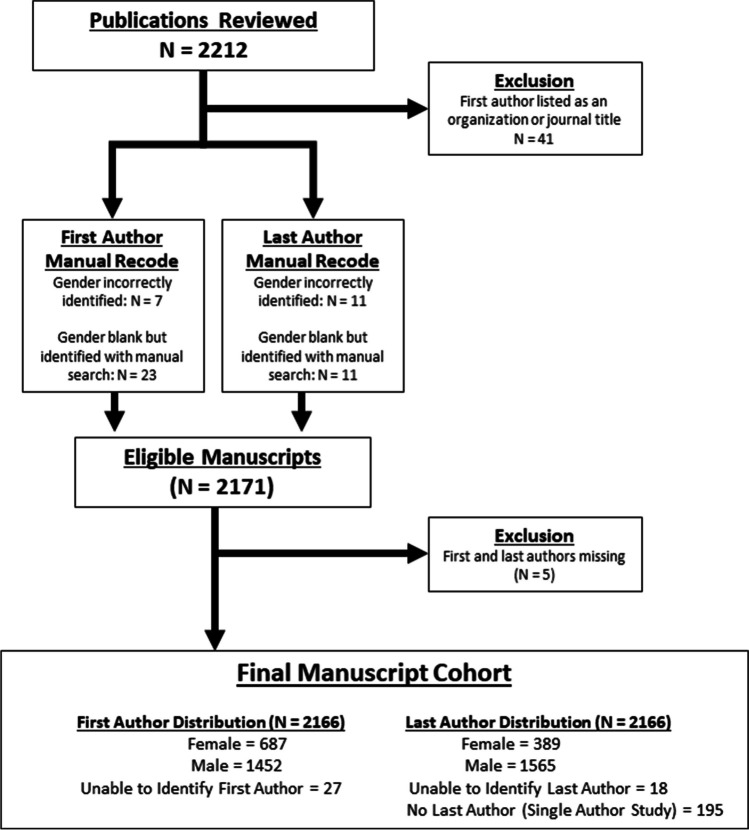
Results: A total of 2212 publications were reviewed and 2171 (97.9%) were included in the dataset. Overall, 31.7% of first authors were identified as female and 67.0% were identified as male by the Gender-API tool. There were 46.8% male-male author dyads, 24.2% female-male author dyads, 12.1% male-female author dyads, and 5.7% female-female author dyads. Predictors of female first authorship included research and case report articles, and percentage of ABEM female toxicologists. Predictors of female senior authorship included number of authors and percentage of ABEM female toxicologists. The proportion of female authorship in both categories increased over the study period.
Conclusions: The frequency of female authorship in the first author position has grown over the last decade and is associated with increasing female representation in medical toxicology and specific manuscript subtypes, specifically research manuscripts.
Keywords: Authorship; Disparities; Gender; Medical toxicology.
© 2023. American College of Medical Toxicology.
Conflict of interest statement
None.
Figures


Comment in
-
Women and Authorship in Medical Toxicology: Canaries in the Coal Mine.J Med Toxicol. 2024 Jan;20(1):7-9. doi: 10.1007/s13181-023-00985-9. Epub 2024 Jan 3. J Med Toxicol. 2024. PMID: 38170432 Free PMC article. No abstract available.
References
-
- American College of Emergency Physicians (ACEP). Policy statement: overcoming barriers to promotion of women and underrepresented in medicine (URiM) faculty in academic emergency medicine. 2020. https://www.acep.org/siteassets/new-pdfs/policy-statements/overcoming-ba.... Accessed 1 Nov 2023. - PMC - PubMed
Publication types
MeSH terms
Grants and funding
LinkOut - more resources
Full Text Sources
