


The association between jaundice and poorly differentiated pancreatic neuroendocrine neoplasms (Ki67 index > 55.0%)
- PMID: 38087239
- PMCID: PMC10717040
- DOI: 10.1186/s12876-023-03076-9
The association between jaundice and poorly differentiated pancreatic neuroendocrine neoplasms (Ki67 index > 55.0%)
Abstract
Background: Jaundice occurs in some pancreatic disease. However, its occurrences and role in pancreatic neuroendocrine neoplasms (PNENs) has not been well studied. In this study we showed the association between jaundice and the risk of high grade and poorly differentiated PNENs.
Methods: Ninety-three patients with head-neck PNENs were included. Poorly differentiated pancreatic neuroendocrine neoplasms were defined by a ki67 index > 55.0%. Logistic regression was used to show the association between demographic information, clinical signs and symptoms and the risk of poorly differentiated tumors. A nomogram model was developed to predict poorly differentiated tumor.
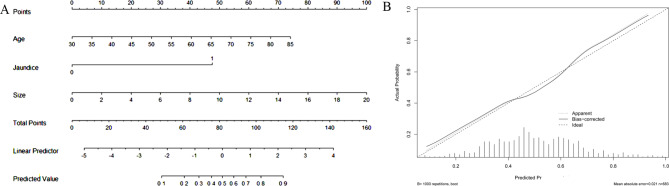
Results: Eight of 93 PNEN patients (8.6%) had jaundice. The age and ki67 index in patients with jaundice were significantly higher than those patients without jaundice. All jaundice occurred in patients with grade 3 PNENs. Mutivariable regression analysis showed that age (odds ratio(OR) = 1.10, 95% confidence interval (CI):1.02-1.19), tumor size (OR = 1.42, 95%CI:1.01-2.00) and jaundice (OR = 14.98, 95%CI: 1.22-184.09) were associated with the risk of poorly differentiated PNENs. The age and size combination showed a good performance in predicting poorly differentiated PNENs (area under the curve (AUC) = 0.81, 95% CI: 0.71-0.90). The addition of jaundice further improved the age- and size-based model (AUC = 0.86, 95% CI: 0.78-0.91). A nomogram was developed based on age, tumor size and jaundice.
Conclusion: Our data showed that jaundice was associated with the risk of high grade PNENs and poorly differentiated PNENs.
Keywords: Grade; Jaundice; Pancreatic neuroendocrine neoplasms.
© 2023. The Author(s).
Conflict of interest statement
None.
The authors declare no competing interests.
Figures


References
-
- Niederle MB, Hackl M, Kaserer K, Niederle B. Gastroenteropancreatic neuroendocrine tumours: the current incidence and staging based on the WHO and European Neuroendocrine Tumour Society classification: an analysis based on prospectively collected parameters. Endocr Relat Cancer. 2010;17(4):909–18. doi: 10.1677/ERC-10-0152. - DOI - PubMed
-
- Halfdanarson TR, Strosberg JR, Tang L, Bellizzi AM, Bergsland EK, O’Dorisio TM, et al. The North American Neuroendocrine Tumor Society Consensus Guidelines for Surveillance and Medical Management of pancreatic neuroendocrine tumors. Pancreas. 2020;49(7):863–81. doi: 10.1097/MPA.0000000000001597. - DOI - PubMed
MeSH terms
Substances
LinkOut - more resources
Full Text Sources
Medical
