


Modeling the influence of attitudes, trust, and beliefs on endoscopists' acceptance of artificial intelligence applications in medical practice
- PMID: 38089040
- PMCID: PMC10715310
- DOI: 10.3389/fpubh.2023.1301563
Modeling the influence of attitudes, trust, and beliefs on endoscopists' acceptance of artificial intelligence applications in medical practice
Abstract
Introduction: The potential for deployment of Artificial Intelligence (AI) technologies in various fields of medicine is vast, yet acceptance of AI amongst clinicians has been patchy. This research therefore examines the role of antecedents, namely trust, attitude, and beliefs in driving AI acceptance in clinical practice.
Methods: We utilized online surveys to gather data from clinicians in the field of gastroenterology.
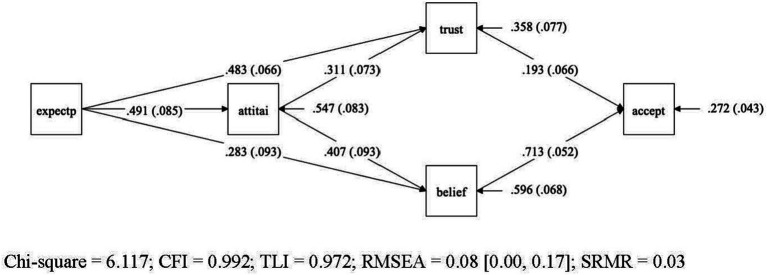
Results: A total of 164 participants responded to the survey. Participants had a mean age of 44.49 (SD = 9.65). Most participants were male (n = 116, 70.30%) and specialized in gastroenterology (n = 153, 92.73%). Based on the results collected, we proposed and tested a model of AI acceptance in medical practice. Our findings showed that while the proposed drivers had a positive impact on AI tools' acceptance, not all effects were direct. Trust and belief were found to fully mediate the effects of attitude on AI acceptance by clinicians.
Discussion: The role of trust and beliefs as primary mediators of the acceptance of AI in medical practice suggest that these should be areas of focus in AI education, engagement and training. This has implications for how AI systems can gain greater clinician acceptance to engender greater trust and adoption amongst public health systems and professional networks which in turn would impact how populations interface with AI. Implications for policy and practice, as well as future research in this nascent field, are discussed.
Keywords: acceptance; artificial intelligence; attitudes; gastroenterology; trust.
Copyright © 2023 Schulz, Lwin, Kee, Goh, Lam and Sung.
Conflict of interest statement
The authors declare that the research was conducted in the absence of any commercial or financial relationships that could be construed as a potential conflict of interest.
Figures
References
-
- Ren Y, Loftus TJ, Datta S, Ruppert MM, Guan Z, Miao S, et al. Performance of a machine learning algorithm using electronic health record data to predict postoperative complications and report on a mobile platform. JAMA Netw Open. (2022) 5:e2211973. doi: 10.1001/jamanetworkopen.2022.11973, PMID: - DOI - PMC - PubMed
-
- Taylor D, Bury M, Campling N, Carter S, Garfied S, Newbould J, et al. A review of the use of the health belief model (HBM), the theory of reasoned action (TRA), the theory of planned behaviour (TPB) and the trans-theoretical model (TTM) to study and predict health related behaviour change. London, UK: National Institute for Health and Clinical Excellence; (2006).
Publication types
MeSH terms
LinkOut - more resources
Full Text Sources
Medical
