. 2022 Jan 28;1(1):7.
doi: 10.20517/mrr.2021.03. eCollection 2022.

The first fungi: mode of delivery determines early life fungal colonization in the intestine of preterm infants

Affiliations

The first fungi: mode of delivery determines early life fungal colonization in the intestine of preterm infants

Jannie G E Henderickx et al. Microbiome Res Rep. .

Abstract

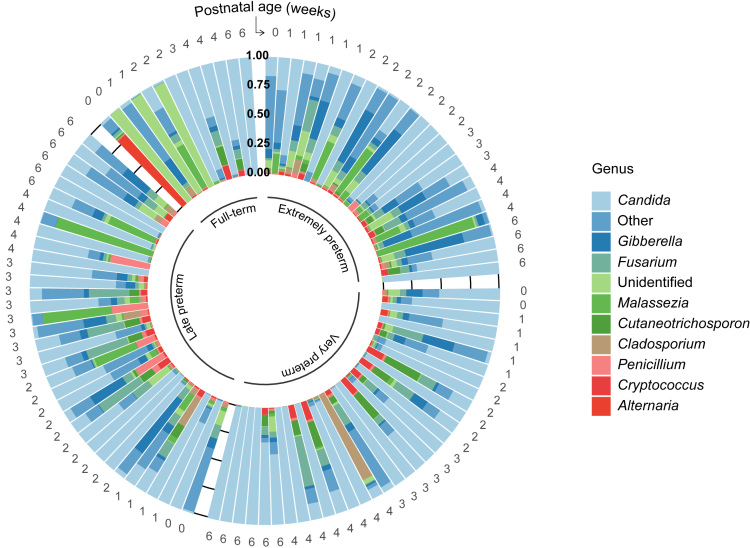
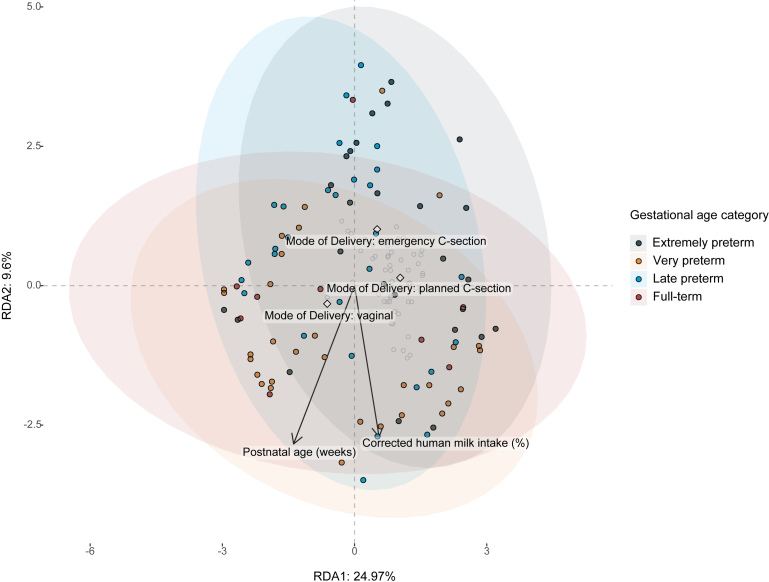
Aim: The role of intestinal fungi in human health and disease is becoming more evident. The mycobiota composition and diversity of preterm infants is affected by interactions with bacteria and clinical variables. In this study, we aimed to characterize the composition and the diversity of the preterm infant mycobiota and the effect of clinical variables on it in the first six postnatal weeks. Methods: Preterm infants (n = 50) and full-term infants (n = 6) admitted to Isala Women and Children's hospital (Zwolle, The Netherlands) who were born during 24-36 or 37-40 weeks of gestation, respectively, were included in this study. Feces were collected during the first six postnatal weeks (n = 109) and their mycobiota composition and diversity were characterized by ITS2 amplicon sequencing. Results: Composition analyses identified fungi and other eukaryotic kingdoms, of which Viridiplantae was most abundant. Of the fungal kingdom, Ascomycota and Basidiomycota were the first and second most prominent phyla in early life of all infants. Candida was the most abundant genus in the first six weeks of life and increased with gestational and postnatal age. Fungal phylogenetic diversity remained stable in the first six postnatal weeks. The individuality and the mode of delivery were identified as significant predictors for the variation in the mycobiota composition. Vaginally delivered infants were enriched in Candida spp., whereas infants delivered through emergency C-section were characterized by Malassezia spp. Conclusion: These results indicate that fungi and other eukaryotic kingdoms are detected in the intestine of preterm and full-term infants in the first six postnatal weeks. Similar to the microbiota, colonization of the preterm intestine with fungi is determined by clinical variables including individuality and mode of delivery.

Keywords: Intestinal tract; fungi; gut; infant; mycobiota; premature birth.


Conflict of interest statement

The authors Henderickx JGE and Belzer C receive financial support from Danone Nutricia Research. de Weerd H and Knol J are employees of Danone Nutricia Research. Danone Nutricia Research develops and sells nutritional products for full-term and preterm infants.

Figures

Figure 1
Figure 1
Relative abundance of the two most abundant fungal phyla in feces of preterm and full-term infants during the first six postnatal weeks.
Figure 2
Figure 2
Relative abundance of the ten most abundant genera in every fecal sample of preterm and full-term infants. The postnatal age in weeks is displayed on the outer circle; the gestational age categories are displayed on the inner circle. The horizontal lines indicate the relative abundance in quartile percentages. Genera not belonging to the ten most abundant ones are merged under “Other”.
Figure 3
Figure 3
Phylogenetic diversity of preterm and full-term infants during the first six postnatal weeks. Individual data points are displayed as open circles, whereas outliers are filled circles. *Padj ≤ 0.05.
Figure 4
Figure 4
Redundancy analysis on the fecal mycobiota of preterm and full-term infants during the first six postnatal weeks. Continuous clinical variables are indicated with arrows, whereas the centroids of categorical clinical variables are indicated with diamonds. Mode of delivery was significant after automatic stepwise model selection (P = 0.005) and its centroids are displayed; centroids of other clinical variables were left out for clarity. Colored points indicate individual fecal samples colored within its respective gestational age category. The effect of gestational age categories on the mycobiota composition was verified with PERMANOVA analysis (P = 0.005, P = 0.005, Supplementary Table 3).
Figure 5
Figure 5
Linear discriminant analysis Effect Size results on the mode of delivery in preterm infant feces (n = 96). The fungal taxa that were significantly different in abundance between the mode of delivery groups are displayed in (A) a histogram of the LDA scores and (B) a cladogram.

References

    1. Chin VK, Yong VC, Chong PP, Amin Nordin S, Basir R, Abdullah M. Mycobiome in the gut: a multiperspective review. Mediators Inflamm. 2020;2020:9560684. doi: 10.1155/2020/9560684. - DOI - PMC - PubMed
    1. Manor O, Dai CL, Kornilov SA, et al. Health and disease markers correlate with gut microbiome composition across thousands of people. Nat Commun. 2020;11:5206. doi: 10.1038/s41467-020-18871-1. - DOI - PMC - PubMed
    1. Lynch SV, Pedersen O. The human intestinal microbiome in health and disease. N Engl J Med. 2016;375:2369–79. doi: 10.1056/NEJMra1600266. - DOI - PubMed
    1. Fan Y, Pedersen O. Gut microbiota in human metabolic health and disease. Nat Rev Microbiol. 2021;19:55–71. doi: 10.1038/s41579-020-0433-9. - DOI - PubMed
    1. Pfeiffer JK, Virgin HW. Viral immunity. Transkingdom control of viral infection and immunity in the mammalian intestine. Science. 2016;351:aad5872. doi: 10.1126/science.aad5872. - DOI - PMC - PubMed

LinkOut - more resources