Review
. 2023 Dec 11;13(51):35947-35963.
doi: 10.1039/d3ra06476j. eCollection 2023 Dec 8.

Stabilization challenges and aggregation in protein-based therapeutics in the pharmaceutical industry

Affiliations
Review

Stabilization challenges and aggregation in protein-based therapeutics in the pharmaceutical industry

Mahdie Rahban et al. RSC Adv. .

Abstract

Protein-based therapeutics have revolutionized the pharmaceutical industry and become vital components in the development of future therapeutics. They offer several advantages over traditional small molecule drugs, including high affinity, potency and specificity, while demonstrating low toxicity and minimal adverse effects. However, the development and manufacturing processes of protein-based therapeutics presents challenges related to protein folding, purification, stability and immunogenicity that should be addressed. These proteins, like other biological molecules, are prone to chemical and physical instabilities. The stability of protein-based drugs throughout the entire manufacturing, storage and delivery process is essential. The occurrence of structural instability resulting from misfolding, unfolding, and modifications, as well as aggregation, poses a significant risk to the efficacy of these drugs, overshadowing their promising attributes. Gaining insight into structural alterations caused by aggregation and their impact on immunogenicity is vital for the advancement and refinement of protein therapeutics. Hence, in this review, we have discussed some features of protein aggregation during production, formulation and storage as well as stabilization strategies in protein engineering and computational methods to prevent aggregation.


Conflict of interest statement

There are no conflicts to declare.

Figures
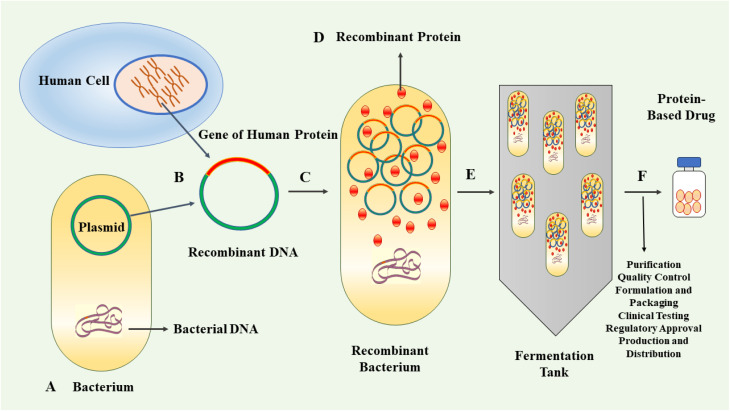
Fig. 1
Fig. 1. Figure exhibited the process of producing recombinant biopharmaceutical products involves using genetic engineering techniques to create therapeutic proteins. (A) The first step is to select a suitable host organism, often a microorganism like bacteria, yeast, or mammalian cells. The choice of host organism depends on factors such as protein complexity and desired post-translational modifications. (B) The gene encoding the desired therapeutic protein is isolated and cloned into a vector. The vector also contains regulatory elements to control gene expression. (C) In the case of bacteria, the vector with the cloned gene is introduced into the host cells through a process called transformation. (D) Once the gene is inside the host cells, it is transcribed and translated, leading to the production of the therapeutic protein. (E) The cells are then grown in bioreactors (fermentation tanks) under controlled conditions to maximize protein yield. (F) After production, the biopharmaceutical product needs to be separated and purified from the host cell components. This is typically done through a series of chromatography and filtration steps, which isolate the protein of interest. The purified protein undergoes rigorous quality control testing to ensure it meets safety, efficacy, and purity standards. This includes tests for identity, potency, sterility, and absence of contaminants. The purified protein is formulated to the desired concentration and stability. It may also be mixed with excipients to improve shelf-life and administration. Before receiving regulatory approval, the biopharmaceutical product goes through extensive clinical trials to assess its safety and efficacy in humans. Once clinical trials are successful, the product can be submitted for regulatory approval by health authorities. If approved, the biopharmaceutical is produced at a larger scale and distributed to healthcare providers for patient use.
Fig. 2
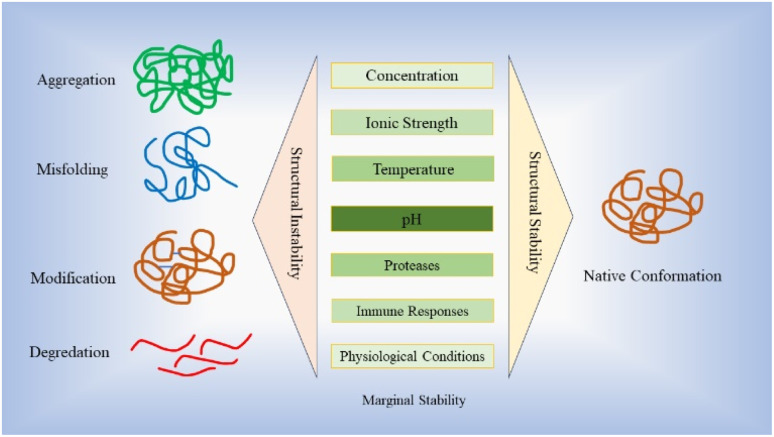
Fig. 2. Figure depicts the issues associated with protein-based therapies' stabilities, notably influencing their efficacy and safety attributes. This figure illustrates the critical role of stability in the development of protein-based therapy. Ensuring stability is crucial to maintain the efficacy and functionality of protein-based therapies throughout manufacturing, storage, and delivery processes. Structural instability, arising from misfolding, unfolding, various modifications, and aggregation, can impair drug efficacy. Proteins and peptides exhibit a limited stability range influenced by factors such as concentration, ionic strength, temperature, and pH often referred to as “marginal stability”. Furthermore, proteins face additional challenges caused by proteases, immune responses and human physiological conditions that can impact their stability.
Fig. 3
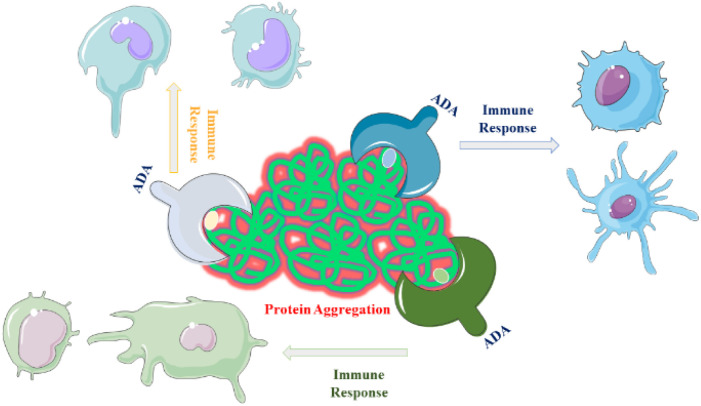
Fig. 3. The illustration depicts how protein aggregates can enhance the immunogenicity of a therapeutic protein by triggering the formation of serum anti-drug antibodies (ADAs) that bind to the protein. The distinct aggregate types activate different immunological pathways.
Fig. 4
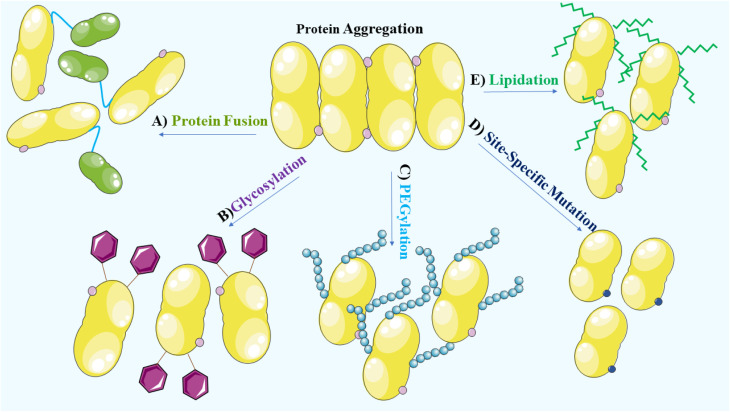
Fig. 4. A schematic representation demonstrates the utilization of various strategies to enhance the solubility and stability of protein aggregates, vital considerations in the development of protein-based therapy. These strategies include: (A) protein fusion, (B) glycosylation, (C) PEGylation, (D) structural modifications and site-specific mutation, and (E) lipidation.
Fig. 5
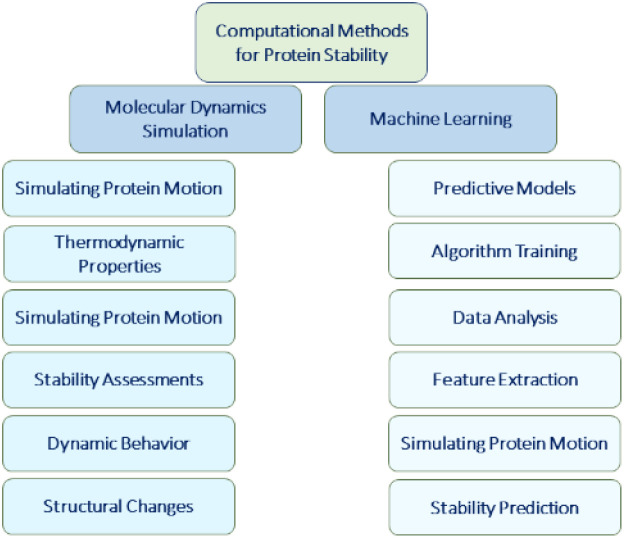
Fig. 5. This diagram represents primary branches of computational methods used in protein stability prediction.
None
Mahdie Rahban
None
Faizan Ahmad
None
Mieczyslaw A. Piatyszek
None
Thomas Haertlé
None
Luciano Saso
None
Ali Akbar Saboury

References

    1. Yang X. Bartlett M. G. Glycan analysis for protein therapeutics. J. Chromatogr. B: Anal. Technol. Biomed. Life Sci. 2019;1120:29–40. - PubMed
    1. Mukherjee A. G. Wanjari U. R. Gopalakrishnan A. V. Bradu P. Biswas A. Ganesan R. et al., Evolving strategies and application of proteins and peptide therapeutics in cancer treatment. Biomed. Pharmacother. 2023;163:114832. - PubMed
    1. Wu J. Sahoo J. K. Li Y. Xu Q. Kaplan D. L. Challenges in delivering therapeutic peptides and proteins: A silk-based solution. J. Controlled Release. 2022;345:176–189. - PMC - PubMed
    1. Dale B. Cheng M. Park K.-S. Kaniskan H. Ü. Xiong Y. Jin J. Advancing targeted protein degradation for cancer therapy. Nat. Rev. Cancer. 2021;21(10):638–654. - PMC - PubMed
    1. Rahban M. Norouzi P. Moosavi-Movahedi Z. Moosavi-Movahedi A. A. Study of catalase reversibility during multiple injections of H2O2 using online measurement by FFT continuous cyclic voltammetry. Mol. Catal. 2023;545:113214.