


Prevalence and feasibility of assessing the frailty phenotype among hemodialysis patients in a dialysis unit
- PMID: 38093284
- PMCID: PMC10720194
- DOI: 10.1186/s12882-023-03413-w
Prevalence and feasibility of assessing the frailty phenotype among hemodialysis patients in a dialysis unit
Abstract
Background: Frailty increases risk of morbidity and mortality in hemodialysis patients. Frailty assessments could trigger risk reduction interventions if broadly adopted in clinical practice. We aimed to assess the clinical feasibility of frailty assessment among Veteran hemodialysis patients.
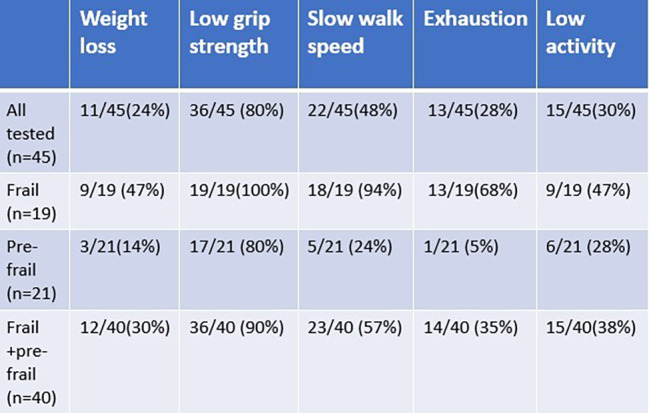
Methods: Hemodialysis patients' ≥50 years were recruited from a single dialysis unit between 9/1/2021 and 3/31/2022.Patients who consented underwent a frailty phenotype assessment by clinical staff. Five criteria were assessed: unintentional weight loss, low grip strength, self-reported exhaustion, slow gait speed, and low physical activity. Participants were classified as frail (3-5 points), pre-frail (1-2 points) or non-frail (0 points). Feasibility was determined by the number of eligible participants completing the assessment.
Results: Among 82 unique dialysis patients, 45 (52%) completed the assessment, 13 (16%) refused, 18 (23%) were not offered the assessment due to death, transfers, or switch to transplant or peritoneal dialysis, and 6 patients were excluded because they did not meet mobility criteria. Among assessed patients, 40(88%) patients were identified as pre-frail (46.6%) or frail (42.2%). Low grip strength was most common (90%). Those who refused were more likely to have peripheral vascular disease (p = 0.001), low albumin (p = 0.0187), low sodium (p = 0.0422), and ineligible for kidney transplant (p = 0.005).
Conclusions: Just over half of eligible hemodialysis patients completed the frailty assessment suggesting difficulty with broad clinical adoption expectations. Among those assessed, frailty and pre-frailty prevalence was high. Given patients who were not tested were clinically high risk, our reported prevalence likely underestimates true frailty prevalence. Providing frailty reduction interventions to all hemodialysis patients could have high impact for this group.
Keywords: Frailty; Hemodialysis; Kidney Disease; Renal transplantation.
© 2023. This is a U.S. Government work and not under copyright protection in the US; foreign copyright protection may apply.
Conflict of interest statement
The authors have no conflicts of interest to declare.
Figures


References
-
- Morley JE. Frailty and Sarcopenia: the New Geriatric giants. Rev Invest Clin 2016 Mar-Apr;68(2):59–67. PMID: 27103041. - PubMed
-
- Travison TG, Nguyen AH, Naganathan V, Stanaway FF, Blyth FM, Cumming RG, Le Couteur DG, Sambrook PN, Handelsman DJ. Changes in reproductive hormone concentrations predict the prevalence and progression of the frailty syndrome in older men: the concord health and ageing in men project. J Clin Endocrinol Metab. 2011;96(8):2464–74. doi: 10.1210/jc.2011-0143. - DOI - PubMed
Publication types
MeSH terms
Grants and funding
LinkOut - more resources
Full Text Sources
