


Use of Smart Devices to Track Cardiovascular Health Goals in the United States
- PMID: 38094515
- PMCID: PMC10718569
- DOI: 10.1016/j.jacadv.2023.100544
Use of Smart Devices to Track Cardiovascular Health Goals in the United States
Abstract
Background: Smartphone-based health applications are increasingly popular, but their real-world use for cardiovascular risk management remains poorly understood.
Objectives: The purpose of this study was to investigate the patterns of tracking health goals using smart devices, including smartphones and/or tablets, in the United States.
Methods: Using the nationally representative Health Information National Trends Survey for 2017 to 2020, we examined self-reported tracking of health-related goals (optimizing body weight, increasing physical activity, and/or quitting smoking) using smart devices among those with cardiovascular disease (CVD) or cardiovascular risk factors of hypertension, diabetes, obesity, and/or smoking. Survey analyses were used to obtain national estimates of use patterns and identify features associated with the use of these devices for tracking health goals.
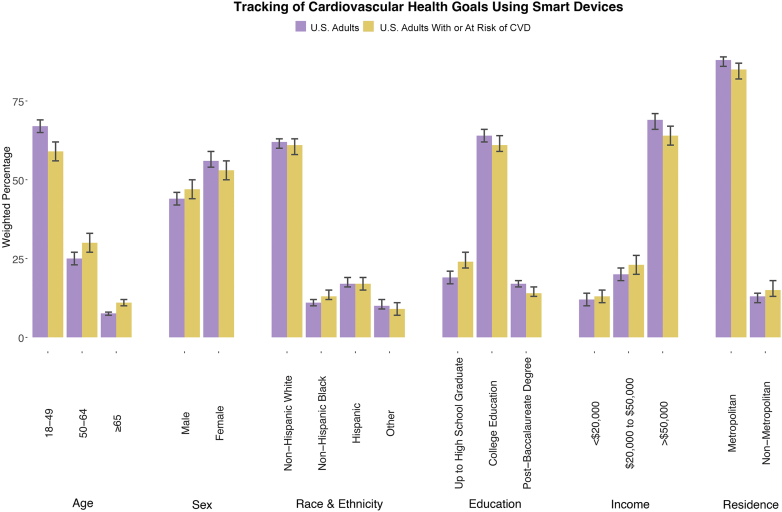
Results: Of 16,092 Health Information National Trends Survey participants, 10,660 had CVD or cardiovascular risk factors, representing 154.2 million (95% CI: 149.2-159.3 million) U.S. adults. Among the general U.S. adult population, 46% (95% CI: 44%-47%) tracked their health goals using their smart devices, compared with 42% (95% CI: 40%-43%) of those with or at risk of CVD. Younger age, female, Black race, higher educational attainment, and greater income were independently associated with tracking of health goals using smart devices.
Conclusions: Two in 5 U.S. adults with or at risk of CVD use their smart devices to track health goals. While representing a potential avenue to improve care, the lower use of smart devices among older and low-income individuals, who are at higher risk of adverse cardiovascular outcomes, requires that digital health interventions are designed so as not to exacerbate existing disparities.
Keywords: cardiovascular diseases; health disparity; healthy lifestyle; heart disease risk factors; smartphone; telemedicine.
Conflict of interest statement
The study was supported by the National Heart, Lung, and Blood Institute of the National Institutes of Health (under award K23HL153775 to Dr Khera) and the Doris Duke Charitable Foundation (under award, 2022060 to Dr Khera). Dr Khera has received research grant support, through Yale, from Bristol-Myers Squibb and Novo Nordisk; is a co-inventor of U.S. Pending Patent Applications 63/177,117, 63/346,610, and 63/428,569, unrelated to the current work; and is a founder of Evidence2Health, a precision health platform to improve evidence-based cardiovascular care. Dr Oikonomou is a co-inventor of the U.S. Provisional Patent Application 63/177,117, a co-founder of Evidence2Health; and has a consultancy and stock option agreement with Caristo Diagnostics Ltd (Oxford, United Kingdom), all unrelated to the current work. Dr Krumholz has received expenses and/or personal fees from UnitedHealthcare, Element Science, Aetna, Reality Labs, Tesseract/4Catalyst, F-Prime, the Siegfried & Jensen law firm, the Arnold & Porter law firm, and the Martin Baughman law firm; is a co-founder of Refactor Health and Hugo Health; and is associated with contracts through Yale New Haven Hospital from the Centers for Medicare & Medicaid Services and through Yale University from Johnson & Johnson outside the submitted work. All other authors have reported that they have no relationships relevant to the contents of this paper to disclose.
Figures



Comment in
-
Inclusive Health Tracking: Unlock the True Potential of Digital Health Solutions.JACC Adv. 2023 Aug 21;2(7):100545. doi: 10.1016/j.jacadv.2023.100545. eCollection 2023 Sep. JACC Adv. 2023. PMID: 38939485 Free PMC article.
References
-
- Pew Research Center Mobile fact sheet. 2021. https://www.pewresearch.org/internet/fact-sheet/mobile/
-
- United States Census Bureau U.S. adult population grew faster than nation’s total population from 2010 to 2020. 2022. https://www.census.gov/library/stories/2021/08/united-states-adult-popul...
Grants and funding
LinkOut - more resources
Full Text Sources
