Review
. 2024 Jan;21(1):35-45.
doi: 10.1038/s41575-023-00864-2. Epub 2023 Dec 14.

The maternal gut microbiome in pregnancy: implications for the developing immune system

Affiliations
Review

The maternal gut microbiome in pregnancy: implications for the developing immune system

Omry Koren et al. Nat Rev Gastroenterol Hepatol. 2024 Jan.

Abstract

The gut microbiome has important roles in host metabolism and immunity, and microbial dysbiosis affects human physiology and health. Maternal immunity and microbial metabolites during pregnancy, microbial transfer during birth, and transfer of immune factors, microorganisms and metabolites via breastfeeding provide critical sources of early-life microbial and immune training, with important consequences for human health. Only a few studies have directly examined the interactions between the gut microbiome and the immune system during pregnancy, and the subsequent effect on offspring development. In this Review, we aim to describe how the maternal microbiome shapes overall pregnancy-associated maternal, fetal and early neonatal immune systems, focusing on the existing evidence and highlighting current gaps to promote further research.


Conflict of interest statement

Competing interests

The other authors declare no competing interests.

Figures
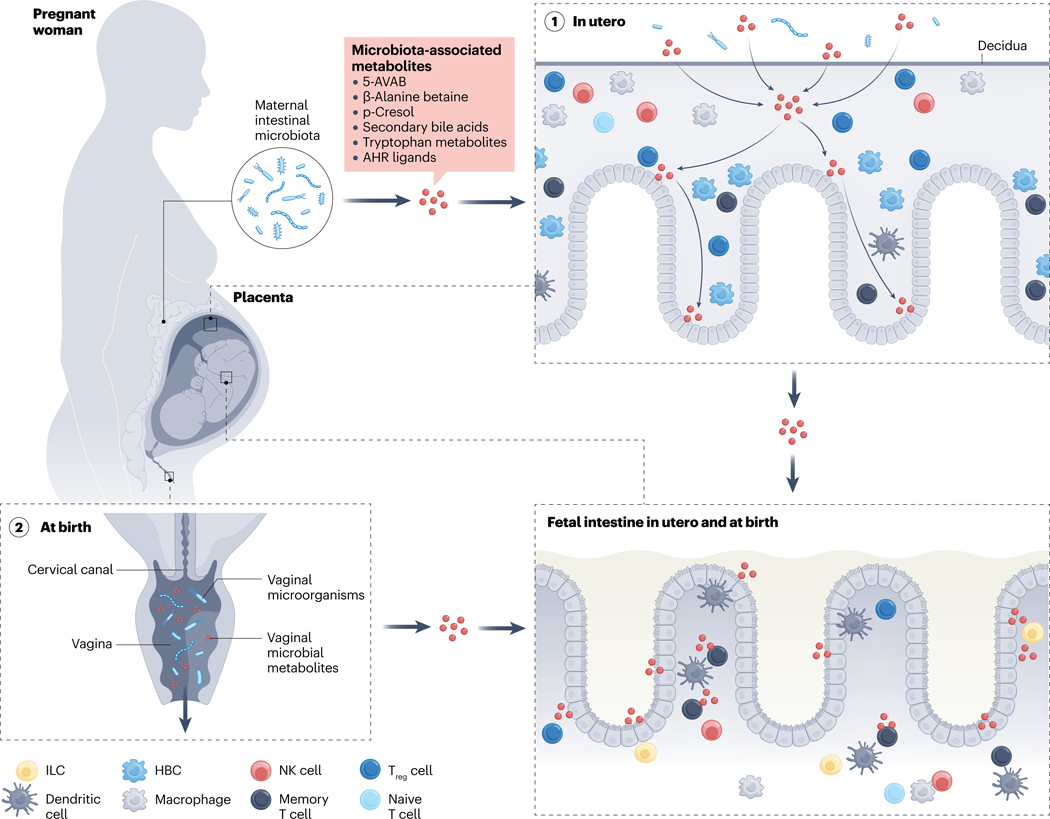
Fig. 1 |
Fig. 1 |. Microbial metabolites from the maternal microbiome contribute to fetal and neonatal immune development.
1) Maternal intestinal microbiota-derived metabolites influence immune development in the placenta and fetal intestine in utero. 2) The vaginal microbiome and microbial metabolites contribute to intestinal immune development at birth. 5-AVAB, 5-aminovaleric acid betaine; AHR, aryl hydrocarbon receptor; HBC, Hoffbauer cell; ILC, innate lymphoid cell; NK, natural killer; Treg cell, regulatory T cell,.
Fig. 2 |
Fig. 2 |. Human milk microorganisms and their metabolites support the gut microbiome and immune system in the offspring.
Breast milk composition is complex and unique. It contains nutrients and specific bioactive compounds, including the microbiota, their metabolites (including short-chain fatty acids (SCFAs)) and microorganism-derived products (cell walls, membrane, DNA, specific secreted proteins, and other fragments or structures), human milk oligosaccharides (HMOs), which are modulated by maternal genotype (FUT2), and immune-related compounds, including secretory IgA and other glycoproteins such as immunoglobulins, lactoferrin and lysozyme. It also contains soluble CD14, cytokines, growth factors (such as transforming growth factor-β) and defensins. Other compounds present include extracellular vesicles, which can cargo microRNAs, long non-coding RNAs, proteins and lipids, as well as maternal cells, including leukocytes and stem cells. This complexity is key to adaptive and innate mucosal immunity in the neonate and to support neonatal microbial assembly by interacting closely with intestinal epithelial cells and intestinal receptors signalling to the immune system (modulating the adaptive immune response via a T helper cell response and stimulating regulatory T (Treg) cells and regulatory B cells) and generating immune tolerance. It is also known that, during breastfeeding, there is a reverse flow of milk from the infant back into the breast and some oral bacterial species have been reported in human breast milk microbiota. Oral mucosal immunity during breastfeeding and the role of breast milk compounds and also milk microorganisms and their metabolites are not fully ascertained and warrant further research. ILC, innate lymphoid cell; NK, natural killer.

References

    1. Nuriel-Ohayon M, Neuman H. & Koren O. Microbial changes during pregnancy, birth, and infancy. Front. Microbiol 7, 1031 (2016). - PMC - PubMed
    1. Gomez de Aguero M. et al. The maternal microbiota drives early postnatal innate immune development. Science 351, 1296–1302 (2016). - PubMed
    1. Li Y. et al. In utero human intestine harbors unique metabolome, including bacterial metabolites. JCI Insight 5, e138751 (2020). - PMC - PubMed
    1. Vuong HE et al. The maternal microbiome modulates fetal neurodevelopment in mice. Nature 586, 281–286 (2020). - PMC - PubMed
    1. Calatayud M, Koren O. & Collado MC Maternal microbiome and metabolic health program microbiome development and health of the offspring. Trends Endocrinol. Metab 30, 735–744 (2019). - PubMed

LinkOut - more resources
