. 2023 Nov 30:17:1294567.
doi: 10.3389/fnins.2023.1294567. eCollection 2023.

Fibroblast growth factor 13-mediated regulation of medium spiny neuron excitability and cocaine self-administration

Affiliations

Fibroblast growth factor 13-mediated regulation of medium spiny neuron excitability and cocaine self-administration

Nolan M Dvorak et al. Front Neurosci. .

Abstract

Cocaine use disorder (CUD) is a prevalent neuropsychiatric disorder with few existing treatments. Thus, there is an unmet need for the identification of new pharmacological targets for CUD. Previous studies using environmental enrichment versus isolation paradigms have found that the latter induces increased cocaine self-administration with correlative increases in the excitability of medium spiny neurons (MSN) of the nucleus accumbens shell (NAcSh). Expanding upon these findings, we sought in the present investigation to elucidate molecular determinants of these phenomena. To that end, we first employed a secondary transcriptomic analysis and found that cocaine self-administration differentially regulates mRNA for fibroblast growth factor 13 (FGF13), which codes for a prominent auxiliary protein of the voltage-gated Na+ (Nav) channel, in the NAcSh of environmentally enriched rats (i.e., resilient behavioral phenotype) compared to environmentally isolated rats (susceptible phenotype). Based upon this finding, we used in vivo genetic silencing to study the causal functional and behavioral consequences of knocking down FGF13 in the NAcSh. Functional studies revealed that knockdown of FGF13 in the NAcSh augmented excitability of MSNs by increasing the activity of Nav channels. These electrophysiological changes were concomitant with a decrease in cocaine demand elasticity (i.e., susceptible phenotype). Taken together, these data support FGF13 as being protective against cocaine self-administration, which positions it well as a pharmacological target for CUD.

Keywords: cocaine use disorder; fibroblast growth factor 13; medium spiny neurons; nucleus accumbens shell; voltage-gated Na+ channel.


Conflict of interest statement

The authors declare that the research was conducted in the absence of any commercial or financial relationships that could be construed as a potential conflict of interest. The author(s) declared that they were an editorial board member of Frontiers, at the time of submission. This had no impact on the peer review process and the final decision.

Figures
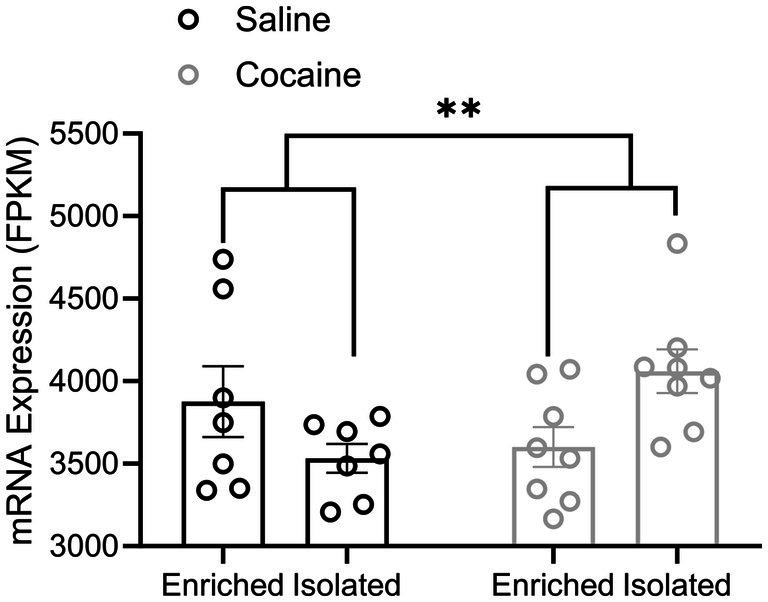
Figure 1
Figure 1
Cocaine differentially regulates FGF13 mRNA levels in environmentally enriched versus environmentally isolated conditions. Bar graph comparing FGF13 mRNA levels in the NAcSh of either environmentally enriched or isolated rats that self-administered saline or cocaine. A significant main effect of cocaine (shown) and an interaction effect (cocaine × housing effect) were found. Data are mean ± SEM (n = 7–8 rats/group). Significance was assessed with a likelihood ratio F-test (**p < 0.01).
Figure 2
Figure 2
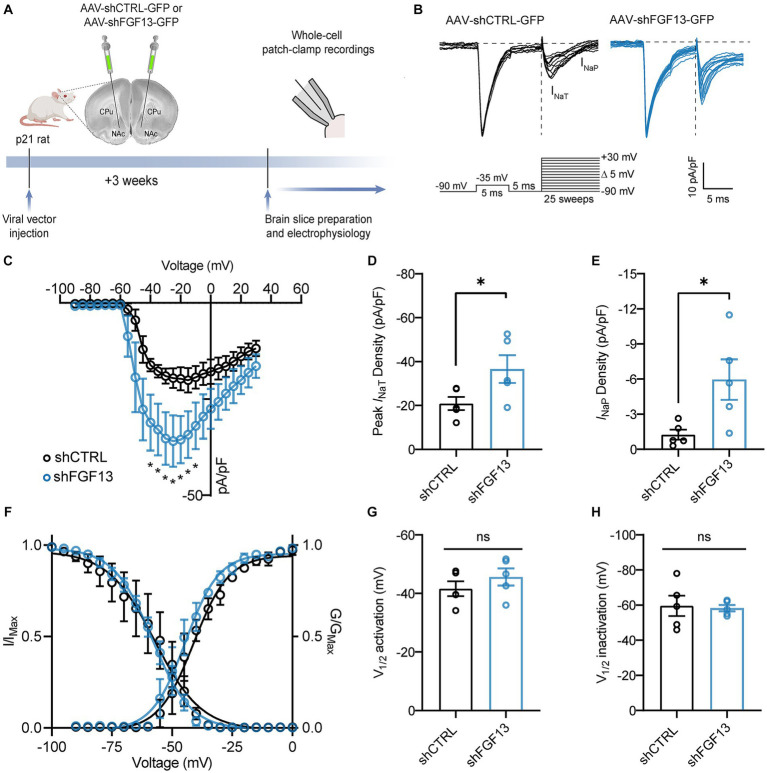
FGF13 regulates the INaT and INaP of MSNs of the NAcSh. (A) Schematic of AAV injection site in the NAcSh and experimental timeline. (B) Representative traces of sodium current elicited by MSNs expressing AAV-shCTRL-GFP or AAV-shFGF13-GFP in response to the depicted voltage-clamp protocol. (C) Current–voltage relationship of the INaT elicited by MSNs belonging to the experimental groups described in (B). (D) Comparison of the peak INaT density of MSNs belonging to the indicated experimental group. (E) Comparison of the INaP density at the −20 mV voltage command for the indicated experimental groups. (F) Comparison of the voltage-dependences of activation and steady-state inactivation of INaT elicited by MSNs of the experimental groups described in (B). (G,H) Comparison of V1/2 of activation (G) and steady-state inactivation (H) of INaT of MSNs belonging to the indicated experimental groups. Data are mean ± SEM (n = 5 cells/group; slices from N = 2 rats/group). Significance was assessed using a student’s t-test (ns, not significant; *p < 0.05). For detailed statistical information, refer to Supplementary Table S1.
Figure 3
Figure 3
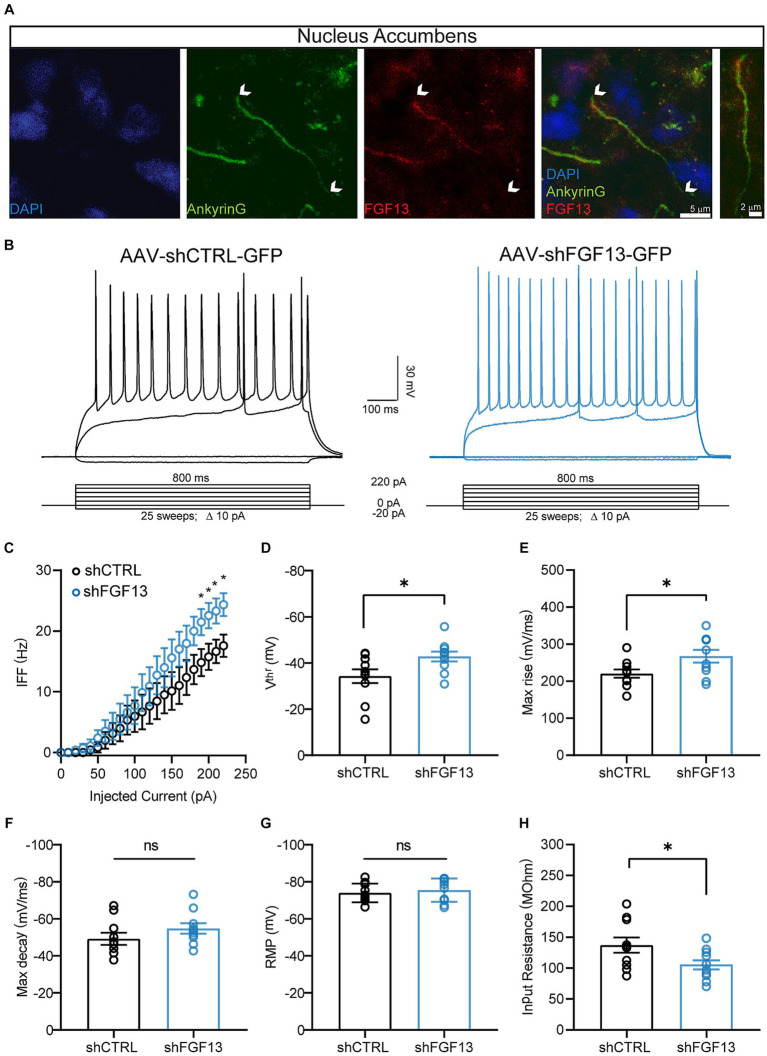
FGF13 regulates the excitability of MSNs of the NAcSh. (A) Staining of FGF13 at the AIS. Representative image of DAPI (blue), AnkyrinG (green) and FGF13 (red) at the AIS in the NAcSh with overlay and zoom to AIS. Scale bars indicate 5 μm and 2 μm. (B) Representative traces of evoked APs of MSNs expressing AAV-shCTRL-GFP or AAV-shFGF13-GFP in response to the depicted current-clamp protocol. (C) Comparison of the IFF of MSNs expressing AAV-shCTRL-GFP (black) or AAV-shFGF13-GFP (blue) over a range of injected current stimuli. (D–H) Comparison of the Vthr for AP initiation (D), maximum rise of the AP upstroke (E), maximum decay of the AP downstroke (F), RMP (G), and Rin (H) between the indicated experimental groups. Data are mean ± SEM (n = 10 cells/group; slices from N = 3 rats/group). Statistical significance was assessed using a student’s t-test (ns, not significant; *p < 0.05). For detailed statistical information, refer to Supplementary Table S2.
Figure 4
Figure 4
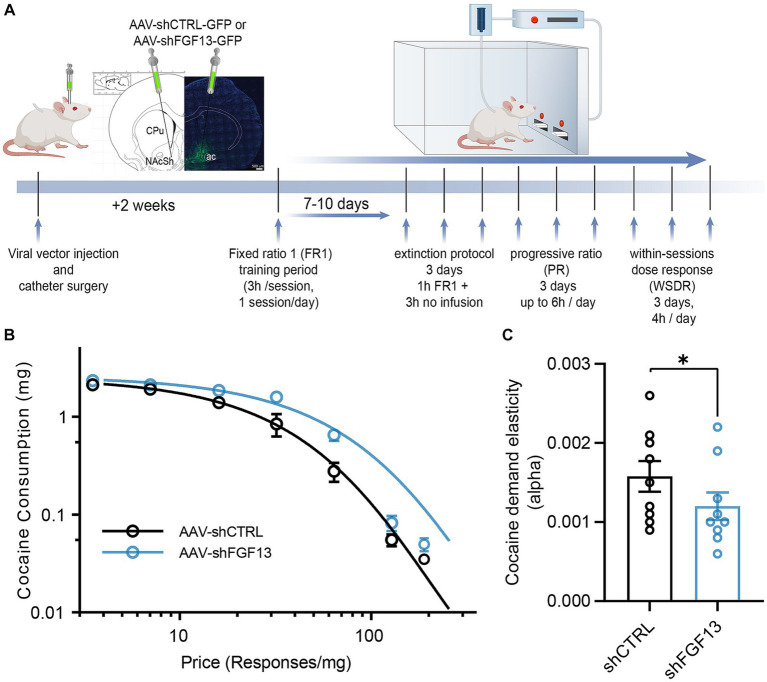
In vivo genetic silencing of FGF13 in the NAcSh decreases cocaine demand elasticity. (A) Timeline for stereotaxic surgery, catheter implantation, and subsequent cocaine self-administration testing. (B) Cocaine demand function across a range of cocaine prices (number of responses for 1 mg/kg of cocaine) for rats belonging to the indicated experimental groups. (C) Cocaine demand elasticity (i.e., slope) derived from (B) for the indicated experimental groups. Data are mean ± SEM (n = 9 rats/group). Statistical significance was assessed using a student’s t-test (*p < 0.05).

References

    1. Aberman J. E., Salamone J. D. (1999). Nucleus accumbens dopamine depletions make rats more sensitive to high ratio requirements but do not impair primary food reinforcement. Neuroscience 92, 545–552. doi: 10.1016/s0306-4522(99)00004-4 - DOI - PubMed
    1. Alexander R. P. D., Mitry J., Sareen V., Khadra A., Bowie D. (2019). Cerebellar stellate cell excitability is coordinated by shifts in the gating behavior of voltage-gated Na+ and A-type K+ channels. eNeuro 6:ENEURO.0126-19.2019. doi: 10.1523/ENEURO.0126-19.2019, PMID: - DOI - PMC - PubMed
    1. Ali S. R., Liu Z., Nenov M. N., Folorunso O., Singh A., Scala F., et al. . (2018). Functional modulation of voltage-gated sodium channels by a FGF14-based peptidomimetic. ACS Chem. Neurosci. 9, 976–987. doi: 10.1021/acschemneuro.7b00399, PMID: - DOI - PMC - PubMed
    1. Alshammari M. A., Alshammari T. K., Laezza F. (2016). Improved methods for fluorescence microscopy detection of macromolecules at the axon initial segment. Front. Cell. Neurosci. 10:5. doi: 10.3389/fncel.2016.00005, PMID: - DOI - PMC - PubMed
    1. Anastasio N. C., Stutz S. J., Fox R. G., Sears R. M., Emeson R. B., DiLeone R. J., et al. . (2014). Functional status of the serotonin 5-HT2C receptor (5-HT2CR) drives interlocked phenotypes that precipitate relapse-like behaviors in cocaine dependence. Neuropsychopharmacology 39, 370–382. doi: 10.1038/npp.2013.199, PMID: - DOI - PMC - PubMed