


Analysis of uterine evacuation methods in postabortion care after implementation of a surveillance network (CLAP MUSA-Network) at a university hospital
- PMID: 38100497
- PMCID: PMC10723722
- DOI: 10.1371/journal.pone.0296009
Analysis of uterine evacuation methods in postabortion care after implementation of a surveillance network (CLAP MUSA-Network) at a university hospital
Abstract
Background: Management of uterine evacuation is essential for increasing safe abortion care. Monitoring through surveillance systems tracks changes in clinical practice and provides information to improve equity in abortion care quality.
Objective: This study aimed to evaluate the frequency of manual vacuum aspiration (MVA) and medical abortion (MA), and identify the factors associated with each uterine evacuation method after surveillance network installation at a Brazilian hospital.
Methods: This cross-sectional study included women admitted for abortion or miscarriage to the University of Campinas Women's Hospital, Brazil, between July 2017 and November 2020. The dependent variables were the use of MVA and MA with misoprostol. The independent variables were the patients' clinical and sociodemographic data. The Cochran-Armitage, chi-square, and Mann-Whitney U tests, as well as multiple logistic regression analysis, were used to compare uterine evacuation methods.
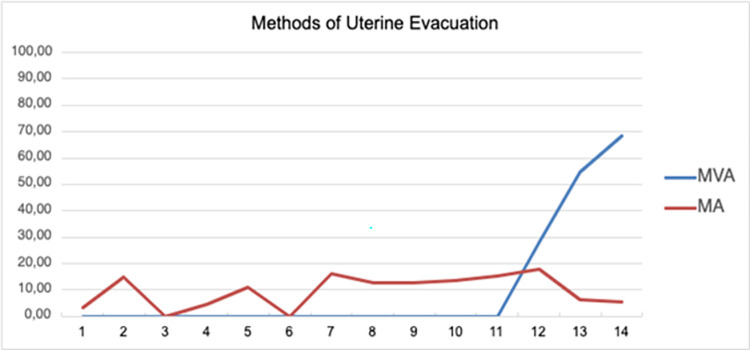
Results: We enrolled 474 women in the study, 91.35% of whom underwent uterine evacuation via uterine curettage (78.75%), MVA (9.46%), or MA (11.54%). MVA use increased during the study period (Z = 9.85, p < 0.001). Admission in 2020 (odds ratio [OR] 64.22; 95% confidence interval [CI] 3.79-1086.69) and lower gestational age (OR 0.837; 95% CI 0.724-0.967) were independently associated with MVA, whereas the only factor independently associated with MA was a higher education level (OR 2.66; 95% CI 1.30-5.46).
Conclusion: MVA use increased following the installation of a surveillance network for good clinical practice. Being part of a network that encourages the use of evidence-based methods provides an opportunity for healthcare facilities to increase access to safe abortions.
Copyright: © 2023 Veiga-Junior et al. This is an open access article distributed under the terms of the Creative Commons Attribution License, which permits unrestricted use, distribution, and reproduction in any medium, provided the original author and source are credited.
Conflict of interest statement
The authors have declared that no competing interests exist.
Figures
References
-
- World Health Organization. Abortion care guideline Geneva: World Health Organization; 2022.
-
- Safe Abortion: Technical and Policy Guidance for Health Systems. 2nd ed. Geneva: World Health Organization; 2012. - PubMed
-
- Diniz D, Medeiros M, Madeiro A. National Abortion Survey—Brazil, 2021. Cien Saude Colet. 2023 Jun;28(6):1601–1606. - PubMed
-
- Cardoso BB, Vieira FMSB, Saraceni V. Abortion in Brazil: what do the official data say?. Cad. Saúde Pública 2020; 36 (1): e00188718. - PubMed
Publication types
MeSH terms
LinkOut - more resources
Full Text Sources
Medical
Research Materials
