Review
. 2024 Jan;4(1):14-26.
doi: 10.1038/s43587-023-00539-2. Epub 2023 Dec 15.

Mechanisms, pathways and strategies for rejuvenation through epigenetic reprogramming

Affiliations
Review

Mechanisms, pathways and strategies for rejuvenation through epigenetic reprogramming

Andrea Cipriano et al. Nat Aging. 2024 Jan.

Erratum in

Abstract

Over the past decade, there has been a dramatic increase in efforts to ameliorate aging and the diseases it causes, with transient expression of nuclear reprogramming factors recently emerging as an intriguing approach. Expression of these factors, either systemically or in a tissue-specific manner, has been shown to combat age-related deterioration in mouse and human model systems at the cellular, tissue and organismal level. Here we discuss the current state of epigenetic rejuvenation strategies via partial reprogramming in both mouse and human models. For each classical reprogramming factor, we provide a brief description of its contribution to reprogramming and discuss additional factors or chemical strategies. We discuss what is known regarding chromatin remodeling and the molecular dynamics underlying rejuvenation, and, finally, we consider strategies to improve the practical uses of epigenetic reprogramming to treat aging and age-related diseases, focusing on the open questions and remaining challenges in this emerging field.


Conflict of interest statement

Competing interests

V.S. is a co-founder, SAB Chairman, Head of Research and shareholder of Turn Biotechnologies. D.A.S. is a consultant, inventor, board member and, in some cases, a founder and investor in Life Biosciences (a reprogramming company), EdenRock Sciences (Cantata, Metrobiotech), InsideTracker, Fully Aligned, Zymo, Galilei, Immetas, Animal Biosciences, Tally Health and others. For full information, see Supplementary File 1. The other authors declare no competing interests.

Figures

Fig. 1 |
Fig. 1 |. Structural diagram of each reprogramming factor.
The linear domain structure (left), DNA-binding sequence (center) and DNA-binding domain structures (right) for OCT4, SOX2, KLF4 and MYC factors. a, OCT4 (PDB ID: 3L1P) refers to the isoform OCT4A encoded by the POU5F1 gene, a DNA-binding transcription factor. The OCT4 DNA-binding (POU) domain consists of a POU-homeodomain (POUh) and a POU-specific (POUs) domain connected by a linker region. b, SOX2 (PDB ID: 6T90) contains a highly conserved, high mobility group (HMG) box DNA-binding domain comprising three α-helices, which bind the DNA minor groove and bend it by 90°. Early structural determination of the HMG POU-DNA revealed that the enhancers of target genes support the gene-specific configuration of the SOX2–OCT4 complex that binds DNA. The HMG includes two nuclear localization signals (NLS) and a nuclear export signal (NES). c, KLF4 (PDB ID: 5KE7) is a member of the cell-type specificity and Krüppel-like factor (SP/KLF) family, characterized by three zinc finger motifs (ZnF1, ZnF2 and ZnF3) with conserved ββα structure within the C terminus. The zinc fingers of KLF4, the second and third motifs, in particular, are responsible for contacting KLF4-specific sequences at the promoters of target genes, making them essential for KLF4-dependent reprogramming. d, MYC (PDB ID: 5I50) is a member of the basic helix–loop–helix zipper (bHLHZip) class of transcription factors, containing an N-terminal transactivation domain (TAD), two highly conserved sequences (known as MYC boxes), a central region containing a NLS and a C terminus containing the helix–loop–helix motif. The C terminus of MYC heterodimerizes with its obligatory partner MAX, which also contains a helix–loop–helix, and forms a stable four-helix structure, capable of recognizing specific DNA sequences (such as CACGTG) at the promoters and enhancers of target genes. The leucine zipper (LZ) domain is involved in protein dimerization and DNA binding. Created with BioRender.com.
Fig. 2 |
Fig. 2 |. Timeline highlighting publications on partial reprogramming in mouse and human models.
Important takeaways from in vitro and in vivo partial reprogramming experiments with the aim of relieving aging phenotypes. Brown and blue boxes indicate works performed in mice and humans, respectively.
Fig. 3 |
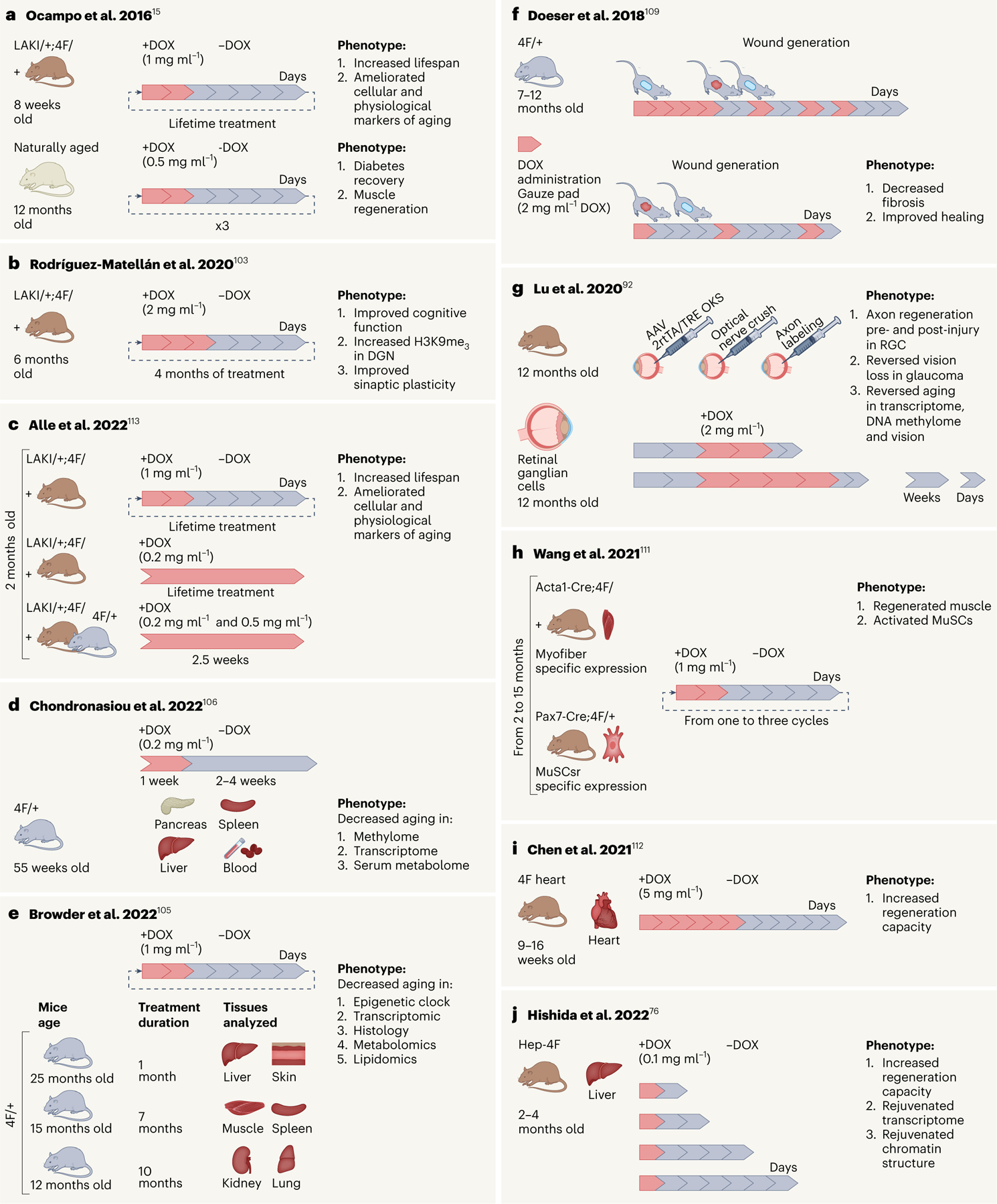
Fig. 3 |. Summary of detailed in vivo whole-organism partial reprogramming protocols.
ae, Whole-organism partial reprogramming for Ocampo et al. 2016 (ref. 15) (a), Rodríguez-Matellán et al. 2020 (ref. 103) (b), Alle et al. 2022 (ref. 104) (c), Chondronasiou et al. 2022 (ref. 106) (d) and Browder et al. 2022 (ref. 105) (e). fj, Tissue-specific partial reprogramming for Doeser et al. 2018 (ref. 109) (f), Lu et al. 2020 (ref. 92) (g), Wang et al. 2021 (ref. 111) (h), Chen et al. 2021 (ref. 112) (i) and Hishida et al. 2022 (ref. 76) (j). Each panel shows the strain of mice used and the respective ages (left), the tissues analyzed and the protocol of partial reprogramming (center) and the phenotype analyzed (right). Pink and grey arrows indicate days or weeks (specified below or above the arrow) of DOX administration and DOX removal, respectively. Created with BioRender.com.
Fig. 4 |
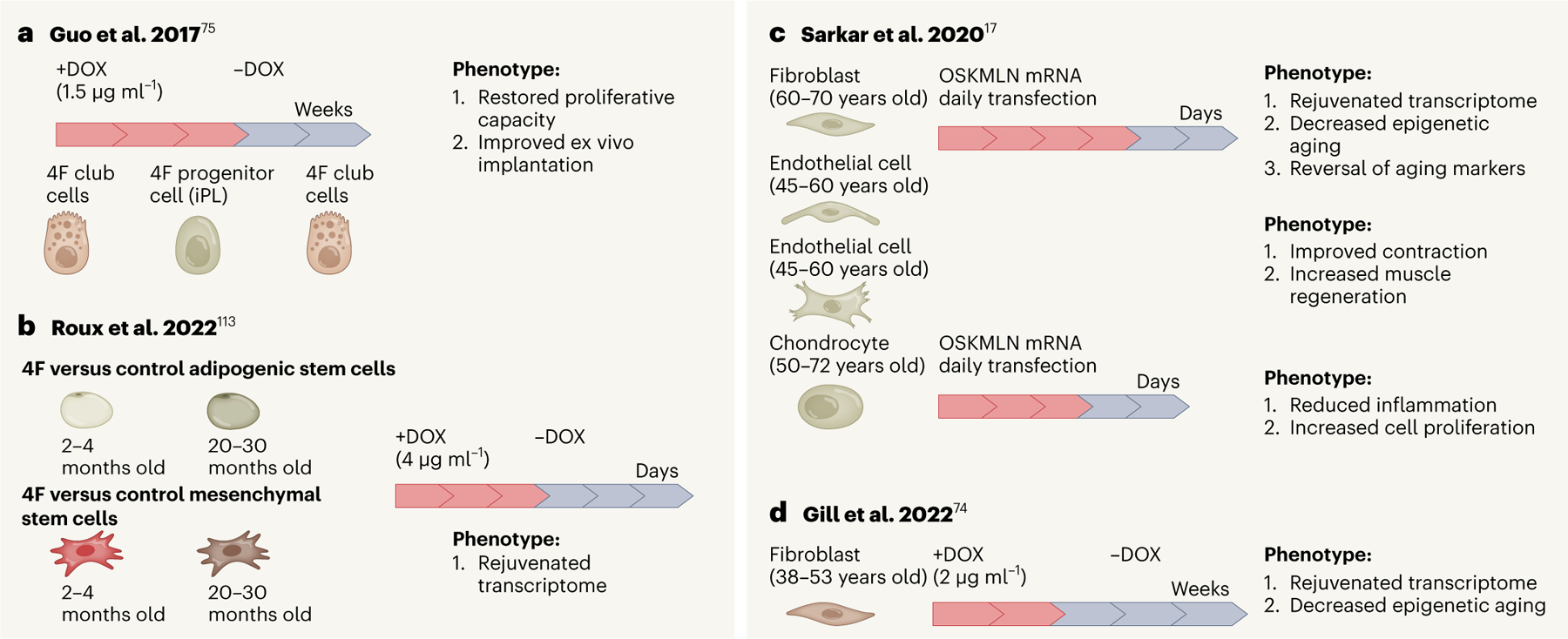
Fig. 4 |. Summary of detailed in vitro partial reprogramming protocols in mouse and human.
a,b, Mouse summary of reprogramming protocols for Guo et al. 2017 (ref. 75) (a) and Roux et al. 2021 (ref. 113) (b). c,d, Human summary of reprogramming protocols for Sarkar et al. 2020 (ref. 17) (c) and Gill et al. 2021 (ref. 74) (d). Each panel shows the cell type used with the respective donor or mice ages (left), the protocol of partial reprogramming (middle) and the phenotype analyzed (right). Pink arrows indicate days or weeks (specified above each induction protocol) of DOX administration (a,b,d) or mRNA transfections (c), and purple arrows indicate days or weeks upon DOX removal (a,b,d) or after mRNA transfections (c). Created with BioRender.com.

References

    1. Lopez-Otin C, Blasco MA, Partridge L, Serrano M & Kroemer G Hallmarks of aging: an expanding universe. Cell 186, 243–278 (2023). - PubMed
    1. Booth LN & Brunet A The aging epigenome. Mol. Cell 62, 728–744 (2016). - PMC - PubMed
    1. Anderson RM, Bitterman KJ, Wood JG, Medvedik O & Sinclair DA Nicotinamide and PNC1 govern lifespan extension by calorie restriction in Saccharomyces cerevisiae. Nature 423, 181–185 (2003). - PMC - PubMed
    1. López-Otín C, Blasco MA, Partridge L, Serrano M & Kroemer G The hallmarks of aging. Cell 153, 1194–1217 (2013). - PMC - PubMed
    1. Alle Q, Borgne EL, Milhavet O & Lemaitre JM Reprogramming: emerging strategies to rejuvenate aging cells and tissues. Int. J. Mol. Sci. 22, 8 (2021). - PMC - PubMed