. 2023 Dec 15;25(1):244.
doi: 10.1186/s13075-023-03215-3.

The dual pro-inflammatory and bone-protective role of calcitonin gene-related peptide alpha in age-related osteoarthritis

Affiliations

The dual pro-inflammatory and bone-protective role of calcitonin gene-related peptide alpha in age-related osteoarthritis

Alexander Hildebrandt et al. Arthritis Res Ther. .

Abstract

Background: The vasoactive neuropeptide calcitonin gene-related peptide alpha (αCGRP) enhances nociception in primary knee osteoarthritis (OA) and has been shown to disrupt cartilage and joint integrity in experimental rheumatoid arthritis (RA). Little is known about how αCGRP may alter articular structures in primary OA. We investigated whether αCGRP modulates local inflammation and concomitant cartilage and bone changes in a murine model of age-dependent OA.

Methods: Sixteen- to 18-month-old αCGRP-deficient mice (αCGRP-/-aged) were compared to, first, age-matched wild type (WTaged) and, second, young 4- to 5-month-old non-OA αCGRP-deficient (αCGRP-/-CTRL) and non-OA WT animals (WTCTRL). αCGRP levels were measured in serum. Knee and hip joint inflammation, cartilage degradation, and bone alterations were assessed by histology (OARSI histopathological grading score), gene expression analysis, and µ-computed tomography.

Results: WTaged mice exhibited elevated αCGRP serum levels compared to young WTCTRL animals. Marked signs of OA-induced cartilage destruction were seen in WTaged animals, while αCGRP-/-aged mice were mostly protected from this effect. Age-dependent OA was accompanied by an increased gene expression of pro-inflammatory Tnfa, Il1b, and Il6 and catabolic Mmp13, Adamts5, Ctsk, Tnfs11 (Rankl), and Cxcl12/Cxcr4 in WTaged but not in αCGRP-/-aged mice. αCGRP-deficiency however further aggravated subchondral bone sclerosis of the medial tibial plateau and accelerated bone loss in the epi- and metaphyseal trabecular tibial bone in age-dependent OA.

Conclusions: Similar to its function in experimental RA, αCGRP exerts a dual pro-inflammatory and bone-protective function in murine primary OA. Although anti-CGRP treatment was previously not successful in reducing pain in OA clinically, these data underline a crucial pathophysiological role of αCGRP in age-related OA.

Keywords: Bone; CGRP; Calca; Cartilage; Joint inflammation; Nociception; Pain.


Conflict of interest statement

The authors declare that they have no competing interests.

Figures
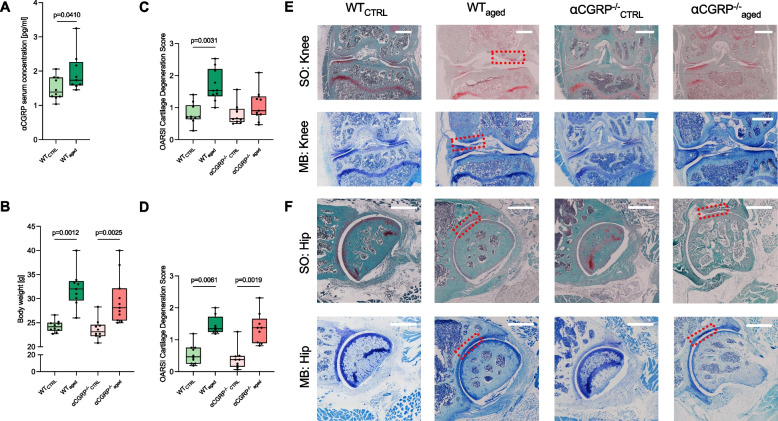
Fig. 1
Fig. 1
Serum αCGRP is elevated in primary OA and knee but not hip joints of aged αCGRP-deficient mice are protected from cartilage degradation. A αCGRP serum concentrations and B body weight of indicated groups. C OARSI histopathological grading scores of knee and D hip joints of indicated groups. E Representative histological images of MB- and SO-stained sections of knee and F hip joints of indicated groups. Red dotted boxes indicate cartilage damage. Scale bars = 500 µm. Given values are median ± minimum and maximum. MB, methylene blue; SO, safranin O
Fig. 2
Fig. 2
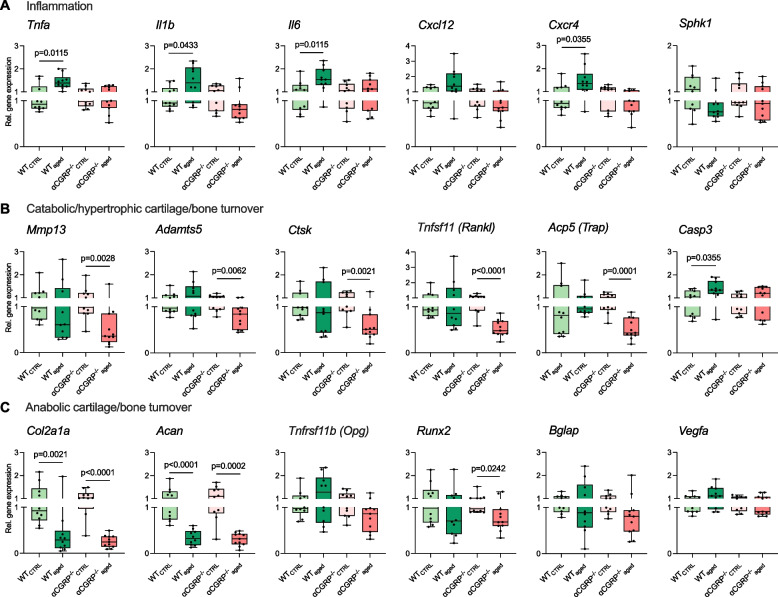
αCGRP promotes intraarticular expression of pro-inflammatory and catabolic cartilage markers in OA-affected knee joints. A qRT-PCR gene expression analysis of inflammation markers, B catabolic/hypertrophic cartilage/bone turnover markers, and C anabolic cartilage/bone turnover markers in knee joint samples of indicated groups. Given values are median ± minimum and maximum. Values for WTaged and αCGRP.−/−aged mice are shown as relative fold changes with respect to CTRL groups that were set to 1
Fig. 3
Fig. 3
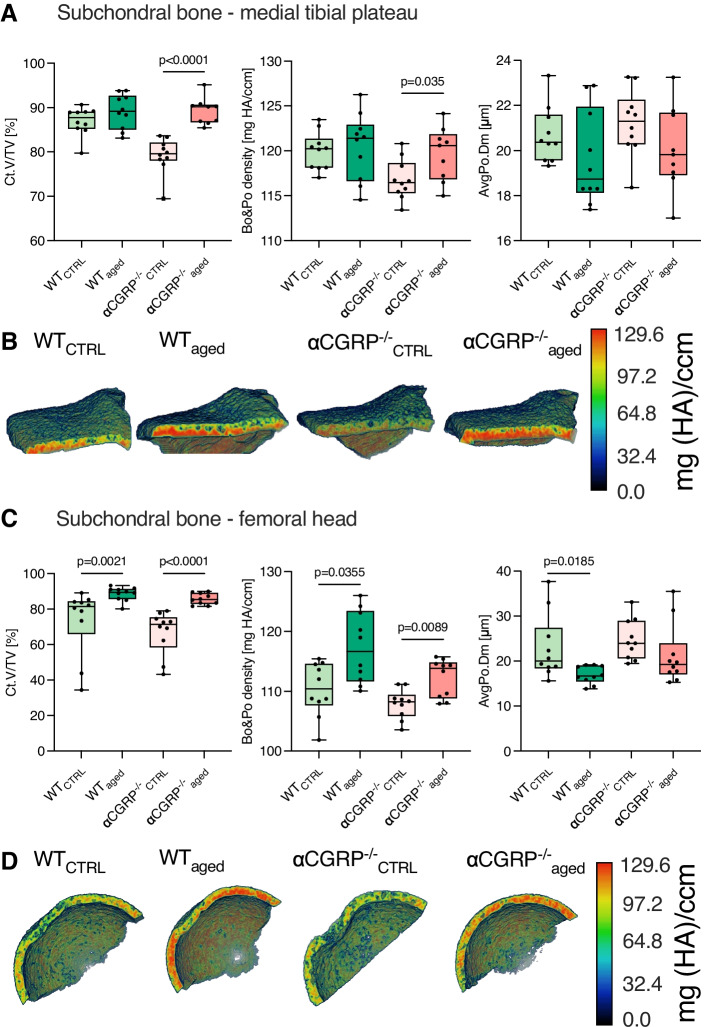
αCGRP prevents the development of primary OA-related subchondral bone sclerosis in the medial knee joint. A µCT parameters of the subchondral bone plate of the MTP, and B representative 3D images of bone density of the MTP using color maps. C µCT parameters of the subchondral bone plate of the femoral head, and D representative 3D images of bone density of the femoral head using color maps. Given values are median ± minimum and maximum. Maximum values for color scales were set to 130 mg HA/ccm. MTP, medial tibial plateau
Fig. 4
Fig. 4
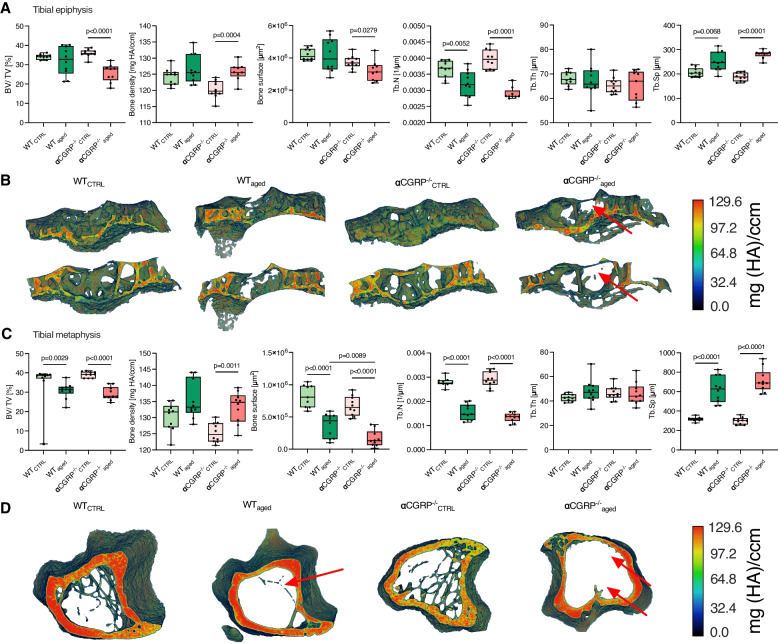
αCGRP prevents radiological OA-related alterations in the tibial epi- and metaphysis. A µCT parameters of the tibial epiphysis, and B representative 3D images of bone density of the trabecular architecture of the tibial epiphysis using color maps (anterior and posterior sections). C µCT parameters of the tibial metaphysis, and D representative 3D images of bone density of the trabecular architecture of the tibial metaphysis using color maps. Red arrows indicate loss of trabecular bone mass. Given values are median ± minimum and maximum. Maximum values for color scales were set to 130 mg HA/ccm

References

    1. Cui A, Li H, Wang D, Zhong J, Chen Y, Lu H. Global, regional prevalence, incidence and risk factors of knee osteoarthritis in population-based studies. EClinicalMedicine. 2020;29–30:100587. doi: 10.1016/j.eclinm.2020.100587. - DOI - PMC - PubMed
    1. Hawker GA. Osteoarthritis is a serious disease. Clin Exp Rheumatol. 2019;37(Suppl 120):3–6. - PubMed
    1. Hunter DJ, March L, Chew M. Osteoarthritis in 2020 and beyond: a Lancet Commission. Lancet. 2020;396(10264):1711–1712. doi: 10.1016/S0140-6736(20)32230-3. - DOI - PubMed
    1. Scanzello CR. Role of low-grade inflammation in osteoarthritis. Curr Opin Rheumatol. 2017;29(1):79–85. doi: 10.1097/BOR.0000000000000353. - DOI - PMC - PubMed
    1. Ashraf S, Wibberley H, Mapp PI, Hill R, Wilson D, Walsh DA. Increased vascular penetration and nerve growth in the meniscus: a potential source of pain in osteoarthritis. Ann Rheum Dis. 2011;70(3):523–529. doi: 10.1136/ard.2010.137844. - DOI - PubMed

Publication types

Substances