


The impact of electronic versus paper-based data capture on data collection logistics and on missing scores in thyroid cancer patients
- PMID: 38103143
- PMCID: PMC11076317
- DOI: 10.1007/s12020-023-03628-9
The impact of electronic versus paper-based data capture on data collection logistics and on missing scores in thyroid cancer patients
Abstract
Purpose: The purpose of this study was to investigate the impact of the type of data capture on the time and help needed for collecting patient-reported outcomes as well as on the proportion of missing scores.
Methods: In a multinational prospective study, thyroid cancer patients from 17 countries completed a validated questionnaire measuring quality of life. Electronic data capture was compared to the paper-based approach using multivariate logistic regression.
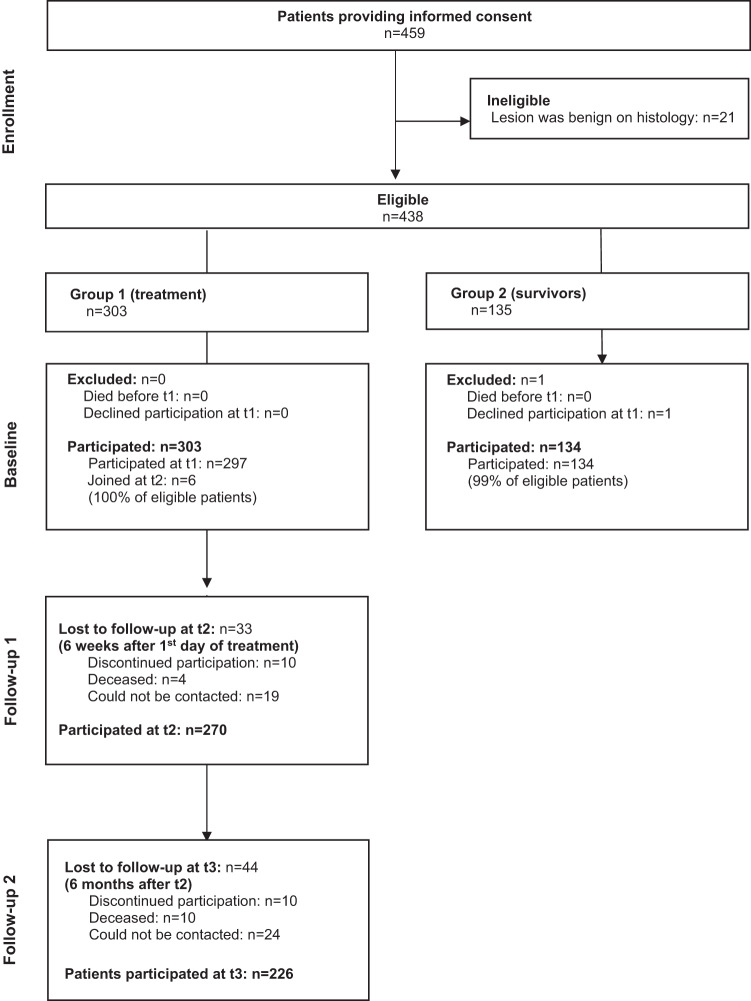
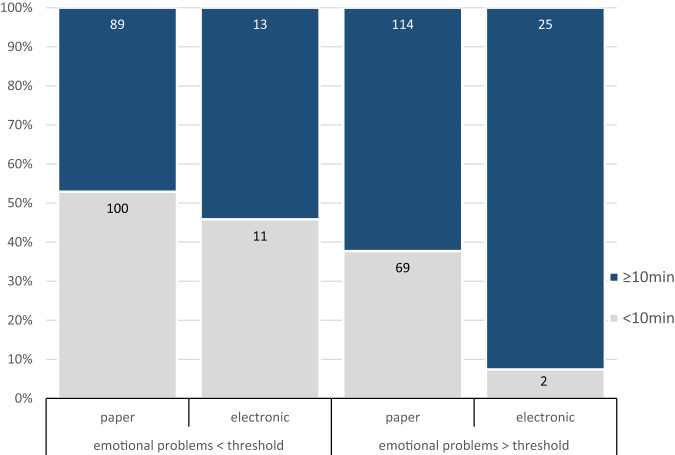
Results: A total of 437 patients were included, of whom 13% used electronic data capture. The relation between data capture and time needed was modified by the emotional functioning of the patients. Those with clinical impairments in that respect needed more time to complete the questionnaire when they used electronic data capture compared to paper and pencil (ORadj 24.0; p = 0.006). This was not the case when patients had sub-threshold emotional problems (ORadj 1.9; p = 0.48). The odds of having the researcher reading the questions out (instead of the patient doing this themselves) (ORadj 0.1; p = 0.01) and of needing any help (ORadj 0.1; p = 0.01) were lower when electronic data capture was used. The proportion of missing scores was equivalent in both groups (ORadj 0.4, p = 0.42).
Conclusions: The advantages of electronic data capture, such as real-time assessment and fewer data entry errors, may come at the price of more time required for data collection when the patients have mental health problems. As this is not uncommon in thyroid cancer, researchers need to choose the type of data capture wisely for their particular research question.
Keywords: Electronic patient-reported outcomes; Help needed; Missing scores; Mode of administration; Paper–pencil; Speed.
© 2023. The Author(s).
Conflict of interest statement
S.S. has received honoraria from Lilly for reviewing papers for their Quality of Life Award and from Eisei for advice in writing a paper, outside of the submitted work. N.K. reports honoraria from ONO PHARMACEUTICAL, Bristol Meyers Squibb, Merck Biopharma, Astra-Zeneca, Merck Sharp & Dohme, Eisai, Bayer and Chugai Pharmaceutical, all outside the submitted work. M.P. reports speaker fees from Meeting&Words and from Hinovia S.r.l., outside the submitted work. G.S. has received research support in the form of donations from Merck Sharp & Dohme, IBSA and Alpha-Sigma, which partially defrayed costs associated with recruiting patients in this study. M.B. has received speaker fees from Lilly and Takeda outside of the submitted work. All authors have a special interest in quality of life in thyroid cancer patients and survivors. The authors declare that they have no conflict of interest that could be perceived as prejudicing the impartiality of the research reported.
Figures
References
-
- Ishiki H, Kikawa Y, Terada M, Mizusawa J, Honda M, Iwatani T, Mizutani T, Mori K, Nakamura N, Miyaji T, et al. Patient-reported outcome and quality of life research policy: Japan Clinical Oncology Group (JCOG) policy. Jpn. J. Clin. Oncol. 2023;53:195–202. doi: 10.1093/jjco/hyad007. - DOI - PMC - PubMed
-
- Velikova G, Coens C, Efficace F, Greimel E, Groenvold M, Johnson C, Singer S, van de Poll-Franse L, Young T, Bottomley A. Health-related quality of life in EORTC clinical trials – 30 years of progress from methodological developments to making a real impact on oncology practice. Eur. J. Cancer Suppl. 2012;10:141–149. doi: 10.1016/S1359-6349(12)70023-X. - DOI
-
- Cramon P, Rasmussen AK, Bonnema SJ, Bjorner JB, Feldt-Rasmussen U, Groenvold M, Hegedus L, Watt T. Development and implementation of PROgmatic: A clinical trial management system for pragmatic multi-centre trials, optimised for electronic data capture and patient-reported outcomes. Clin. Trials. 2014;11:344–354. doi: 10.1177/1740774513517778. - DOI - PubMed
Publication types
MeSH terms
Grants and funding
LinkOut - more resources
Full Text Sources
Medical
Research Materials
