


Personalized functional brain network topography is associated with individual differences in youth cognition
- PMID: 38110396
- PMCID: PMC10728159
- DOI: 10.1038/s41467-023-44087-0
Personalized functional brain network topography is associated with individual differences in youth cognition
Abstract
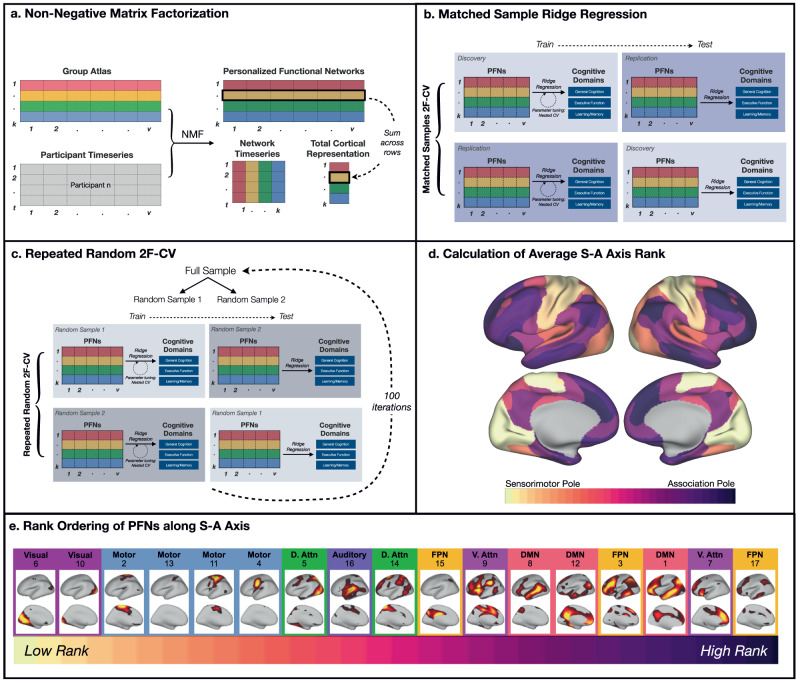
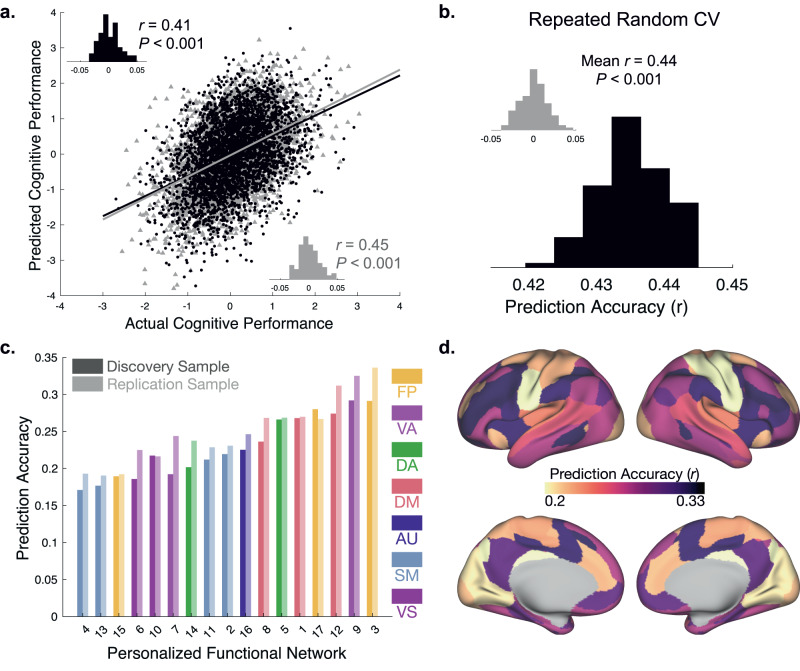
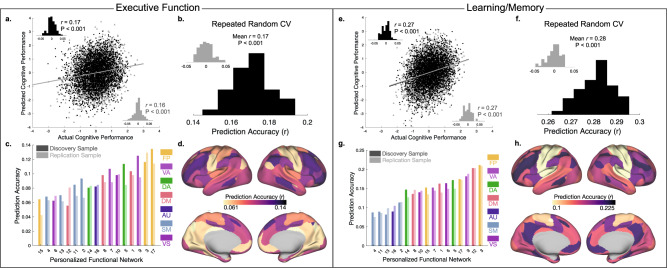
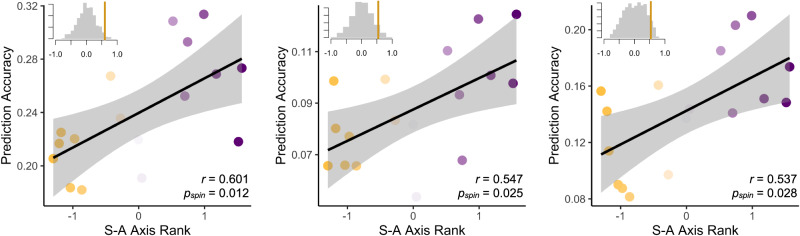
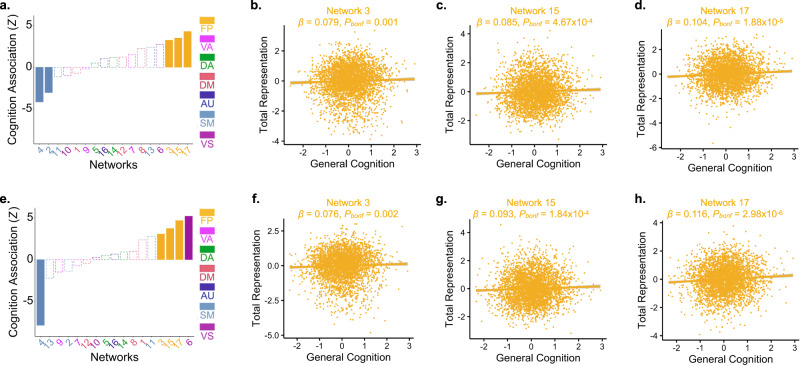
Individual differences in cognition during childhood are associated with important social, physical, and mental health outcomes in adolescence and adulthood. Given that cortical surface arealization during development reflects the brain's functional prioritization, quantifying variation in the topography of functional brain networks across the developing cortex may provide insight regarding individual differences in cognition. We test this idea by defining personalized functional networks (PFNs) that account for interindividual heterogeneity in functional brain network topography in 9-10 year olds from the Adolescent Brain Cognitive Development℠ Study. Across matched discovery (n = 3525) and replication (n = 3447) samples, the total cortical representation of fronto-parietal PFNs positively correlates with general cognition. Cross-validated ridge regressions trained on PFN topography predict cognition in unseen data across domains, with prediction accuracy increasing along the cortex's sensorimotor-association organizational axis. These results establish that functional network topography heterogeneity is associated with individual differences in cognition before the critical transition into adolescence.
© 2023. The Author(s).
Conflict of interest statement
R.B. reports owning stock in Taliaz Health and serving on the scientific boards of Taliaz Health and Zynerba Pharmaceuticals outside the submitted work. Dr. Shinohara has consulting income from Genentech/Roche and Octave Bioscience. All other authors report no competing interests.
Figures
References
-
- Richards M, Shipley B, Fuhrer R, Wadsworth MEJ. Cognitive ability in childhood and cognitive decline in mid-life: Longitudinal birth cohort study. Br. Med. J. 2004;328:552–554. doi: 10.1136/bmj.37972.513819.EE. - DOI - PMC - PubMed
Publication types
MeSH terms
Grants and funding
- U01 DA051039/DA/NIDA NIH HHS/United States
- R37 MH125829/MH/NIMH NIH HHS/United States
- U01 DA051018/DA/NIDA NIH HHS/United States
- U01 DA051037/DA/NIDA NIH HHS/United States
- U01 DA051016/DA/NIDA NIH HHS/United States
- U01 DA041117/DA/NIDA NIH HHS/United States
- U01 DA041148/DA/NIDA NIH HHS/United States
- K99 MH127293/MH/NIMH NIH HHS/United States
- R01 MH119185/MH/NIMH NIH HHS/United States
- U01 DA041174/DA/NIDA NIH HHS/United States
- U24 DA041147/DA/NIDA NIH HHS/United States
- T32 MH019112/MH/NIMH NIH HHS/United States
- R01 EB022573/EB/NIBIB NIH HHS/United States
- R01 MH112847/MH/NIMH NIH HHS/United States
- U01 DA041120/DA/NIDA NIH HHS/United States
- T32 NS091006/NS/NINDS NIH HHS/United States
- R01 MH123550/MH/NIMH NIH HHS/United States
- R01 MH123563/MH/NIMH NIH HHS/United States
- U01 DA041093/DA/NIDA NIH HHS/United States
- R01 MH120482/MH/NIMH NIH HHS/United States
- U24 DA041123/DA/NIDA NIH HHS/United States
- U24 NS130411/NS/NINDS NIH HHS/United States
- U01 DA051038/DA/NIDA NIH HHS/United States
- R00 MH127293/MH/NIMH NIH HHS/United States
- U01 DA041134/DA/NIDA NIH HHS/United States
- U01 DA041022/DA/NIDA NIH HHS/United States
- R25 MH119043/MH/NIMH NIH HHS/United States
- R01 MH132934/MH/NIMH NIH HHS/United States
- R01 MH113550/MH/NIMH NIH HHS/United States
- U01 DA041156/DA/NIDA NIH HHS/United States
- U01 DA050987/DA/NIDA NIH HHS/United States
- U01 DA041025/DA/NIDA NIH HHS/United States
- U01 DA050989/DA/NIDA NIH HHS/United States
- T32 NS091008/NS/NINDS NIH HHS/United States
- U01 DA041089/DA/NIDA NIH HHS/United States
- F31 MH123063/MH/NIMH NIH HHS/United States
- U01 DA050988/DA/NIDA NIH HHS/United States
- U01 DA041106/DA/NIDA NIH HHS/United States
- R01 MH120174/MH/NIMH NIH HHS/United States
- U01 DA041028/DA/NIDA NIH HHS/United States
- U01 DA041048/DA/NIDA NIH HHS/United States
LinkOut - more resources
Full Text Sources
Medical
