Clinical Outcomes of Intracardiac Echocardiography-Guided Contrast Agent-Free Cryoballoon Ablation in Atrial Fibrillation Patients With Renal Insufficiency
- PMID: 38111185
- PMCID: PMC10961213
- DOI: 10.4070/kcj.2023.0194
Clinical Outcomes of Intracardiac Echocardiography-Guided Contrast Agent-Free Cryoballoon Ablation in Atrial Fibrillation Patients With Renal Insufficiency
Abstract
Background and objectives: Previous studies have reported an association between impaired renal function and poor outcomes after radiofrequency catheter ablation in patients with atrial fibrillation (AF). However, outcomes of cryoballoon ablation (CBA) in patients with renal insufficiency are not fully elucidated. This study aimed to compare outcomes of CBA in AF patients with chronic kidney disease (CKD) versus those without CKD and to assess changes in renal function over 12 months following CBA.
Methods: A total of 839 patients (65.1% with non-paroxysmal AF [PAF]) who underwent de novo CBA were prospectively enrolled. We divided patients into two groups based on creatinine clearance rate (CCr) and performed intracardiac echocardiography (ICE)-guided contrast agent-free CBA.
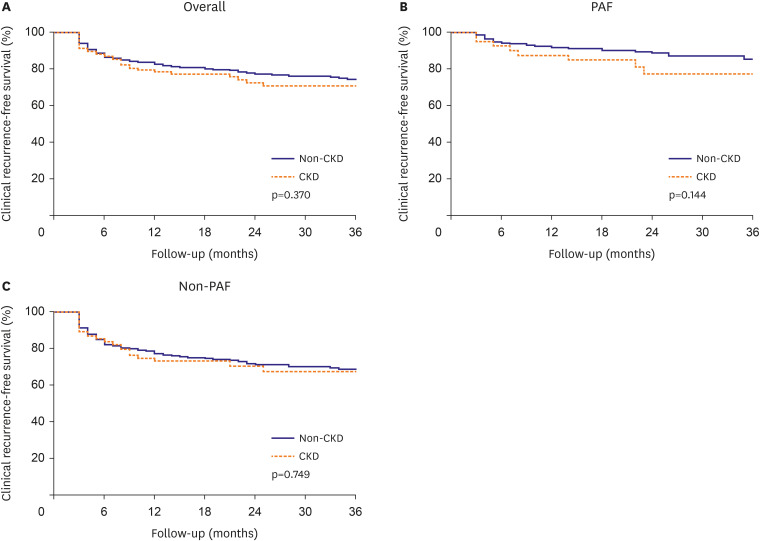
Results: In comparison with patients without CKD (CCr >50, n=722), those with CKD (CCr ≤50, n=117) were older and predominantly female, had a lower body mass index, and showed a higher prevalence of heart failure and hypertension. Mean CHA2DS2-VAS score was significantly higher in CKD group than in non-CKD group. Procedure-related complications were not significantly different between two groups. During a mean follow-up period of 25.4±11.9 months, clinical recurrence occurred in 182 patients (21.7%) and not significantly different between two groups. In multivariate analysis, non-PAF and left atrial size were independent predictors of AF recurrence. CCr levels significantly improved over 12 months after CBA in CKD group.
Conclusions: ICE-guided contrast-agent-free CBA showed comparable long-term clinical outcomes without increasing procedure-related complications and improvement of renal function over 12 months following CBA in AF patients with CKD.
Keywords: Ablation; Atrial fibrillation; Echocardiography; Renal insufficiency.
Copyright © 2024. The Korean Society of Cardiology.
Conflict of interest statement
The authors have no financial conflict of interest.
Figures


References
-
- Kirchhof P, Benussi S, Kotecha D, et al. 2016 ESC Guidelines for the management of atrial fibrillation developed in collaboration with EACTS. Eur Heart J. 2016;37:2893–2962. - PubMed
-
- Boriani G, Savelieva I, Dan GA, et al. Chronic kidney disease in patients with cardiac rhythm disturbances or implantable electrical devices: clinical significance and implications for decision making-a position paper of the European Heart Rhythm Association endorsed by the Heart Rhythm Society and the Asia Pacific Heart Rhythm Society. Europace. 2015;17:1169–1196. - PMC - PubMed
-
- Haïssaguerre M, Jaïs P, Shah DC, et al. Spontaneous initiation of atrial fibrillation by ectopic beats originating in the pulmonary veins. N Engl J Med. 1998;339:659–666. - PubMed
-
- Khan AR, Khan S, Sheikh MA, Khuder S, Grubb B, Moukarbel GV. Catheter ablation and antiarrhythmic drug therapy as first- or second-line therapy in the management of atrial fibrillation: systematic review and meta-analysis. Circ Arrhythm Electrophysiol. 2014;7:853–860. - PubMed
Grants and funding
LinkOut - more resources
Full Text Sources