


Do We Need New Electrocardiographic Criteria for Left Ventricular Hypertrophy? The Case of the Peguero-Lo Presti Criterion. A Narrative Review
- PMID: 38112655
- PMCID: PMC10906064
- DOI: 10.1093/ajh/hpad117
Do We Need New Electrocardiographic Criteria for Left Ventricular Hypertrophy? The Case of the Peguero-Lo Presti Criterion. A Narrative Review
Abstract
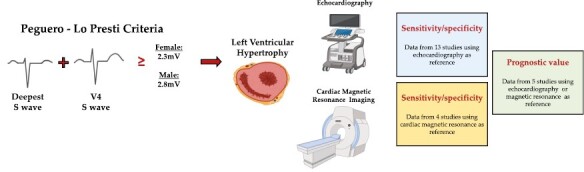
The cardiovascular risk associated with left ventricular hypertrophy (LVH) in the community and, particularly, in the hypertensive fraction of the general population, represents the rationale for its timely and accurate identification in order to implement adequate preventive strategies. Although electrocardiography (ECG) is the first-line and most economical method of diagnosing LVH its accuracy is largely suboptimal. Over the last 70 years, dozens of different ECG criteria, mostly based on measurements of QRS voltages, have been proposed. In this long journey, a few years ago Peguero et al. developed a novel ECG voltage criterion, currently recognized as Peguero-Lo Presti (PLP) suggesting that it has greater sensitivity than traditional ECG-LVH criteria. Considering that in the last 5 years numerous studies have investigated the diagnostic value of this new index, this review aimed to summarize the data published so far on this topic focusing both on the accuracy in identifying the presence of LVH compared with imaging techniques such as echocardiography (ECHO) and magnetic resonance imaging (MRI) and the value in predicting hard outcomes. The evidence in favor of the greater diagnostic accuracy of the PLP criterion in detecting LVH, phenotyped by ECHO or MRI, and in the stratification of hard outcomes compared with traditional ECG criteria does not appear to be sufficiently proven. Given that the diagnosis of LVH by all ECG criteria (including the PLP) exclusively based on the QRS amplitude is largely imprecise, the development of new multiparametric ECG criteria based on artificial intelligence could represent a real improvement in the diagnostic capacity of the ECG.
Keywords: Peguero–Lo Presti; blood pressure; echocardiography; electrocardiography; hypertension; left ventricular hypertrophy.
© The Author(s) 2023. Published by Oxford University Press on behalf of American Journal of Hypertension, Ltd.
Conflict of interest statement
The authors declared no conflict of interest.
References
-
- Vakili BA, Okin PM, Devereux RB.. Prognostic implications of left ventricular hypertrophy. Am Heart J 2001; 141:334–341. - PubMed
-
- Özbek BT, Modin D, Møgelvang R, Jørgensen PG, Jensen M, Schnohr P, Gislason GH, Sørensen TB.. Echocardiographic predictors of long-term adverse cardiovascular outcomes in participants with and without diabetes mellitus: a follow-up analysis of the Copenhagen City Heart Study. Diabet Med 2021; 38:e14627. - PubMed
-
- Bombelli M, Facchetti R, Carugo S, Madotto F, Arenare F, Quarti-Trevano F, Capra A, Giannattasio C, Dell’Oro R, Grassi G, Sega R, Mancia G.. Left ventricular hypertrophy increases cardiovascular risk independently of in-office and out-of-office blood pressure values. J Hypertens 2009; 27:2458–2464. - PubMed
-
- Tadic M, Cuspidi C, Marwick TH.. Phenotyping the hypertensive heart. Eur Heart J 2022; 43:3794–3810. - PubMed
Publication types
MeSH terms
LinkOut - more resources
Full Text Sources
Medical
Research Materials
