


Validation of the brain injury associated visual impairment - impact questionnaire (BIVI-IQ)
- PMID: 38112864
- PMCID: PMC10894123
- DOI: 10.1007/s11136-023-03565-0
Validation of the brain injury associated visual impairment - impact questionnaire (BIVI-IQ)
Abstract
Purpose: The Brain Injury associated Visual Impairment - Impact Questionnaire (BIVI-IQ) was developed to assess the impact of post-stroke visual impairment. The development of the questionnaire used robust methods involving stroke survivors and clinicians. The aim of this study was to assess the validity of the BIVI-IQ in a stroke population.
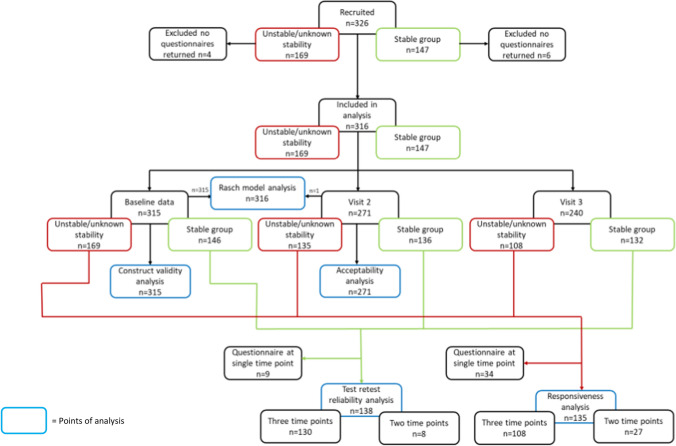
Methods: Stroke survivors with visual impairment were recruited from stroke units, outpatient clinics and non-healthcare settings. Participants were asked to complete questionnaire sets on three separate occasions; the BIVI-IQ at each visit with additional questionnaires at baseline and visit 2. Vision assessment and anchor questions from participants and clinicians were collected. The analysis included assessment of missing data, acceptability, Rasch model analysis, test-retest reliability, construct validity (NEI VFQ-25, EQ-5D-5L) and responsiveness to change.
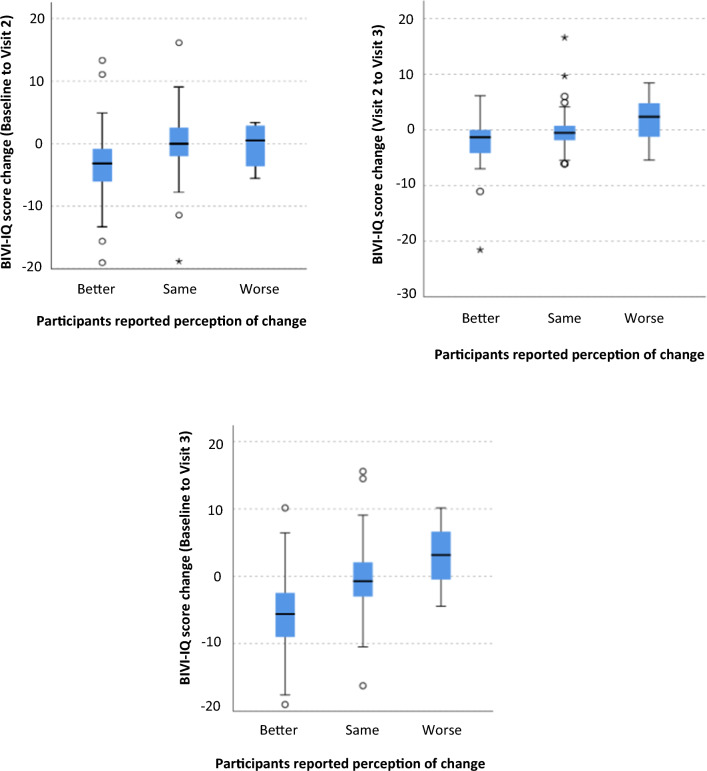
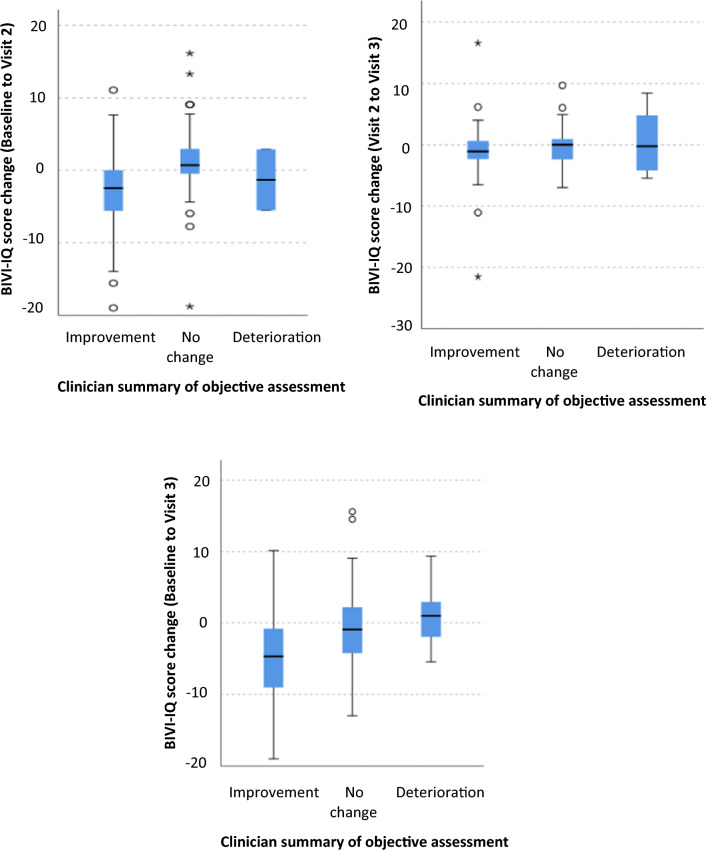
Results: 316 stroke survivors completed at least one questionnaire of the 326 recruited. Mean age was 67 years and 64% were male. Adequate fit statistics to the Rasch model were reached (χ2 = 73.12, p = 0.02) with two items removed and thresholds of two adjusted, indicating validity and unidimensionality. Excellent test-retest reliability was demonstrated (ICC = 0.905) with a 3-month interval. Construct validity was demonstrated with a strong significant correlation to the NEI VFQ-25 (r = 0.837, p < 0.01). The BIVI-IQ also demonstrated responsiveness to change with significant differences identified between groups based on participant and clinician anchor questions (X2 = 23.29, p < 0.001; X2 = 24.56, p < 0.001).
Conclusion: The BIVI-IQ has been shown to be valid and practical for 'everyday' use by clinicians and researchers to monitor vision-related quality of life in stroke survivors with visual impairment.
Keywords: Brain injury; Impact; PROM; Quality of life; Stroke; Visual impairment.
© 2023. The Author(s).
Conflict of interest statement
LH and FR were involved in the development of the BIVI-IQ. LP, JK, BH, CH, EW, ML and ST declare that they have no conflicts of interest.
Figures
References
-
- Headway. (2021). Acquired brain injury: Statisitics based on UK admissions. Retrieved 22 May 2023, from www.headway.org.uk/media/10100/uk-wide-acquired-brain-injury-statistics-...
-
- Rowe FJ, Hepworth LR, Howard C, Hanna KL, Currie J. Impact of visual impairment following stroke (IVIS study): A prospective clinical profile of central and peripheral visual deficits, eye movement abnormalities and visual perceptual deficits. Disability and Rehabilitation. 2020 doi: 10.1080/09638288.2020.1859631. - DOI - PubMed
MeSH terms
Grants and funding
LinkOut - more resources
Full Text Sources
