. 2023 Dec 18;13(1):22623.
doi: 10.1038/s41598-023-49649-2.

Role of the autonomic nervous system in young, middle-aged, and older individuals with essential hypertension and sleep-related changes in neurocardiac regulation

Affiliations

Role of the autonomic nervous system in young, middle-aged, and older individuals with essential hypertension and sleep-related changes in neurocardiac regulation

Chia-Hsin Yeh et al. Sci Rep. .

Abstract

Essential hypertension involves complex cardiovascular regulation. The autonomic nervous system function fluctuates throughout the sleep-wake cycle and changes with advancing age. However, the precise role of the autonomic nervous system in the development of hypertension during aging remains unclear. In this study, we characterized autonomic function during the sleep-wake cycle in different age groups with essential hypertension. This study included 97 men (53 with and 44 without hypertension) aged 30-79 years. They were stratified by age into young (< 40 years), middle-aged (40-59 years), and older (60-79 years) groups. Polysomnography and blood pressure data were recorded for 2 min before and during an hour-long nap. Autonomic function was assessed by measuring heart rate variability and blood pressure variability. Data were analyzed using t tests, correlation analyses, and two-way analysis of variance. During nonrapid eye movement (nREM), a main effect of age was observed on cardiac parasympathetic measures and baroreflex sensitivity (BRS), with the highest and lowest levels noted in the younger and older groups, respectively. The coefficients of the correlations between these measures and age were lower in patients with hypertension than in normotensive controls. The BRS of young patients with hypertension was similar to that of their middle-aged and older counterparts. However, cardiac sympathetic activity was significantly higher (p = 0.023) and BRS was significantly lower (p = 0.022) in the hypertension group than in the control group. During wakefulness, the results were similar although some of the above findings were absent. Autonomic imbalance, particularly impaired baroreflex, plays a more significant role in younger patients with hypertension. The nREM stage may be suitable for gaining insights into the relevant mechanisms.


Conflict of interest statement

The authors declare no competing interests.

Figures

Figure 1
Figure 1
Influence of age and hypertension on HRV parameters in young, middle-aged, and older participants. For each group of samples (CON, HTN), each bar represents the average means of the parameters within the corresponding age range. RR R–R intervals, TP total power, LF low frequency, HF high frequency, LF/HF LF to HF ratio, LF% normalized LF, AW wakefulness, nREM nonrapid eye movement sleep, CON control group, HTN hypertension group. Data are presented as mean ± SEM, two-way ANOVA. *p < 0.05 HTN vs. CON. (A) p < 0.05 main effect of age, vs. 30–39; (B) p < 0.05 main effect of age, vs. 40–59. HTN vs. CON p < 0.05 main effect of HTN.
Figure 2
Figure 2
Two-dimensional scatter plots depicting the correlations between HRV parameters and age. *p < 0.05. rCON correlation coefficient of the control group, rHTN correlation coefficient of the hypertension group, RR R–R intervals, TP total power, LF low frequency, HF high frequency, LF/HF LF to HF ratio, LF% normalized LF, AW wakefulness, nREM nonrapid eye movement sleep.
Figure 3
Figure 3
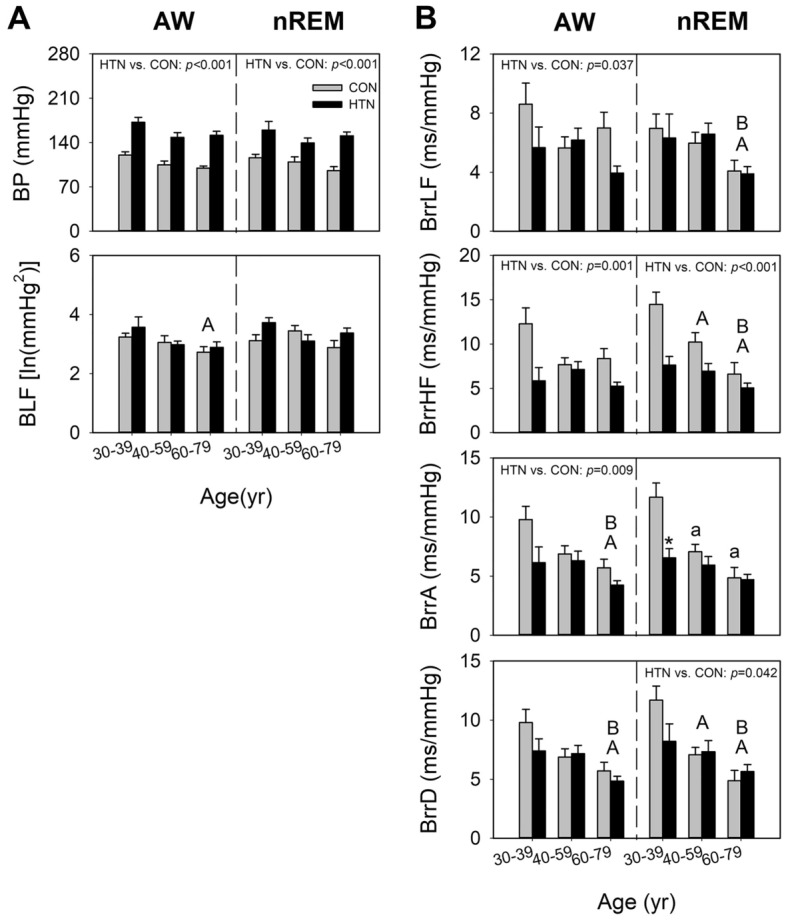
Effects of age and hypertension on arterial pressure variability/BRS parameters in young, middle-aged, and older men. Each bar in the graph represents the average values of the parameters within the respective age range for each group (HTN vs. CON). ln natural logarithm, BP blood pressure, BLF LF of arterial pressure variability, BrrLF/BrrHF magnitude of mean arterial pressure—R–R interval transfer function, BrrA/BrrD slope of mean arterial pressure—R–R interval linear regression, AW wakefulness, nREM nonrapid eye movement sleep, CON control group, HTN hypertension group. Data are presented in terms of the mean ± SEM values. (A) p < 0.05 main effect of age, vs. 30–39; (B) p < 0.05 main effect of age, vs. 40–59. a p < 0.05 vs. 30–39, least-significant difference post hoc test. *p < 0.05 vs. control of the same age group, independent-samples t test.
Figure 4
Figure 4
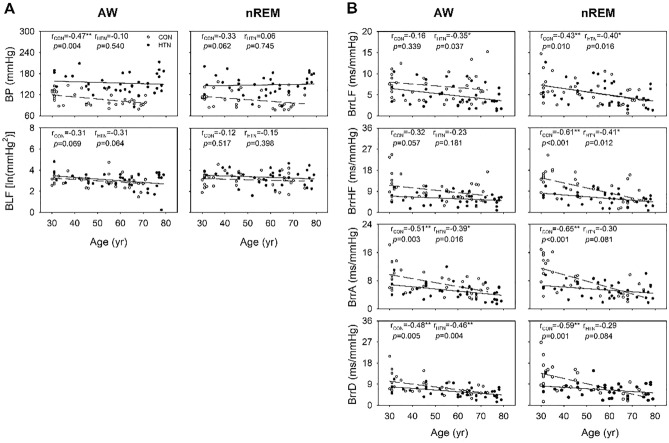
Two-dimensional scatter plots depicting the correlations between arterial pressure variability/BRS parameters and age. *p < 0.05. rCON correlation coefficient of the control group, rHTN correlation coefficient of the hypertension group, ln natural logarithm, BP blood pressure, BLF LF of arterial pressure variability, BrrLF/BrrHF magnitude of mean arterial pressure—R–R interval transfer function, BrrA/BrrD slope of mean arterial pressure—R–R interval linear regression, AW wakefulness, nREM nonrapid eye movement sleep.

References

    1. Raj M. Essential hypertension in adolescents and children: Recent advances in causative mechanisms. Indian J. Endocrinol. Metab. 2011;15(Suppl 4):S367–S373. doi: 10.4103/2230-8210.86981. - DOI - PMC - PubMed
    1. Mancia G, Grassi G. The autonomic nervous system and hypertension. Circ. Res. 2014;114:1804–1814. doi: 10.1161/circresaha.114.302524. - DOI - PubMed
    1. Harrison DG, Coffman TM, Wilcox CS. Pathophysiology of hypertension: The mosaic theory and beyond. Circ. Res. 2021;128:847–863. doi: 10.1161/CIRCRESAHA.121.318082. - DOI - PMC - PubMed
    1. Oparil S. The sympathetic nervous system in clinical and experimental hypertension. Kidney Int. 1986;30:437–452. doi: 10.1038/ki.1986.204. - DOI - PubMed
    1. Zhao M, et al. Vagal nerve modulation: A promising new therapeutic approach for cardiovascular diseases. Clin. Exp. Pharmacol. Physiol. 2012;39:701–705. doi: 10.1111/j.1440-1681.2011.05644.x. - DOI - PubMed