. 2023 Dec 20;15(1):196.
doi: 10.1186/s13148-023-01598-3.

A comprehensive characterisation of phaeochromocytoma and paraganglioma tumours through histone protein profiling, DNA methylation and transcriptomic analysis genome wide

Affiliations

A comprehensive characterisation of phaeochromocytoma and paraganglioma tumours through histone protein profiling, DNA methylation and transcriptomic analysis genome wide

Prodromos Chatzikyriakou et al. Clin Epigenetics. .

Abstract

Background: Phaeochromocytomas and paragangliomas (PPGLs) are rare neuroendocrine tumours. Pathogenic variants have been identified in more than 15 susceptibility genes; associated tumours are grouped into three Clusters, reinforced by their transcriptional profiles. Cluster 1A PPGLs have pathogenic variants affecting enzymes of the tricarboxylic acid cycle, including succinate dehydrogenase. Within inherited PPGLs, these are the most common. PPGL tumours are known to undergo epigenetic reprograming, and here, we report on global histone post-translational modifications and DNA methylation levels, alongside clinical phenotypes.

Results: Out of the 25 histone post-translational modifications examined, Cluster 1A PPGLs were distinguished from other tumours by a decrease in hyper-acetylated peptides and an increase in H3K4me2. DNA methylation was compared between tumours from individuals who developed metastatic disease versus those that did not. The majority of differentially methylated sites identified tended to be completely methylated or unmethylated in non-metastatic tumours, with low inter-sample variance. Metastatic tumours by contrast consistently had an intermediate DNA methylation state, including the ephrin receptor EPHA4 and its ligand EFNA3. Gene expression analyses performed to identify genes involved in metastatic tumour behaviour pin-pointed a number of genes previously described as mis-regulated in Cluster 1A tumours, as well as highlighting the tumour suppressor RGS22 and the pituitary tumour-transforming gene PTTG1.

Conclusions: Combined transcriptomic and DNA methylation analyses revealed aberrant pathways, including ones that could be implicated in metastatic phenotypes and, for the first time, we report a decrease in hyper-acetylated histone marks in Cluster 1 PPGLs.

Keywords: Cancer predisposition; DNA methylation; Epigenetics; Germline pathogenic variant; Histone post-translational modifications; Mass spectrometry; Paraganglioma; Phaeochromocytoma; SDH; Succinate dehydrogenase.


Conflict of interest statement

The authors declare no competing interests.

Figures
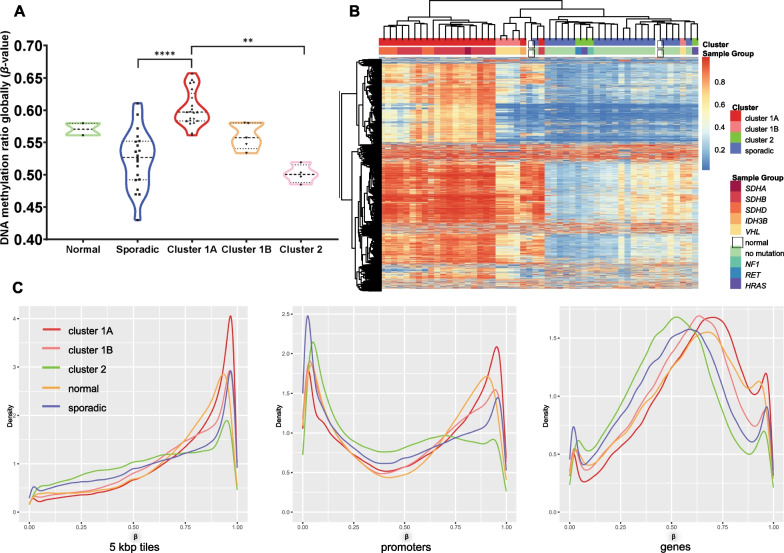
Fig. 1
Fig. 1
A Average DNA methylation levels from all the probes of the 850 K array: Cluster 1A tumours are significantly more methylated than sporadic (p < 0.0001, Kruskal–Wallis test) and Cluster 2 (p = 0.0014) tumours. In Cluster 1A, SDHB samples are shown as triangle and all the other samples with a star symbol. B Unsupervised hierarchical clustering of all samples based on the DNA methylation levels of the 5000 most variable probes. Three distinct groups are observed, largely coinciding with the clusters described in the literature previously. The SDHx tumours form a separate cluster with the VHL tumour, while sporadic and Cluster 2 tumours form one uniform group. C Comparison of β-value densities across samples from each group. Cluster 1A tumours have a higher peak on more methylated regions when the genome is divided in 5 Kbp-tiles agnostic of content and in both promoter and gene bodies
Fig. 2
Fig. 2
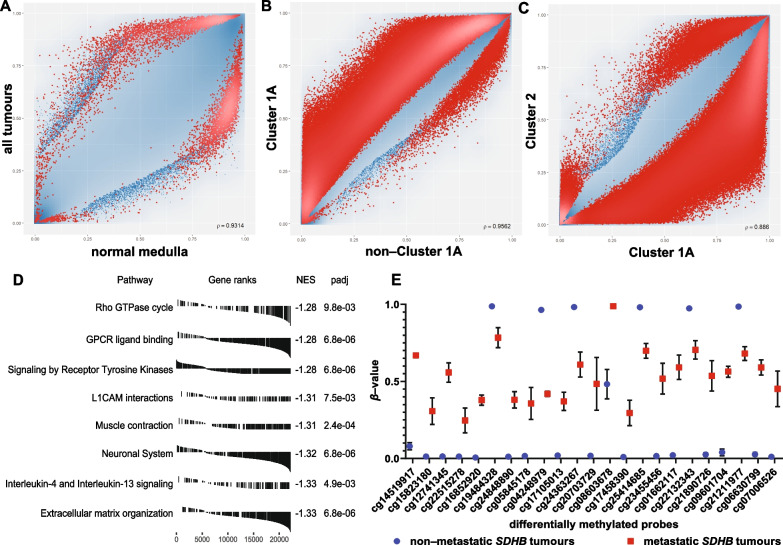
A–C Scatterplots for differentially methylated sites genome wide. Each point represents a probe of the 850 K array, and significantly differentially methylated probes (FDR < 0.05) are marked with red. Cluster 1A has the highest number of differentially methylated sites when compared to all other tumour samples (non-Cluster 1A) (B) or when compared only to Cluster 2 (C). D Top 10 gene set enrichment analysis (GSEA) results on differentially methylated promoters in Cluster 1A tumours after collapsing the redundant pathways with their corresponding gene-rank plots. Receptor tyrosine kinase and MAPK signalling pathways and the extracellular matrix are amongst the most affected. NES: normalised enrichment score. F: β-values of differentially methylated probes between metastatic and non-metastatic SDHB tumours. In the case of non-metastatic tumours, DMPs are in a binary state, mostly completely unmethylated with some completely methylated. In contrast, these loci in metastatic tumours have intermediate methylation levels. Mean ± standard deviation error bars
Fig. 3
Fig. 3
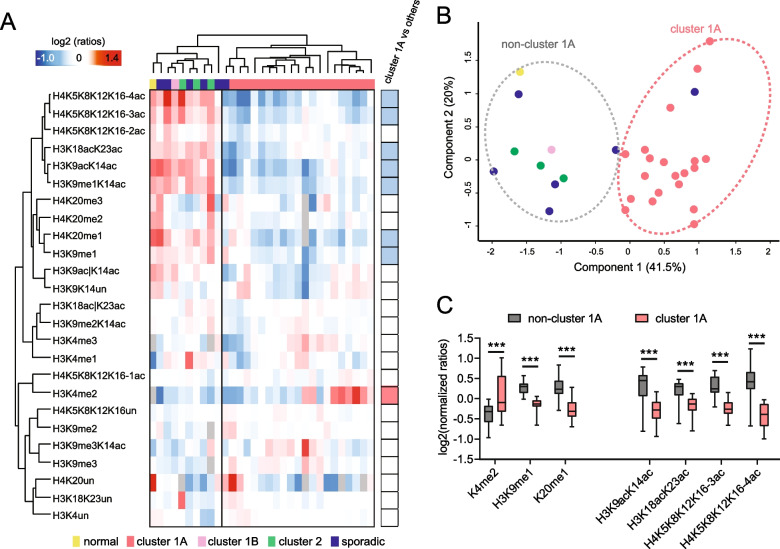
A Heatmap display of histone PTM levels in PPGL patient tissues. L/H (light/heavy) relative abundances ratios were obtained using a spike-in strategy (light channel: sample, heavy channel: spike-in standard) and were normalised over the average ratios across samples. The grey colour indicates peptides that were not quantified. Right panel: Modified peptides were compared in samples belonging to Cluster 1A or other tumour classes by multiple t test. The red colour indicates a significant increase (FDR < 0.05) in Cluster 1A, and the blue colour indicates a significant decrease. B PCA analysis based on quantitative histone PTM data obtained from the samples shown in A. C Boxplot display of the data shown in A, for selected PTMs. *** FDR < 0.001 by multiple unpaired t test
Fig. 4
Fig. 4
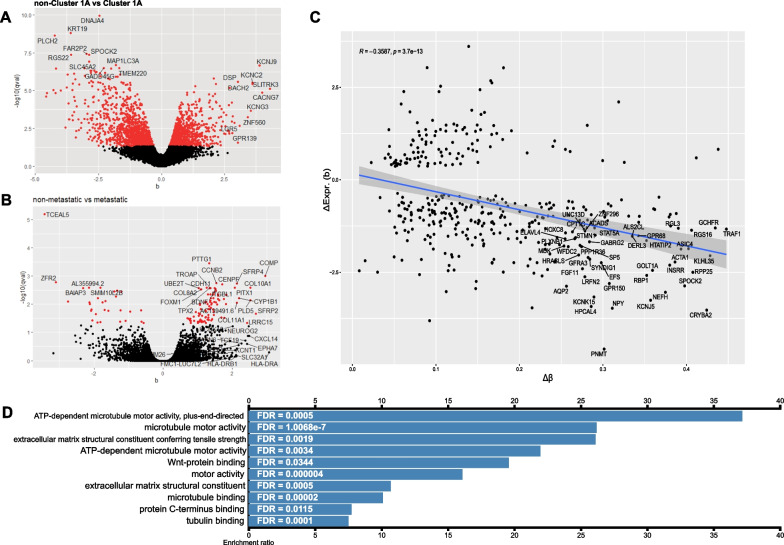
A–B Volcano plots showing the effect size (b) of differential gene expression and its statistical significance for the comparisons Cluster 1A versus non-Cluster 1A and metastatic versus non-metastatic tumours from the RNA-seq data. C Correlation plot of differentially methylated promoters and differentially expressed genes in metastatic tumours shows an inverse relationship between the more differentially methylated (higher Δβ) and the level of downregulation. Pearson’s correlation coefficient ρ = −0.3587, p = 3.7 × 10–13. D Over-representation analysis of upregulated differentially expressed genes between metastatic and non-metastatic tumours for molecular function ontology revealed enriched terms were mainly related to motor proteins, the Wnt-pathway and the extracellular matrix

References

    1. Fishbein L, Leshchiner I, Walter V, Danilova L, Robertson AG, Johnson AR, Lichtenberg TM, Murray BA, Ghayee HK, Else T, et al. Comprehensive molecular characterization of pheochromocytoma and paraganglioma. Cancer Cell. 2017;31:181–193. doi: 10.1016/j.ccell.2017.01.001. - DOI - PMC - PubMed
    1. Corssmit EPM, Snel M, Kapiteijn E. Malignant pheochromocytoma and paraganglioma: management options. Curr Opinion Oncol. 2019. - PubMed
    1. Ilanchezhian M, Jha A, Pacak K, Del Rivero J. Metastatic Pheochromocytoma and Paraganglioma. In: Current treatment options in oncology. vol. 21: Springer; 2020: 85. - PMC - PubMed
    1. Mukherjee JJ, Kaltsas GA, Islam N, Plowman PN, Foley R, Hikmat J, Britton KE, Jenkins PJ, Chew SL, Monson JP, et al. Treatment of metastatic carcinoid tumours, phaeochromocytoma, paraganglioma and medullary carcinoma of the thyroid with (131)I-meta-iodobenzylguanidine [(131)I-mIBG]. In: Clinical endocrinology. vol. 55: Clin Endocrinol (Oxf); 2001: 47–60. - PubMed
    1. Huang H, Abraham J, Hung E, Averbuch S, Merino M, Steinberg SM, Pacak K, Fojo T: Treatment of malignant pheochromocytoma/paraganglioma with cyclophosphamide, vincristine, and dacarbazine: recommendation from a 22-year follow-up of 18 patients. In: Cancer. vol. 113: Cancer; 2008; 2020–2028. - PMC - PubMed

Publication types