Financial Toxicity and Quality of Life in Patients Undergoing Stem-Cell Transplant Evaluation: A Single-Center Analysis
- PMID: 38127876
- PMCID: PMC11927761
- DOI: 10.1200/OP.23.00243
Financial Toxicity and Quality of Life in Patients Undergoing Stem-Cell Transplant Evaluation: A Single-Center Analysis
Abstract
Purpose: We investigated the prevalence of financial toxicity in a population undergoing hematopoietic cell transplantation (HCT) evaluation and measured its impact on post-transplant clinical and health-related quality-of-life outcomes.
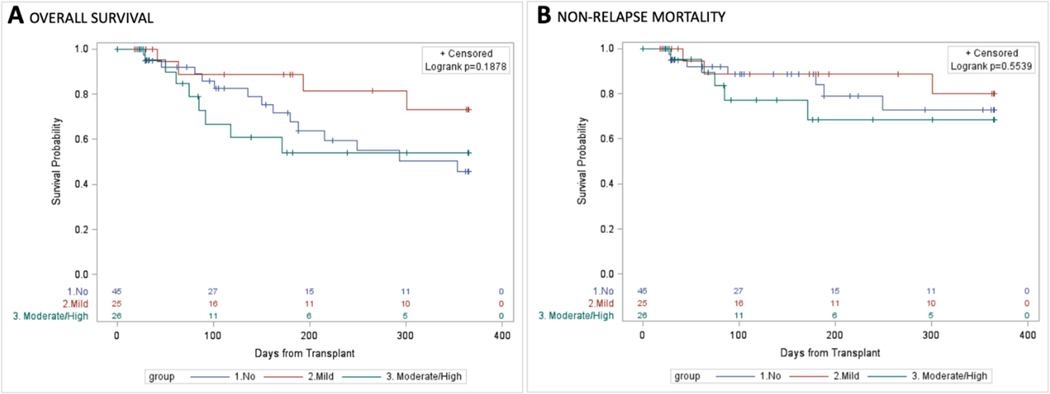
Materials and methods: This was a prospective study in patients undergoing evaluation for allogeneic HCT between January 1, 2018, and September 23, 2020, at a large academic medical center. Financial health was measured via a baseline survey and the comprehensive score for financial toxicity-functional assessment of chronic illness therapy (COST-FACIT) survey. The cohort was divided into three groups: none (grade 0), mild (grade 1), and moderate-high financial toxicity (grades 2-3). Health-related quality of life outcomes were measured at multiple time points. Multivariate logistic regression analysis evaluated factors associated with financial toxicity. Kaplan-Meier curves and log-rank tests was used to evaluate overall survival (OS) and nonrelapse survival.
Results: Of 245 patients evaluated for transplant, 176 (71.8%) completed both questionnaires (median age was 57 years, 63.1% were male, 72.2% were White, and 39.2% had myelodysplastic syndrome, 38.1% leukemia, and 13.6% lymphoma). At initial evaluation, 83 (47.2%) patients reported no financial toxicity, 51 (29.0%) with mild, and 42 (23.9%) with moderate-high financial toxicity. Patients with financial toxicity reported significant cost-cutting behaviors, including reduced spending on food or clothing, using their savings, or not filling a prescription because of costs (P < .0001). Quality of life was lower in patients with moderate-high financial toxicity at 6 months (P = .0007) and 1 year (P = .0075) after transplant. Older age (>62; odds ratio [OR], 0.33 [95% CI, 0.13 to 0.79]; P = .04) and income ≥$60,000 in US dollars (USD) (OR, 0.17 [95% CI, 0.08 to 0.38]; P < .0001) were associated with lower odds of financial toxicity. No association was noted between financial toxicity and selection for transplant, OS, or nonrelapse mortality.
Conclusion: Financial toxicity was highly correlated with patient-reported changes in compensatory behavior, with notable impact on patient quality of life after transplant.
Figures

References
-
- Dusetzina SB, Winn AN, Abel GA, Huskamp HA, Keating NL. Cost sharing and adherence to tyrosine kinase inhibitors for patients with chronic myeloid leukemia. J Clin Oncol. 2014;32(4):306–311. - PubMed
Publication types
MeSH terms
Grants and funding
LinkOut - more resources
Full Text Sources
Medical