Clinical Trial
. 2024 Jan:99:104922.
doi: 10.1016/j.ebiom.2023.104922. Epub 2023 Dec 20.

Safety and immunogenicity of a synthetic nanoparticle-based, T cell priming peptide vaccine against dengue in healthy adults in Switzerland: a double-blind, randomized, vehicle-controlled, phase 1 study

Affiliations
Clinical Trial

Safety and immunogenicity of a synthetic nanoparticle-based, T cell priming peptide vaccine against dengue in healthy adults in Switzerland: a double-blind, randomized, vehicle-controlled, phase 1 study

Alix Miauton et al. EBioMedicine. 2024 Jan.

Abstract

Background: Vaccines that minimize the risk of vaccine-induced antibody-dependent enhancement and severe dengue are needed to address the global health threat posed by dengue. This study assessed the safety and immunogenicity of a gold nanoparticle (GNP)-based, multi-valent, synthetic peptide dengue vaccine candidate (PepGNP-Dengue), designed to provide protective CD8+ T cell immunity, without inducing antibodies.

Methods: In this randomized, double-blind, vehicle-controlled, phase 1 trial (NCT04935801), healthy naïve individuals aged 18-45 years recruited at the Centre for primary care and public health, Lausanne, Switzerland, were randomly assigned to receive PepGNP-Dengue or comparator (GNP without peptides [vehicle-GNP]). Randomization was stratified into four groups (low dose [LD] and high dose [HD]), allocation was double-blind from participants and investigators. Two doses were administered by intradermal microneedle injection 21 days apart. Primary outcome was safety, secondary outcome immunogenicity. Analysis was by intention-to-treat for safety, intention-to-treat and per protocol for immunogenicity.

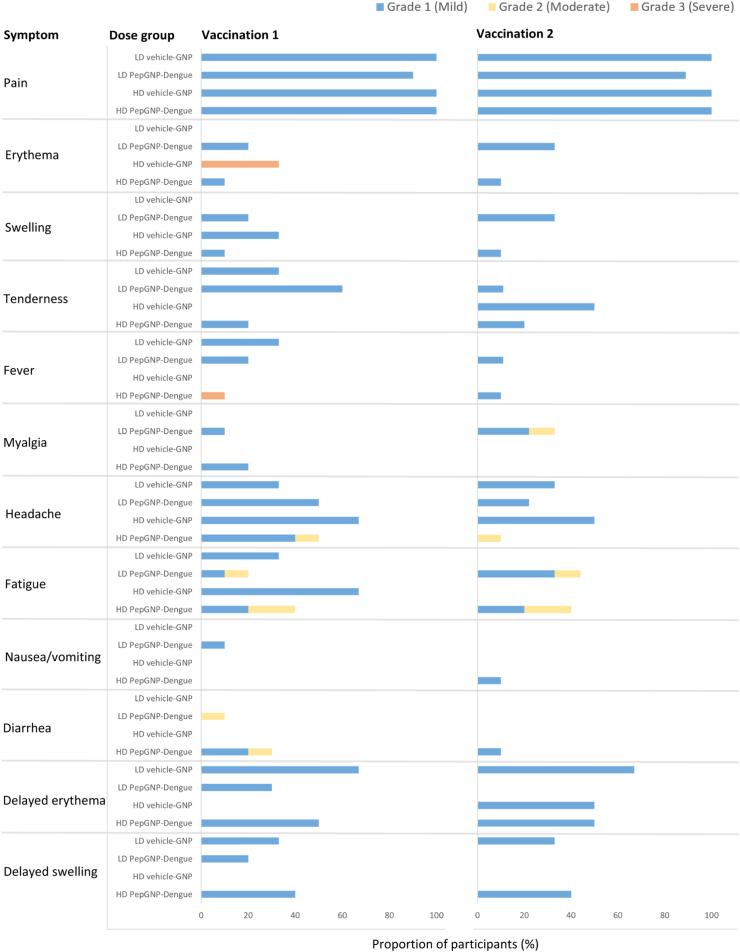
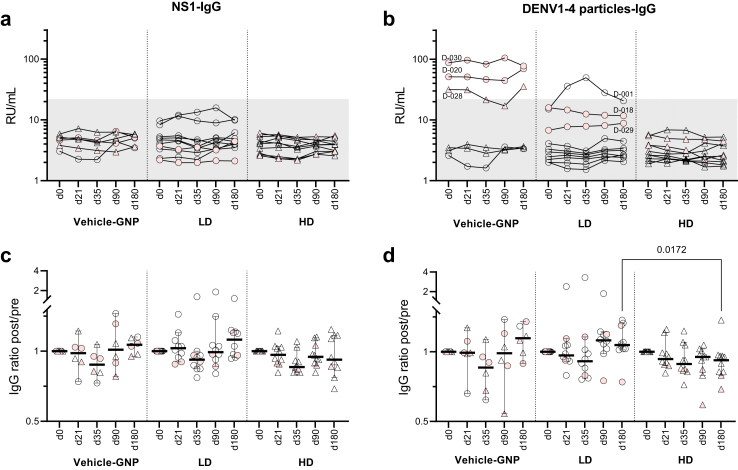
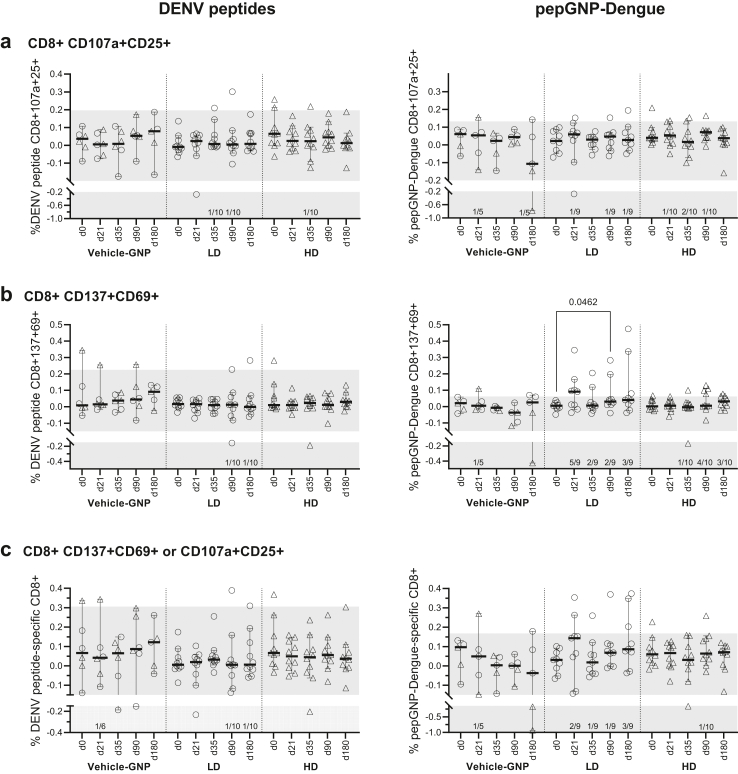
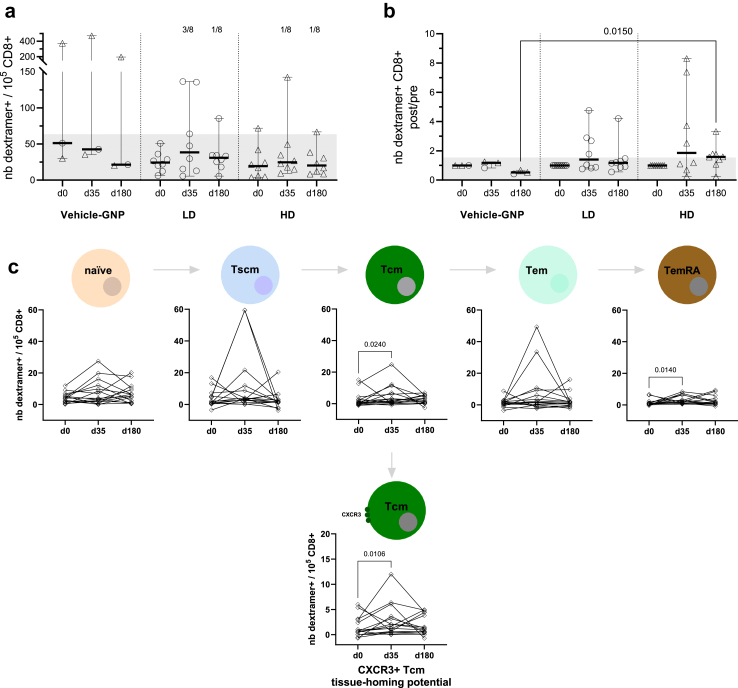
Findings: 26 participants were enrolled (August-September 2021) to receive PepGNP-Dengue (LD or HD, n = 10 each) or vehicle-GNP (LD or HD, n = 3 each). No vaccine-related serious adverse events occurred. Most (90%) related adverse events were mild; injection site pain and transient discoloration were most frequently reported. Injection site erythema occurred in 58% of participants. As expected, PepGNP-Dengue did not elicit anti-DENV antibodies of significance. Significant increases were observed in specific CD8+ T cells and dengue dextramer+ memory cell subsets in the LD PepGNP-Dengue but not in the HD PepGNP-Dengue or vehicle-GNP groups, specifically PepGNP-activated CD137+CD69+CD8+ T cells (day 90, +0.0318%, 95% CI: 0.0088-0.1723, p = 0.046), differentiated effector memory (TemRA) and central memory (Tcm) CD8+ T cells (day 35, +0.8/105 CD8+, 95% CI: 0.19-5.13, p = 0.014 and +1.34/105 CD8+, 95% CI: 0.1-7.34, p = 0.024, respectively).

Interpretation: Results provide proof of concept that a synthetic nanoparticle-based peptide vaccine can successfully induce virus-specific CD8+ T cells. The favourable safety profile and cellular responses observed support further development of PepGNP-Dengue.

Funding: Emergex Vaccines Holding Limited.

Keywords: Dengue vaccine; Dengue virus; Nanoparticle-based vaccine; T cell immunity.


Conflict of interest statement

Declaration of interests All authors and the PV CRO Qvigilance declare no competing interests.

Figures
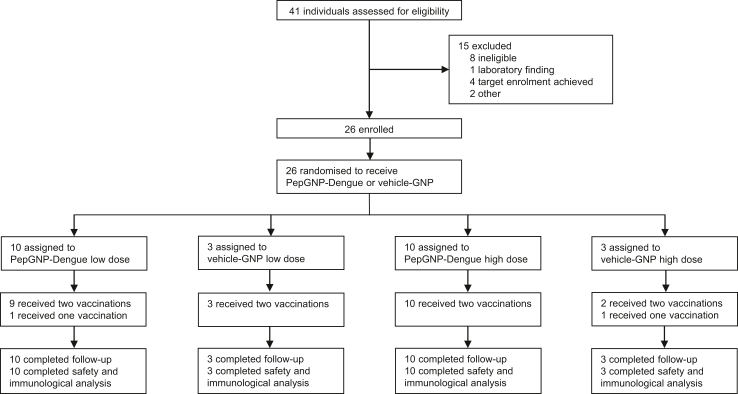
Fig. 1
Fig. 1
naNO-DENGUE trial profile. Participants were enrolled according to a dose-escalation protocol and randomly assigned within each dose group to receive two doses of PepGNP-Dengue (gold nanoparticles and dengue peptides) or vehicle-GNP (gold nanoparticles only). Two participants did not receive the second vaccination: one because of consent withdrawal (PepGNP-Dengue low dose group) and one because of grade 3 erythema at the injection site (vehicle-GNP high dose group). All participants completed 180 days of follow-up. GNP = gold nanoparticles.
Fig. 2
Fig. 2
Local and systemic solicited reactogenicity∗ and delayed erythema and swelling. n = 3 in the LD and HD vehicle-GNP groups, except for the second vaccination of the HD vehicle-GNP group in which n = 2 (one participant not vaccinated due to grade 3 local erythema after first injection). n = 10 in the LD and HD PepGNP-Dengue groups, except for the second vaccination of the LD PepGNP-Dengue group in which n = 9 (one participant not vaccinated for personal reasons). ∗Solicited local and systemic reactogenicity: signs/symptoms occurring within 7- and 14-days post-vaccination, respectively. GNP = gold nanoparticles; LD = low dose; HD = high dose.
Fig. 3
Fig. 3
Anti-DENV1-4 IgG response∗ to PepGNP-Dengue vaccination. Kinetics of anti-NS1 (a and c) and anti-DENV1-4 particles (b and d) IgG levels are shown in groups vehicle-GNP (n = 6), LD PepGNP-Dengue (n = 10) and HD PepGNP-Dengue (n = 10). In (a and b), antibody titres (RU/ml) above the grey zone are positive (>22 RU/ml). In (c and d), fold change from baseline; bars indicate medians and 95% confidence intervals. Intra-group comparisons with day 0 used non-parametric Friedman tests; inter-group comparisons used non-parametric Kruskal–Wallis tests at each timepoint. p values <0.05 are indicated. Pink symbols indicate participants with TBE positive response. ∗Measured by enzyme-linked immunosorbent assay. LD = low dose (○); HD = high dose (▵); GNP = gold nanoparticles; TBE = tick-borne encephalitis.
Fig. 4
Fig. 4
Dengue-specific CD8+ responses by AIM. Kinetics of CD8+ responses were evaluated by AIM assay in groups vehicle-GNP (n = 6), LD PepGNP-Dengue (n = 10), and HD PepGNP-Dengue (n = 10). Percentage of antigen-specific CD8+ over total CD8+, stimulated minus unstimulated specific CD8+, defined as expressing activation co-markers CD107a+CD25+ (a), CD137+CD69+ (b) or at least one co-marker (c) upon stimulation with DENV peptides (left panels) or PepGNP-Dengue (right panels). Intra-group comparison with day 0 used Friedman tests, and inter-group comparison used Kruskal–Wallis tests. p values <0.05 are indicated. Bars indicate medians and 95% confidence intervals. Number of responders indicated above the x-axis were defined as a volunteer with a positive delta (post- minus pre-vaccination) response and frequency of dengue-specific CD8+ T cell above the mean +2 SD of the AIM+CD8+ T cell response in all volunteers at day 0 (grey zone). LD = low dose (○); HD = high dose (▵); GNP = gold nanoparticles; AIM = activation-induced markers; SD = standard deviation.
Fig. 5
Fig. 5
Dengue dextramer+ CD8+ T cells. CD8+ responses were evaluated using eight dengue dextramers HLA-A∗02, B∗07, and A∗03 in groups vehicle-GNP (n = 3), LD PepGNP-Dengue (n = 8), and HD PepGNP-Dengue (n = 8) at day 0, 35 and 180. (a) Number of dengue dextramer+ CD8+ T cells over 105 total CD8+ T cells, as the sum of dengue dextramer responses for each participant. Responses to one to seven dengue dextramers per participant were assessed according to their HLA expression and summed. Number of responders are indicated at the top of the panel. (b) Change from baseline as the ratio of post-/pre-vaccination response. (c) Memory phenotype of D-dextramer+CD8+ in vaccinees (LD and HD, n = 16, ◊). Subsets defined as naïve (CD45RA+CCR7+CD95−), Tscm (CD45RA+CCR7+CD95+), Tcm (CD45RA−CCR7+), Tem (CD45RA−CCR7−) and TemRA (CD45RA+CCR7−). Additionally, the functionality of dextramer+ CD8+ T cells was assessed by the expression of CXCR3. Intra-group comparisons with day 0 using Friedman tests and inter-group comparisons used Kruskal–Wallis tests followed with Dunn’s post tests. p values <0.05 are indicated. Bars indicate medians and 95% confidence intervals. Grey zones indicate cut-off responses (63.4 dextramer+CD8+/105 CD8+ T cells and a ratio of 1.54). LD = low dose (○); HD = high dose (▵); GNP = gold nanoparticles.

References

    1. Bhatt S., Gething P.W., Brady O.J., et al. The global distribution and burden of dengue. Nature. 2013;496(7446):504–507. - PMC - PubMed
    1. World Health Organization . 2017. Fact sheets: dengue and severe dengue.https://apps.who.int/mediacentre/factsheets/fs117/en/index.html Available from:
    1. Ryan S.J., Carlson C.J., Mordecai E.A., Johnson L.R. Global expansion and redistribution of Aedes-borne virus transmission risk with climate change. PLoS Negl Trop Dis. 2019;13(3) - PMC - PubMed
    1. Zeng Z., Zhan J., Chen L., Chen H., Cheng S. Global, regional, and national dengue burden from 1990 to 2017: a systematic analysis based on the global burden of disease study 2017. EClinicalMedicine. 2021;32 - PMC - PubMed
    1. World Health Organization . 2019. Ten threats to Global Health in 2019.https://www.who.int/news-room/spotlight/ten-threats-to-global-health-in-... Available from:

Publication types