


Modeling Contraception and Pregnancy in Malawi: A Thanzi La Onse Mathematical Modeling Study
- PMID: 38129327
- PMCID: PMC10941698
- DOI: 10.1111/sifp.12255
Modeling Contraception and Pregnancy in Malawi: A Thanzi La Onse Mathematical Modeling Study
Abstract
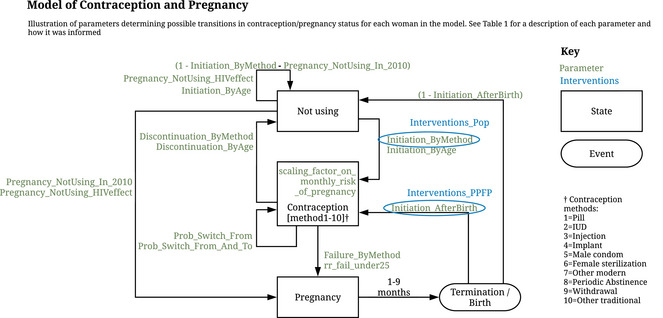
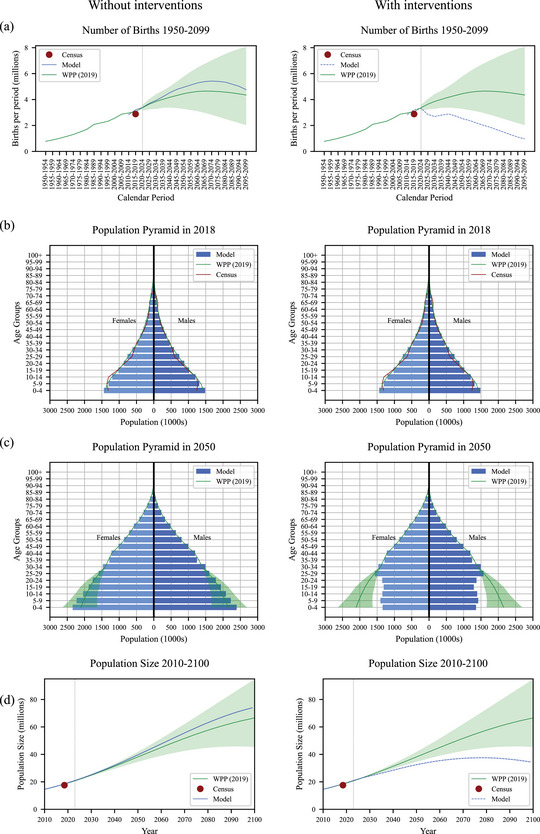
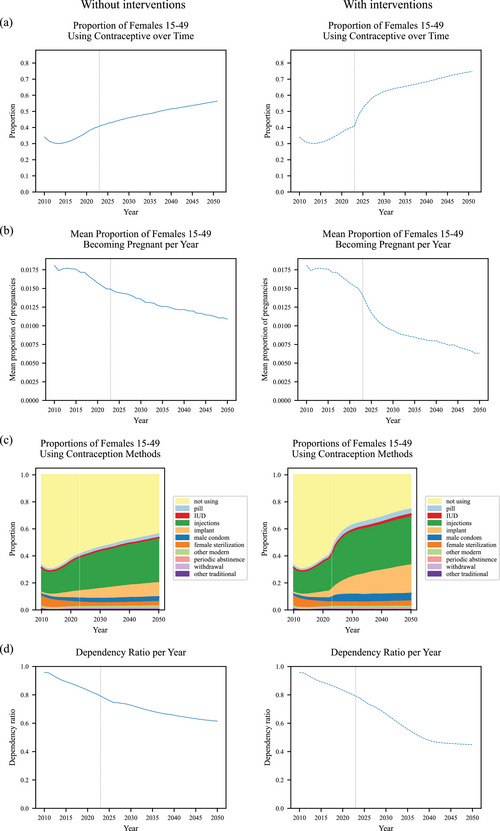
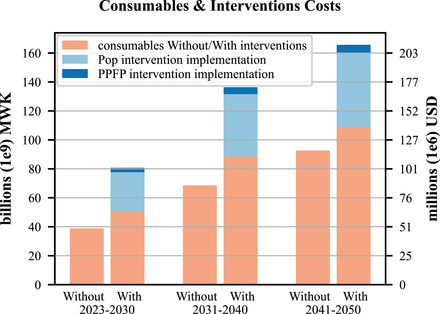
Malawi has high unmet need for contraception with a costed national plan to increase contraception use. Estimating how such investments might impact future population size in Malawi can help policymakers understand effects and value of policies to increase contraception uptake. We developed a new model of contraception and pregnancy using individual-level data capturing complexities of contraception initiation, switching, discontinuation, and failure by contraception method, accounting for differences by individual characteristics. We modeled contraception scale-up via a population campaign to increase initiation of contraception (Pop) and a postpartum family planning intervention (PPFP). We calibrated the model without new interventions to the UN World Population Prospects 2019 medium variant projection of births for Malawi. Without interventions Malawi's population passes 60 million in 2084; with Pop and PPFP interventions. it peaks below 35 million by 2100. We compare contraception coverage and costs, by method, with and without interventions, from 2023 to 2050. We estimate investments in contraception scale-up correspond to only 0.9 percent of total health expenditure per capita though could result in dramatic reductions of current pressures of very rapid population growth on health services, schools, land, and society, helping Malawi achieve national and global health and development goals.
© 2023 The Authors. Studies in Family Planning published by Wiley Periodicals LLC on behalf of Population Council.
Figures
References
-
- Askew, Ian , Weinberger Michelle, Dasgupta Aisha, Darroch Jacqueline, Smith Ellen, Stover John, and Yahner Melanie. 2017. “Harmonizing Methods for Estimating the Impact of Contraceptive Use on Unintended Pregnancy, Abortion, and Maternal Health.” Global Health: Science and Practice 5(4): 658–667. 10.9745/GHSP-D-17-00121 - DOI - PMC - PubMed
-
- Brunborg, Helge. 1983. “An Economic Model of Fertility, Sex and Contraception.” Ph.D. thesis, University of Michigan.
-
- Cardona, Carolina , Rusatira Jean Christophe, Cheng Xiaomeng, Silberg Claire, Salas Ian, Li Qingfeng, Bishai David, and Rimon Jose G.. 2020. “Generating and Capitalizing on the Demographic Dividend Potential in Sub‐Saharan Africa: A Conceptual Framework from a Systematic Literature Review.” Gates Open Research 4: 145. 10.12688/gatesopenres.13176.1 - DOI - PMC - PubMed
MeSH terms
Grants and funding
LinkOut - more resources
Full Text Sources
Medical
