. 2023 Dec 20;13(1):22818.
doi: 10.1038/s41598-023-50001-x.

Reduced period from follicular wave emergence to luteolysis generated greater steroidogenic follicles and estrus intensity in dairy cows

Affiliations

Reduced period from follicular wave emergence to luteolysis generated greater steroidogenic follicles and estrus intensity in dairy cows

T Minela et al. Sci Rep. .

Abstract

The onset of productive life in dairy cattle, concomitant to parturition, is accompanied by a substantial decrease in fertility in comparison with non-lactating, nulliparous heifers. Follicular growth patterns differ between parous and nulliparous dairy cattle. Nulliparous heifers ovulate follicles with reduced antral age (RAA). This study aimed to exogenously reduce ovulatory follicle age in lactating dairy cows from 7 to 5 days old. Cows (n = 80) had their estrous cycles synchronized with the Double-Ovsynch program. At the final portion of this program, luteolysis was induced at either 5 (RAA) or 7 (Control) days following follicular wave emergence. RAA outcomes were estimated in comparison with Controls. RAA resulted in smaller follicles 2 days post-treatment. Despite lower serum concentrations of 17β-estradiol before treatment compared with Controls, the rate of increase in this hormone was greater for the RAA treatment. There was no difference in luteolysis rates between treatments. Proestrus (luteolysis onset to estrus onset) was prolonged in RAA cows. Cows with RAA had more intense estruses. Collectively, these results indicate that decreasing the age of the ovulatory follicle may improve the steroidogenic capacity of the dominant follicle and estrus expression intensity in lactating dairy cows.


Conflict of interest statement

The authors declare no competing interests.

Figures
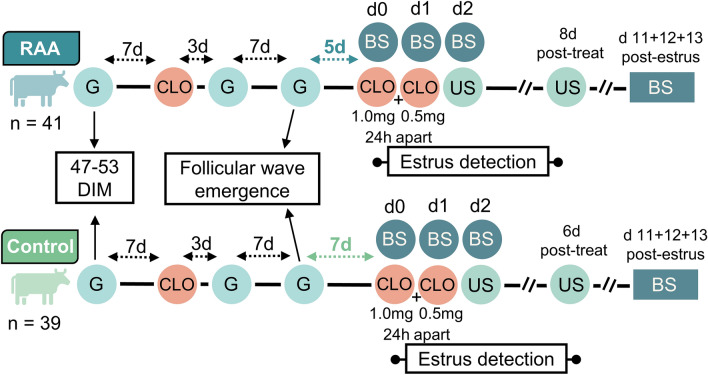
Figure 1
Figure 1
Experimental design to determine the effects of shorter (RAA) vs longer (Controls) development periods of ovulatory follicles utilizing the fertility program Double-Ovsynch in lactating Holstein cows that were detected, or not, in estrus. Double-Ovsynch was initiated between 47–53 days in milk (DIM) for both treatments (treat). Gonadotropin-releasing hormone (G) was utilized to induce follicular wave emergence in both treatments. Estrus detection was performed with automated activity monitors following cloprostenol sodium (CLO) first administered on day 0. Blood samples (BS) were collected on day (d) 0, 1, 2, from CLO, and at day 11, 12 and 13 after a detected estrus. Ultrasound (US) was utilized to measure follicular diameter at day 2 post-induction of luteolysis and to confirm ovulation on days 6 or 8 post-induction of luteolysis.
Figure 2
Figure 2
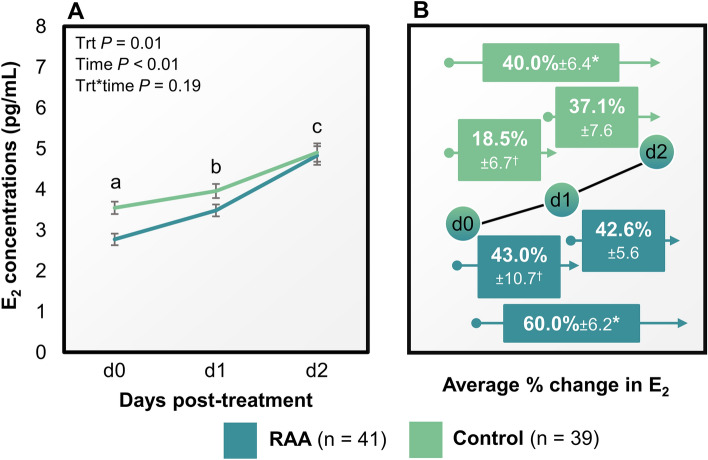
Effect of treatment on 17β-estradiol (E2) concentrations (pg/mL) in lactating Holstein cows following cloprostenol sodium at day (d) 5 (reduced antral age; RAA) or 7 (Control) of follicular development (A). Illustration of the percentage change in E2 concentrations between days 0 and 1, 1 and 2, and days 0 and 2 in lactating Holstein cows following cloprostenol sodium at day 5 or 7 of follicular development (B). The letter superscript describes the comparison between treatments within day post-induction of luteolysis. The letters “a” and “b” denote a P ≤ 0.01, and “c” denotes a P = 0.15. *Indicates a greater % increase in E2 concentrations between day 0 and 2 in RAA compared with Controls (P = 0.03). Indicates a tendency for greater % increase in E2 concentrations between day 0 and 1 in RAA in comparison with Controls (P = 0.08). The % increase in E2 concentrations between day 1 and 2 was not different between treatments (P = 0.53). Data are shown as means ± SEM.
Figure 3
Figure 3
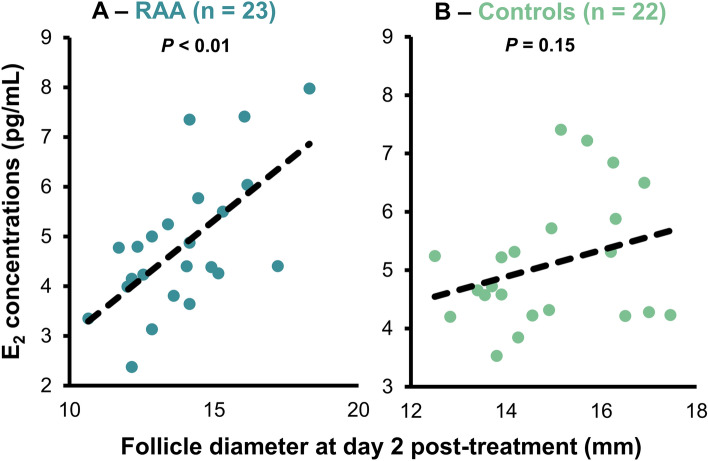
Linear relationship within treatment between 17β-estradiol (E2) concentrations (pg/mL) and follicle diameter (mm) in lactating Holstein cows 2 days post-induction of luteolysis with cloprostenol sodium at (A) day 5 (reduced antral age; RAA) or (B) day 7 (Control) of follicular development. Linear regression was estimated only in cows with single ovulations to isolate the relationship between the dominant follicle diameter and its E2 output.
Figure 4
Figure 4
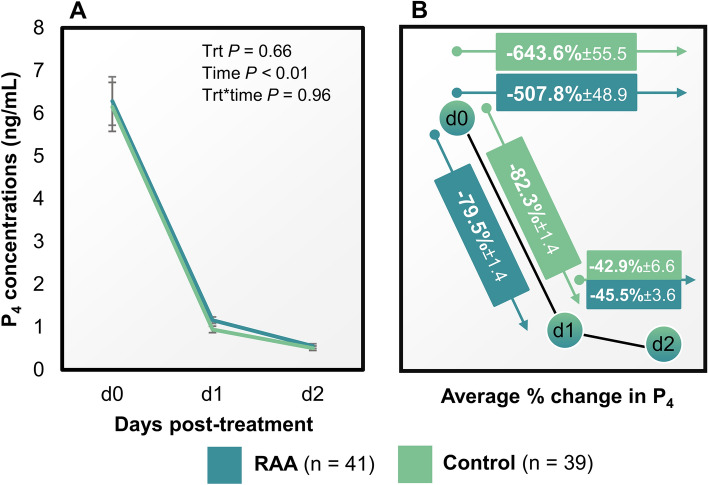
Effect of reducing the time from follicular wave onset to cloprostenol sodium (CLO) in lactating Holstein cows on progesterone (P4) concentrations (ng/mL) 0, 1 and 2 days (d) following induction of luteolysis with CLO (A). Illustration of the effect of treatment on percentage change in P4 concentrations between days 0 and 1, 1 and 2, and days 0 and 2 in lactating Holstein cows following CLO at day 5 (reduced antral age; RAA) or 7 (Control) of follicular development (B). No differences were observed in the % decrease in P4 concentrations between day 0 and 1, day 1 and 2, and day 0 and 2 (P ≥ 0.25) between treatments. Data are shown as means ± SEM.
Figure 5
Figure 5
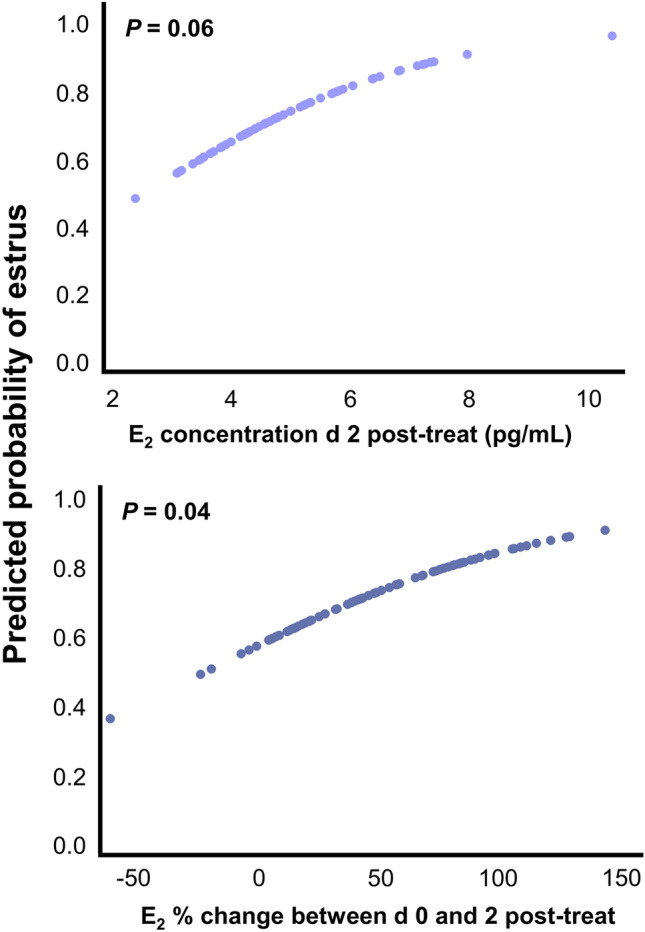
Predicted probability of estrus in relation to 17β-estradiol (E2) concentrations (pg/mL) 2 days (d) post-induction of luteolysis (post-treat; A) and E2 concentrations % change between days 0 and 2 post-induction of luteolysis (B). Data shown includes all cows from RAA and Control treatments, regardless of ovulation number (n = 80).

References

    1. Pursley JR, et al. Pregnancy rates per artificial insemination for cows and heifers inseminated at a synchronized ovulation or synchronized estrus. J. Dairy Sci. 1997;80:295–300. doi: 10.3168/jds.S0022-0302(97)75937-X. - DOI - PubMed
    1. Wolfenson D, et al. Follicular dynamics and concentrations of steroids and gonadotropins in lactating cows and nulliparous heifers. Theriogenology. 2004;62:1042–1055. doi: 10.1016/j.theriogenology.2003.12.020. - DOI - PubMed
    1. Kirby CJ, Smith MF, Keisler DH, Lucy MC. Follicular function in lactating dairy cows treated with sustained-release bovine somatotropin. J. Dairy Sci. 1997;80:273–285. doi: 10.3168/jds.S0022-0302(97)75935-6. - DOI - PubMed
    1. Sirois J, Fortune JE. Ovarian follicular dynamics during the estrous cycle in heifers monitored by real-time ultrasonography. Biol. Reprod. 1988;39:308–317. doi: 10.1095/biolreprod39.2.308. - DOI - PubMed
    1. De los Reyes M, et al. Histological characteristics and steroid concentration of ovarian follicles at different stages of development in pregnant and non-pregnant dairy cows. Vet. Res. Commun. 2006;30:161–173. doi: 10.1007/s11259-006-3100-3. - DOI - PubMed