


Racial, Ethnic, and Geographic Disparities in Immunization Rates Among Patients With Inflammatory Bowel Disease
- PMID: 38130948
- PMCID: PMC10734681
- DOI: 10.1093/crocol/otad078
Racial, Ethnic, and Geographic Disparities in Immunization Rates Among Patients With Inflammatory Bowel Disease
Abstract
Background and aims: Racial and ethnic disparities exist in the treatment of IBD. These disparities exist in adult vaccine uptake among the general population and may extend to patients with IBD. The primary aim of this study was to determine whether racial, ethnic, or geographic disparities existed in influenza vaccine uptake among patients with IBD.
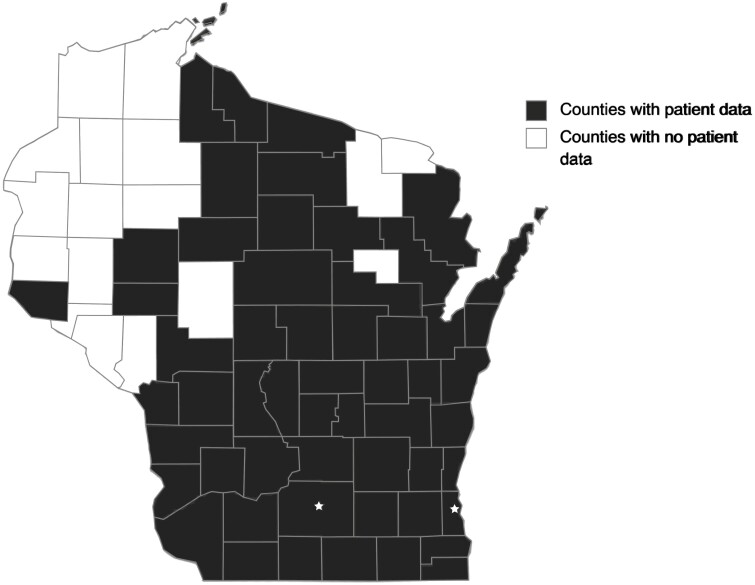
Methods: We performed a multicenter, retrospective cohort study evaluating adult vaccine uptake among patients with IBD seen at two tertiary referral centers between September 2019 and February 2020. The primary outcome was to determine if racial/ethnic and geographic disparities existed in influenza vaccine uptake for the two prior seasons. Our secondary outcomes were to determine if disparities existed for pneumococcal, zoster, or hepatitis B vaccines.
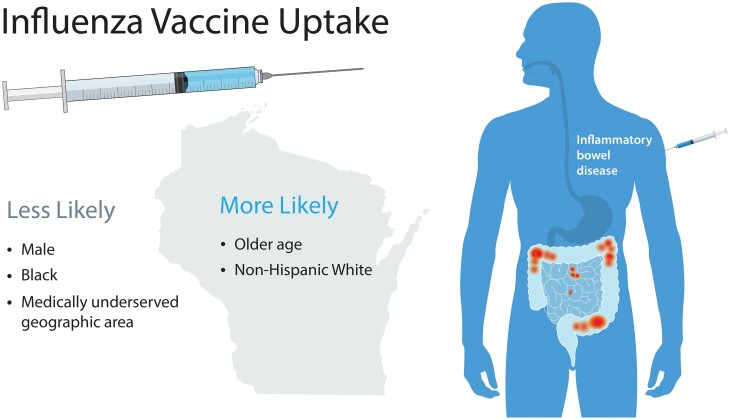
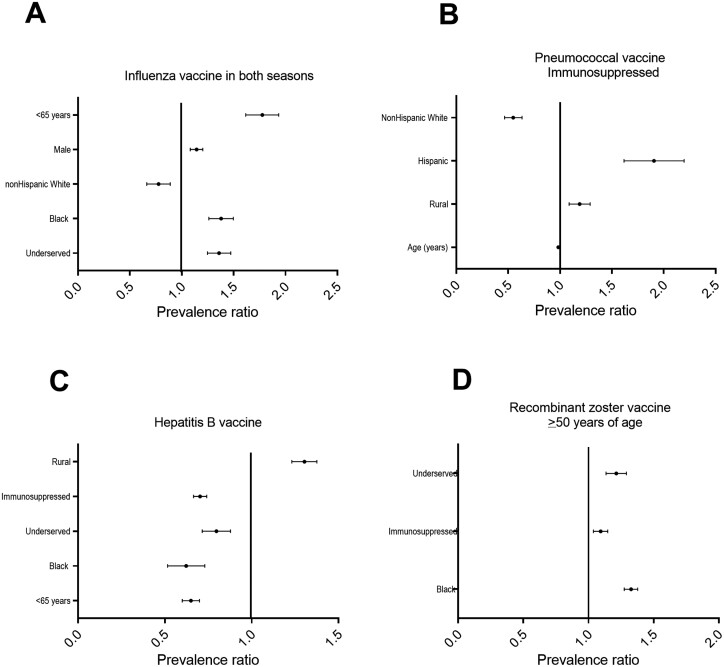
Results: Among the 2453 patients who met the inclusion criteria, most identified as non-Hispanic White (89.9%), were on immunosuppressive therapy (74.5%), and received the influenza vaccine in both seasons (56.0%). Older age (prevalence ratio (PR) 0.98; 95% confidence interval (95%CI) 0.98-0.99; P < .001) and non-Hispanic White patients (PR 0.76, 95%CI 0.59-0.98, P < 0.03) were significantly more likely to be immunized. Black patients (PR 1.37; 95%CI 1.18-1.59; P < .001) and those living in underserved geographic areas (PR 1.35; 95%CI 1.17-1.56; P < 0.001) were less likely to be immunized. Racial/ethnic and geographic disparities were identified for pneumococcal, zoster, and hepatitis B vaccine uptake.
Conclusions: Racial and ethnic vaccination uptake disparities exist among patients with IBD; patients from medically underserved areas are also vulnerable to these disparities Studies identifying patient, provider, and system-level opportunities to address these disparities are needed.
Keywords: inflammatory bowel diseases; influenza vaccine; pneumococcal vaccines; recombinant zoster vaccine.
© The Author(s) 2023. Published by Oxford University Press on behalf of Crohn's & Colitis Foundation.
Conflict of interest statement
F.C. has received research support from Takeda Pharmaceuticals. He has been a consultant for Takeda, Arena Pharmaceuticals, GSK, and Celgene. F.A.F. is a consultant for AbbVie, BMS, Braintree Labs, Fresenius Kabi, GI Reviewers, GSK, IBD Educational Group, Iterative Health, Janssen, Pharmacosmos, Pfizer,Sebela and Viatris. He sits on a DSMB for Eli Lilly. M.S.H. is a consultant for GSK Vaccines and Seqirus and has received research support from Takeda Pharmaceuticals and Dynavax. P.B.P. has been a consultant for Takeda Pharmaceuticals. Guarantor of the article: F.C., D.O., M.S. F.C.—study concept and design, acquisition of data, analysis and interpretation of data, drafting of the manuscript, and critical revision of manuscript. M.S.H—study concept and design, acquisition of data, analysis, and interpretation of data, drafting of the manuscript, and critical revision of manuscript. P.B.P.—study concept and design, acquisition of data, and interpretation of data, drafting of the manuscript, and critical revision of manuscript. G.W.—study concept and design, acquisition of data, analysis and interpretation of data, drafting of the manuscript, and critical revision of manuscript. F.A.F.—critical revision of manuscript. J.W.—study concept and design and critical revision of manuscript. K.B.—acquisition of data and critical revision of manuscript. A.U.—acquisition of data and critical revision of manuscript. T.L.S.—acquisition of data and critical revision of manuscript. R.S.—acquisition of data and critical revision of manuscript. A.H.—acquisition of data and critical revision of manuscript. L.H.—acquisition of data and critical revision of manuscript. K.E.D.—acquisition of data and critical revision of manuscript. S.D.—acquisition of data and critical revision of manuscript. N.S.—acquisition of data and critical revision of manuscript. K.R.S.—acquisition of data and critical revision of manuscript. R.K.R.—data analysis and critical revision of manuscript. M.A.M.—acquisition of data and critical revision of manuscript. F.O.—statistical analysis.
Figures
References
-
- Dahlhamer JM, Zammitti EP, Ward BW, Wheaton AG, Croft JB.. Prevalence of inflammatory bowel disease among adults aged ≥18 years—United States, 2015. MMWR Morb Mortal Wkly Rep. 2016;65(42):1166-1169. - PubMed
-
- Martinez ML, Coles S.. Addressing immunization health disparities. Prim Care. 2020;47(3):483-495. - PubMed
LinkOut - more resources
Full Text Sources
Research Materials
Miscellaneous