. 2024 Mar 1;15(3):e00669.
doi: 10.14309/ctg.0000000000000669.

Clinical Long-Term Outcomes of Patient-Reported Outcomes in the Prospective Real-World Tofacitinib Response in Ulcerative Colitis Registry

Affiliations

Clinical Long-Term Outcomes of Patient-Reported Outcomes in the Prospective Real-World Tofacitinib Response in Ulcerative Colitis Registry

Hans H Herfarth et al. Clin Transl Gastroenterol. .

Abstract

Introduction: We previously reported the results of tofacitinib induction therapy in the prospective multisite US real-world Tofacitinib Response in Ulcerative Colitis registry. We now assessed patient-reported outcomes (PROs) and predictors of success during tofacitinib maintenance therapy.

Methods: Tofacitinib Response in Ulcerative Colitis included 103 patients with refractory ulcerative colitis (UC); 67% had failed ≥ 2 biologics. Patients reported the Simple Clinical Colitis Activity Index (SCCAI), Patient-Reported Outcome Measurement Information System measures for anxiety, depression, social satisfaction, and adverse events between weeks 8 and 52 using a web-based system. Paired t test and P for trend were used to compare changes in PRO measures over time. Bivariate analyses and logistic regression models were used to determine factors associated with response (SCCAI <5) or remission (SCCAI <2) at week 52.

Results: Of 103 patients, 82.5% entered the maintenance phase and 43.7% remained on tofacitinib at week 52. Tofacitinib de-escalation to 5 mg BID occurred in 15% of patients. At week 52, 42.7% and 31.1% of all patients reported an SCCAI <5 and SCCAI ≤2, respectively. Normalization of bowel frequency, rectal bleeding, and urgency occurred in 79%, 61%, and 48% of patients remaining on maintenance therapy. Social satisfaction improved significantly ( P < 0.001), while anxiety and depression scores only numerically improved. No consistent predictors for tofacitinib long-term treatment efficacy were identified, and safety findings were consistent with the known safety profile of tofacitinib.

Discussion: Tofacitinib is an effective maintenance therapy in patients with refractory UC. Dose reductions infrequently occurred during maintenance. Unmet needs in UC maintenance include improvement of urgency and psychosocial factors (NCT03772145).


Conflict of interest statement

Guarantor of the article: Hans H. Herfarth, MD, PhD, FACG.

Specific author contributions: H.H.H. and M.D.L.: conceptualization and execution of the study, analysis, and interpretation of data and cowrote the manuscript. E.E.: coordination of study sites, supervision of data collection, and revised and critically reviewed the manuscript for intellectual content and accuracy. X.Z.: data analyses and interpretation of data and revised and critically reviewed the manuscript for intellectual content and accuracy. A.A., M.F., M.A., R.M., B.L.C., R.C.U., W.H., J.H.; G.G.K., S.P., T.R., B.S., and J.S.: patient recruitment and data acquisition and revised and critically reviewed the manuscript for intellectual content and accuracy. All authors approved the final version of the article.

Financial support: This registry was funded by Pfizer Inc.

Potential competing interests: H.H.H. has served as a consultant to Alivio, AMAG, BMS, Boehringer, ExeGI, Finch, Fresenius Kabi, Galapagos, Gilead, Janssen, Lycera, Merck, Otsuka, Pfizer, PureTech, Seres, and Ventyx and received research support from Artizan Biosciences, Allakos, NovoNordisk, and Pfizer. A.A. has served as a consultant for AbbVie, Takeda, Janssen, Bristol Myers Squibb, Pfizer, Eli Lilly, Gilead, DiaSorin, and TLL Pharmaceuticals and as a speaker for AbbVie, Takeda, Janssen, Bristol Myers Squibb, and Pfizer. M.F. has served as an advisory board member or consultant for AbbVie, Bristol Myer Squibb, Pfizer, Eli Lily, Takeda, Janssen, and Scioto and as a DSMB member for Rebiotix. D.H. has served as a consultant for Abbvie, BMS, Fresenius Kabi, Janssen, Pfizer, Prometheus, Takeda, and UCB and has received research support from Janssen and Pfizer. M.A. has no conflicts. R.M. has served as an advisory board member of BMS. B.L.C. has served as an advisory board member or consultant for Abbvie, Celgene-Bristol Myers Squibb, Lilly, Pfizer, Sublimity Therapeutics, Takeda, TARGET RWE; CME Companies: Cornerstones, Vindico; speaking: Abbvie; and educational grant: Pfizer. R.C.U. has served as a consultant/advisory board member for AbbVie, Bristol Myers Squibb, Janssen, Pfizer, and Takeda; received research support from AbbVie, Boehringer Ingelheim, Bristol Myers Squibb, Lilly, and Pfizer; and is funded by a National Institutes of Health (NIH) K23 Career Development Award K23KD111995-01A1. W.H. has no conflicts. J.H. has served an advisory board member for Bristol Myers Squibb and for the Speakers Bureau of AbbVie and Pfizer. G.K. has served as a consultant to Pfizer and ProciseDx and for the speakers' bureau of Takeda and Lilly. S.P. has served as an advisory board member or consultant to Pfizer and Takeda and received research support from Gilead, AbbVie, Seres, Bristol Myer Squibb, Pfizer, and Takeda. T.R. has served on advisory boards for Abbive, Arena, Boeeringer Ingleheim, Bristol Myers, Ferring, Genentech, Gilead, Intercept, Iterative Scopes, Janssen, Lilly, Pfizer, Prometheus, and Takeda and as a speaker for Abbvie, Bristol Myers, Janssen, Pfizer and Takeda. B.S. has no conflicts. J.S. has served as a consultant for AbbVie, UCB, Takeda, Janssen, Pfizer, BMS, and Prometheus and has received research support from Takeda. E.E. has no conflicts. X.Z. has no conflicts. M.D.L. has served as a consultant for AbbVie, Takeda, Janssen, Pfizer, Lilly, Genentech, Roche, BMS, Target RWE, and Prometheus and has received research support from Pfizer, Takeda, and Lilly.

Figures

None
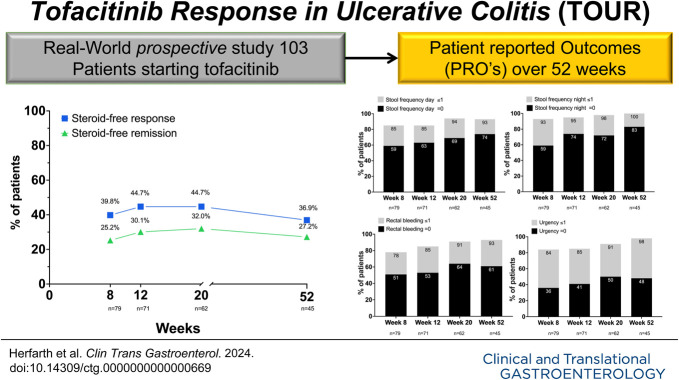
Graphical abstract
Figure 1.
Figure 1.
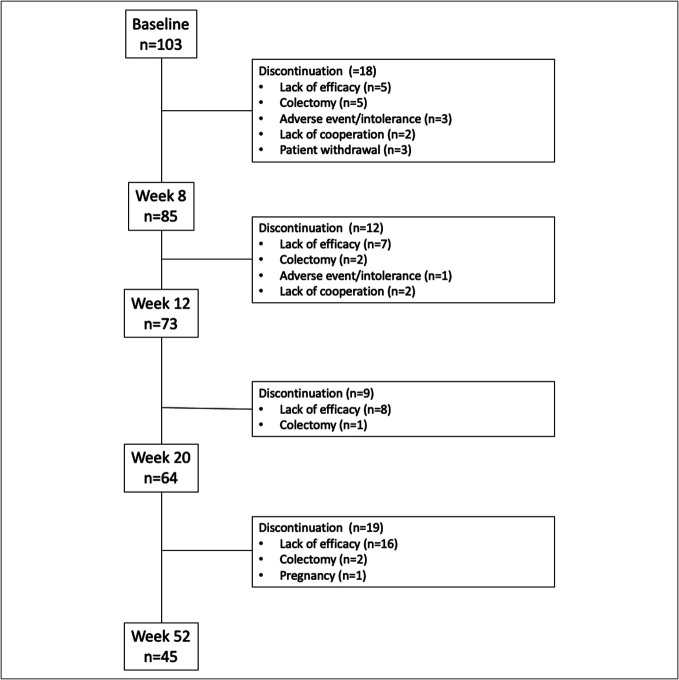
Study flow diagram with timing and reasons for tofacitinib withdrawal.
Figure 2.
Figure 2.
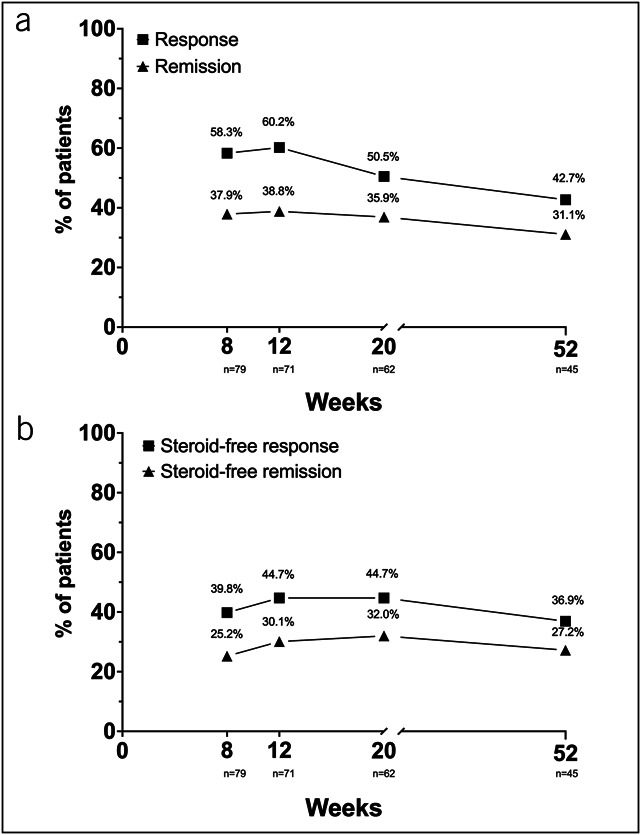
(a) Proportions of patients with response, defined as mild or no disease activity (SCCAI <5) and remission (SCCAI ≤2) between week 8 and week 52 (n = 103). (b) Proportions of patients with steroid-free response, defined as mild or no disease activity (SCCAI <5) and remission (SCCAI ≤2) between week 8 and week 52 (n = 103). At weeks 8, 12, 20, and 52, 79/85 (92.9%), 71/73 (97.3%), 62/64(96.9%), and 45/45 (100%) patients, respectively, reported the SCCAI scores in the visit window. SCCAI, Simple Clinical Colitis Activity Index.
Figure 3.
Figure 3.
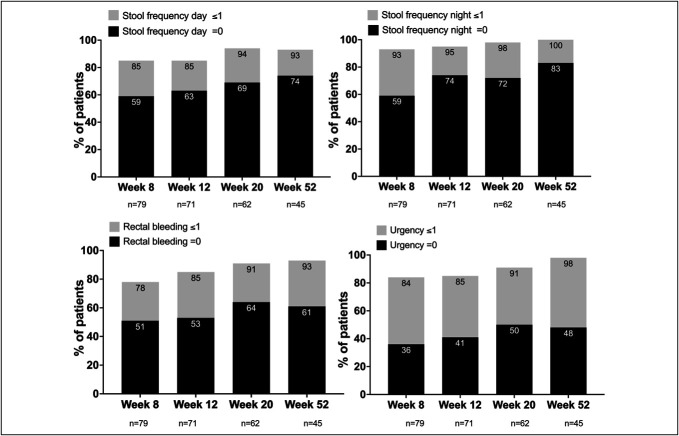
Percentage of patients with SCCAI subscores of 0 and ≤1 for daily stool frequency, nightly stool frequency, rectal bleeding, and urgency at weeks 8, 12, 20, and 52. At weeks 8, 12, 20, and 52, 79/85 (92.9%), 71/73 (97.3%), 62/64 (96.9%), and 45/45 (100%) patients, respectively, reported the SCCAI scores in the visit window. SCCAI, Simple Clinical Colitis Activity Index.

References

    1. Singh S, Allegretti JR, Siddique SM, et al. AGA technical review on the management of moderate to severe ulcerative colitis. Gastroenterology 2020;158(5):1465–96.e17. - PMC - PubMed
    1. Rubin DT, Ananthakrishnan AN, Siegel CA, et al. ACG clinical guideline: Ulcerative colitis in adults. Am J Gastroenterol 2019;114(3):384–413. - PubMed
    1. Sandborn WJ, Su C, Sands BE, et al. Tofacitinib as induction and maintenance therapy for ulcerative colitis. N Engl J Med 2017;376(18):1723–36. - PubMed
    1. Sandborn WJ, Panes J, D'Haens GR, et al. Safety of tofacitinib for treatment of ulcerative colitis, based on 4.4 years of data from global clinical trials. Clin Gastroenterol Hepatol 2019;17(8):1541–50. - PubMed
    1. Kayal M, Posner H, Spencer E, et al. Net remission rates with biologic and small molecule treatment in ulcerative colitis: A reappraisal of the clinical trial data. Clin Gastroenterol Hepatol 2023;21(13):3433–6.e1. - PubMed

Publication types

Associated data