. 2023 Nov 30;12(12):1409.
doi: 10.3390/pathogens12121409.

Genomes of Endotrypanum monterogeii from Panama and Zelonia costaricensis from Brazil: Expansion of Multigene Families in Leishmaniinae Parasites That Are Close Relatives of Leishmania spp

Affiliations

Genomes of Endotrypanum monterogeii from Panama and Zelonia costaricensis from Brazil: Expansion of Multigene Families in Leishmaniinae Parasites That Are Close Relatives of Leishmania spp

Percy O Tullume-Vergara et al. Pathogens. .

Abstract

The Leishmaniinae subfamily of the Trypanosomatidae contains both genus Zelonia (monoxenous) and Endotrypanum (dixenous). They are amongst the nearest known relatives of Leishmania, which comprises many human pathogens widespread in the developing world. These closely related lineages are models for the genomic biology of monoxenous and dixenous parasites. Herein, we used comparative genomics to identify the orthologous groups (OGs) shared among 26 Leishmaniinae species to investigate gene family expansion/contraction and applied two phylogenomic approaches to confirm relationships within the subfamily. The Endotrypanum monterogeii and Zelonia costaricensis genomes were assembled, with sizes of 29.9 Mb and 38.0 Mb and 9.711 and 12.201 predicted protein-coding genes, respectively. The genome of E. monterogeii displayed a higher number of multicopy cell surface protein families, including glycoprotein 63 and glycoprotein 46, compared to Leishmania spp. The genome of Z. costaricensis presents expansions of BT1 and amino acid transporters and proteins containing leucine-rich repeat domains, as well as a loss of ABC-type transporters. In total, 415 and 85 lineage-specific OGs were identified in Z. costaricensis and E. monterogeii. The evolutionary relationships within the subfamily were confirmed using the supermatrix (3384 protein-coding genes) and supertree methods. Overall, this study showed new expansions of multigene families in monoxenous and dixenous parasites of the subfamily Leishmaniinae.

Keywords: Endotrypanum monterogeii; Zelonia costaricensis; catalase; gene family expansion; glycoprotein 63; phylogenomics; sialidase.


Conflict of interest statement

The authors declare no conflict of interest. The funders had no role in the design of the study; in the collection, analyses, or interpretation of data; in the writing of the manuscript; or in the decision to publish the results.

Figures
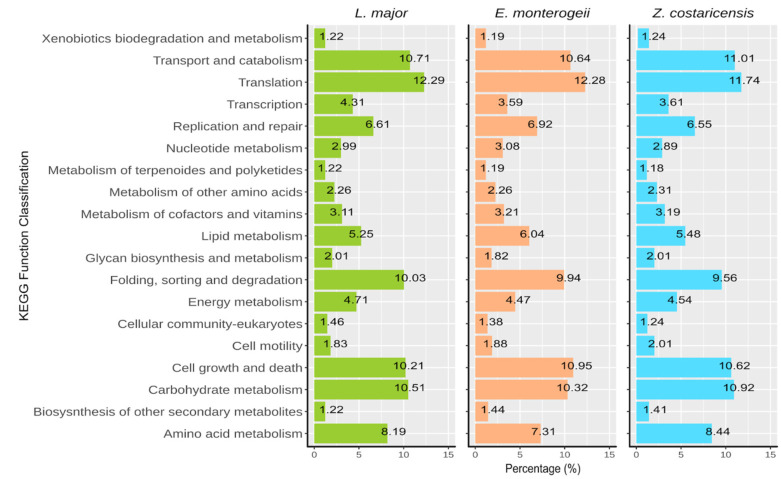
Figure 1
Figure 1
KEGG function classification for enzymatic characterization based in cellular processes, genetic information processing, and metabolic pathways using the Leishmania (Leishmania) major, Endotrypanum monterogeii and Zelonia costaricensis genomes.
Figure 2
Figure 2
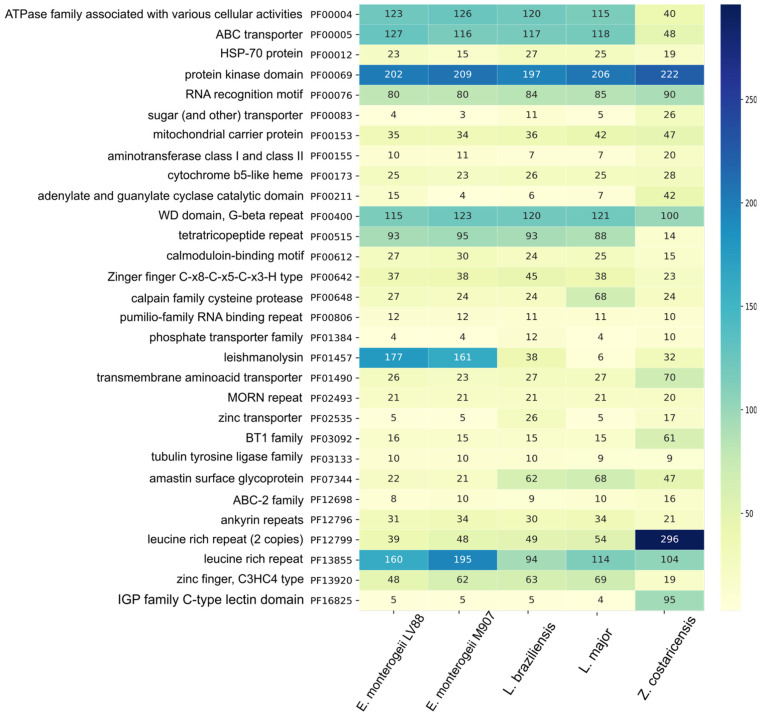
Abundance heatmap of 30 protein domain families in five Leishmaniinae species. The column on the left lists domain names along with Pfam code. The high number of domains is depicted in dark-blue and the low number of domains in light-green, following the color scale on the right.
Figure 3
Figure 3
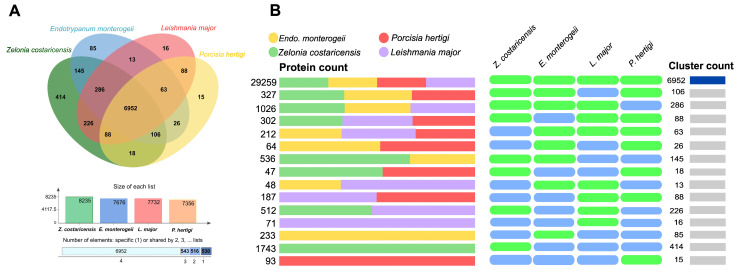
Comparative analysis of four species of Leishmaniinae. (A) Venn diagram of shared and unique orthologous group in four lineages. (B) Cluster count and proteins assigned to Ogs for Leishmania (Leishmania) major, Endotrypanum monterogeii, Porcisia hertigi, and Zelonia costaricensis. A core of 6952 orthologous groups was shared by all four lineages.
Figure 4
Figure 4
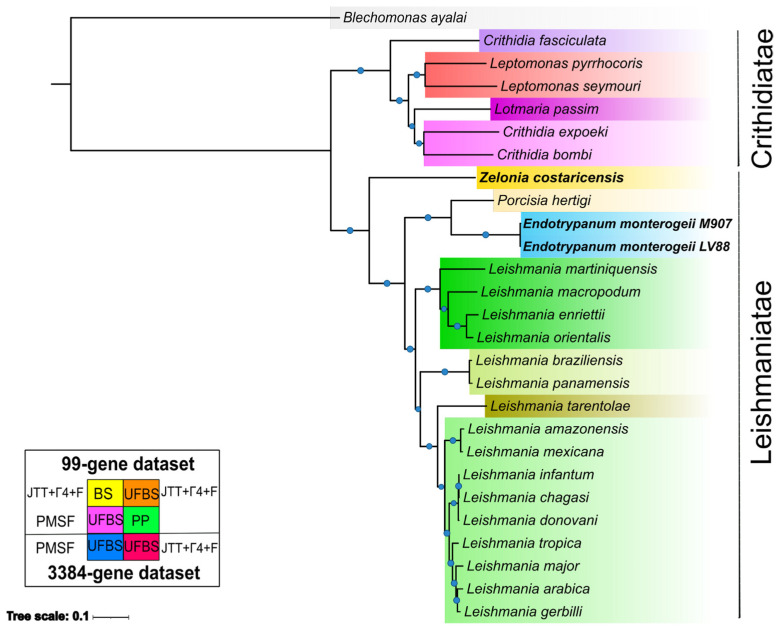
Maximum likelihood (ML) phylogenomic tree based on a concatenated dataset of 3384 single-copy genes. The tree was reconstructed using 27 species, and 5 different models using ML and 1 model using BI were tested. All analyses recovered the same topological structure. UFBS, BS, and PP values higher than 95%, 75%, and 1 are shown as light blue circles. The horizontal bar depicts 0.01 substitutions per site.
Figure 5
Figure 5
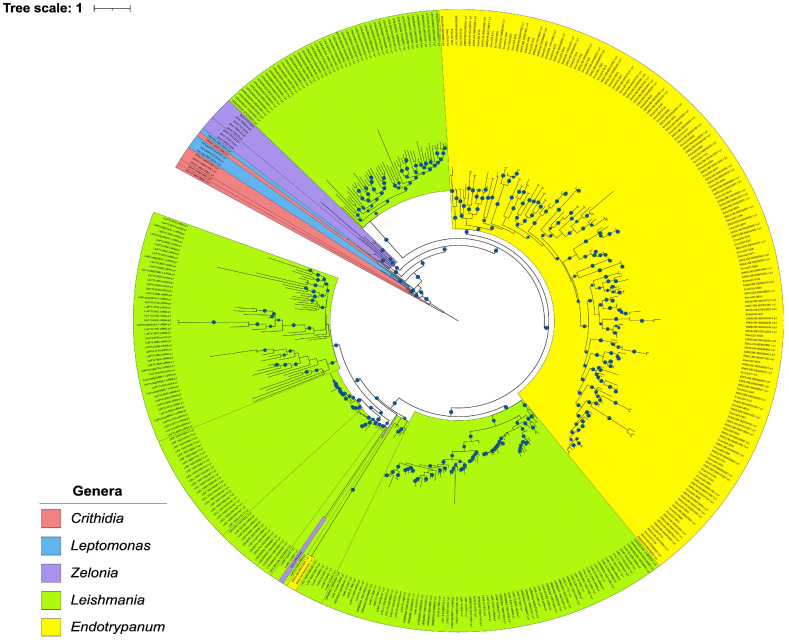
Phylogenetic relationships of glycoprotein 63 in 21 species using the ML method. The phylogram is represented by 406 gp63 protein sequences. The sequences from Zelonia and Endotrypanum genera are shown in red and yellow, respectively. Bootstrap exceeding 95% are shown in branches as blue circles.
Figure 6
Figure 6
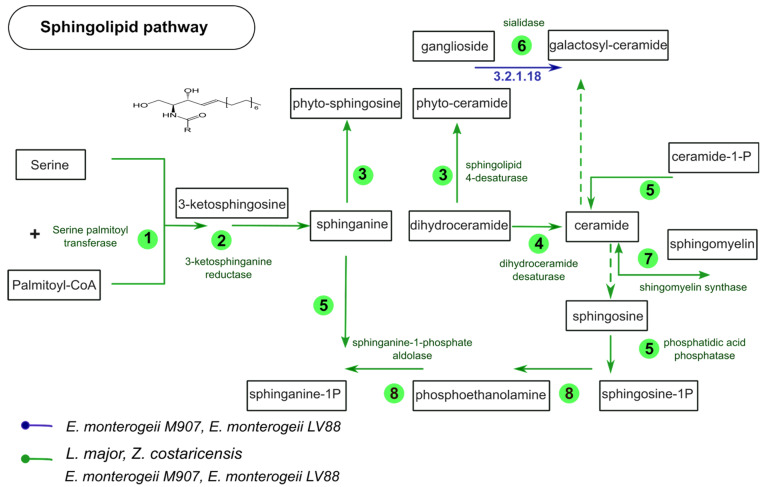
Schematic representation of sphingolipid metabolism comparing four Leishmaniinae parasites. The numbers in green circles represent the number of predicted enzymes that are present in each pathway and in the four lineages. The blue arrow shows the sialidase enzyme present only in Endotrypanum monterogeii strains but absent in Leishmania (Leishmania) major.

References

    1. Lukeš J., Butenko A., Hashimi H., Maslov D.A., Votýpka J., Yurchenko V. Trypanosomatids Are Much More than Just Trypanosomes: Clues from the Expanded Family Tree. Trends Parasitol. 2018;34:466–480. doi: 10.1016/j.pt.2018.03.002. - DOI - PubMed
    1. Maslov D.A., Votýpka J., Yurchenko V., Lukeš J. Diversity and phylogeny of insect trypanosomatids: All that is hidden shall be revealed. Trends Parasitol. 2013;29:43–52. doi: 10.1016/j.pt.2012.11.001. - DOI - PubMed
    1. Maslov D.A., Opperdoes F.R., Kostygov A.Y., Hashimi H., Lukeš J., Yurchenko V. Recent advances in trypanosomatid research: Genome organization, expression, metabolism, taxonomy and evolution. Parasitology. 2019;146:1–27. doi: 10.1017/S0031182018000951. - DOI - PubMed
    1. Espinosa O.A., Serrano M.G., Camargo E.P., Teixeira M.M.G., Shaw J.J. An appraisal of the taxonomy and nomenclature of trypanosomatids presently classified as Leishmania and Endotrypanum. Parasitology. 2016;145:430–442. doi: 10.1017/S0031182016002092. - DOI - PubMed
    1. Votýpka J., d’Avila-Levy C.M., Grellier P., Maslov D.A., Lukeš J., Yurchenko V. New Approaches to Systematics of Trypanosomatidae: Criteria for Taxonomic (Re)description. Trends Parasitol. 2015;31:460–469. doi: 10.1016/j.pt.2015.06.015. - DOI - PubMed

LinkOut - more resources