Improving Malaria Case Management and Referral Relationships at the Primary Care Level in Ghana: Evaluation of a Quality Assurance Internship
- PMID: 38135513
- PMCID: PMC10749655
- DOI: 10.9745/GHSP-D-23-00050
Improving Malaria Case Management and Referral Relationships at the Primary Care Level in Ghana: Evaluation of a Quality Assurance Internship
Abstract
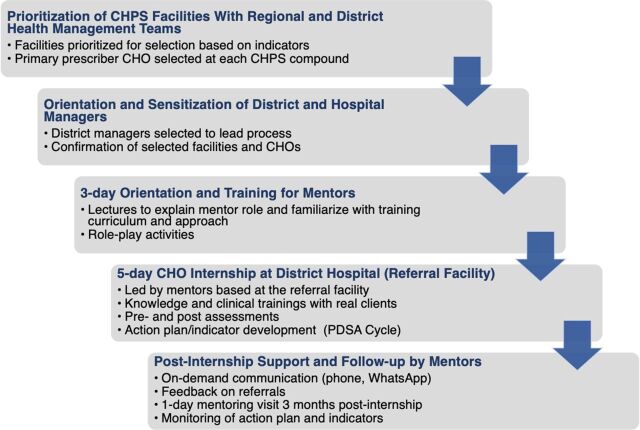
In Ghana, Community-based Health Planning and Services (CHPS) compounds managed by trained nurses and midwives called community health officers (CHOs) play a major role in malaria service delivery. With heavy administrative burdens and minimal training in providing patient care, particularly for febrile illnesses, including malaria, CHOs struggle to comply with the World Health Organization's test, treat, and track initiative guidelines and appropriate referral practices. A clinical training and mentorship program was implemented for CHOs to prevent and manage uncomplicated malaria and offer appropriate pre-referral treatment and referrals to district hospitals. Medical officers, pharmacists, midwives, health information officers, and medical laboratory scientists at 52 district referral hospitals were trained as mentors; CHOs from 520 poorly performing CHPS compounds underwent a 5-day internship at their assigned district referral hospital to improve knowledge and clinical skills for malaria case management. Three months later, mentors conducted post-training mentoring visits to assess knowledge and skill retention and provide ongoing on-the-job guidance. Significant percentage-point increases were observed immediately post-internship for history taking (+12.0, 95% confidence interval [CI]=8.3, 15.1; P<.001); fever assessment (+24.9, 95% CI=20.9, 29.3; P<.001); severe malaria assessment and referral (+32.0, 95% CI=28.2, 35.8; P<.001); and knowledge assessment (+15.8, 95% CI=10.0, 21.3; P<.001). Three months later, a third assessment revealed these gains were largely maintained. Analysis of national health management information system data showed statistically significant improvements in testing, treatment, and referral indicators at intervention CHPS compounds after the intervention that were not observed in comparison CHPS compounds. This training and mentorship approach offers a replicable model to build primary care provider competencies in malaria prevention and management and demonstrates how developing relationships between primary care and first-level referral facilities benefits both providers and clients. More methodologically rigorous studies are needed to measure the impact of this approach.
© Asiedu et al.
Figures
References
-
- Ghana Statistical Service (GSS), ICF. Ghana Malaria Indicator Survey 2019. GSS/ICF; 2020. Accessed October 12, 2023. https://dhsprogram.com/pubs/pdf/MIS35/MIS35.pdf
-
- World Health Organization (WHO). World Malaria Report 2022. WHO; 2022. Accessed October 12, 2023. https://www.who.int/publications/i/item/9789240064898
-
- Ghana. National Malaria Control Programme (NMCP). 2021-2025 Malaria Strategic Plan. NMCP; 2021.
-
- World Health Organization (WHO). World Malaria Report 2021. WHO; 2021. Accessed October 12, 2023. https://www.who.int/publications/i/item/9789240040496
Publication types
MeSH terms
LinkOut - more resources
Full Text Sources
Medical