


Duplication at 19q13.32q13.33 Segregating with Neuropsychiatric Phenotype in a Three-Generation Family: Towards the Definition of a Critical Region
- PMID: 38136979
- PMCID: PMC10742575
- DOI: 10.3390/genes14122157
Duplication at 19q13.32q13.33 Segregating with Neuropsychiatric Phenotype in a Three-Generation Family: Towards the Definition of a Critical Region
Abstract
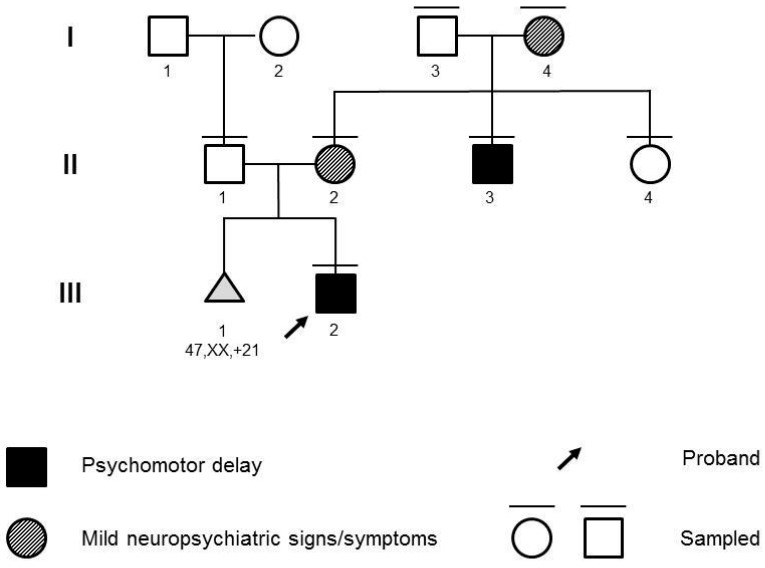
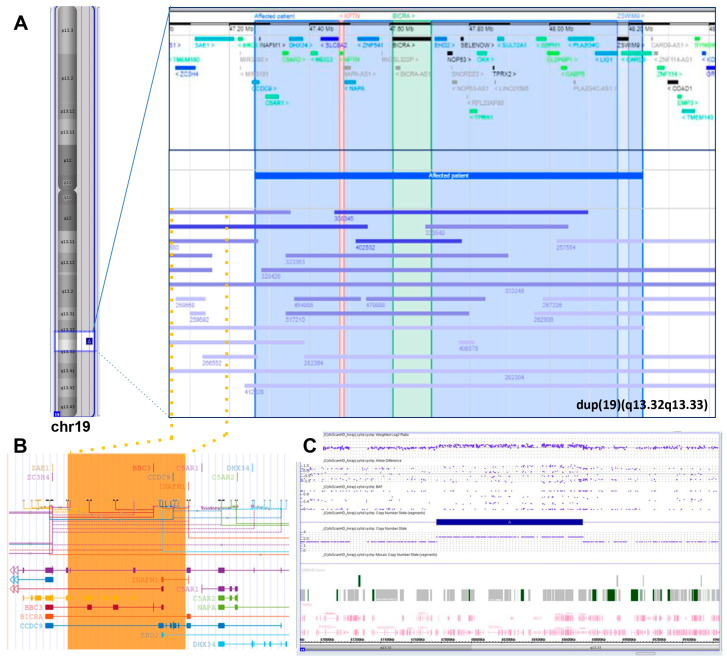
Chromosomal submicroscopic imbalances represent well-known causes of neurodevelopmental disorders. In some cases, these can cause specific autosomal dominant syndromes, with high-to-complete penetrance and de novo occurrence of the variant. In other cases, they result in non-syndromic neurodevelopmental disorders, often acting as moderate-penetrance risk factors, possibly inherited from unaffected parents. We describe a three-generation family with non-syndromic neuropsychiatric features segregating with a novel 19q13.32q13.33 microduplication. The propositus was a 28-month-old male ascertained for psychomotor delay, with no dysmorphic features or malformations. His mother had Attention-Deficit/Hyperactivity Disorder and a learning disability. The maternal uncle had an intellectual disability. Chromosomal microarray analysis identified a 969 kb 19q13.32q13.33 microduplication in the proband. The variant segregated in the mother, the uncle, and the maternal grandmother of the proband, who also presented neuropsychiatric disorders. Fragile-X Syndrome testing was negative. Exome Sequencing did not identify Pathogenic/Likely Pathogenic variants. Imbalances involving 19q13.32 and 19q13.33 are associated with neurodevelopmental delay. A review of the reported microduplications allowed to propose BICRA (MIM *605690) and KPTN (MIM *615620) as candidates for the neurodevelopmental delay susceptibility in 19q13.32q13.33 copy number gains. The peculiarities of this case are the small extension of the duplication, the three-generation segregation, and the full penetrance of the phenotype.
Keywords: 19q13.32q13.33 microduplication; BICRA; KPTN; chromosomal microarray analysis; copy number gain; neurodevelopmental delay.
Conflict of interest statement
The authors declare no conflict of interest.
Figures
References
-
- Rosenfeld J.A., Coppinger J., Bejjani B.A., Girirajan S., Eichler E.E., Shaffer L.G., Ballif B.C. Speech delays and behavioral problems are the predominant features in individuals with developmental delays and 16p11.2 microdeletions and microduplications. J. Neurodev. Disord. 2010;2:26–38. doi: 10.1007/s11689-009-9037-4. - DOI - PMC - PubMed
Publication types
MeSH terms
Substances
Grants and funding
LinkOut - more resources
Full Text Sources
