. 2023 Dec 10;11(12):2957.
doi: 10.3390/microorganisms11122957.

Oral Microbial Profile Analysis in Patients with Oral and Pharyngeal Cancer Reveals That Tumoral Fusobacterium nucleatum Promotes Oral Cancer Progression by Activating YAP

Affiliations

Oral Microbial Profile Analysis in Patients with Oral and Pharyngeal Cancer Reveals That Tumoral Fusobacterium nucleatum Promotes Oral Cancer Progression by Activating YAP

Yuki Yamamoto et al. Microorganisms. .

Abstract

The incidence of oral cancer has recently been increasing worldwide, particularly among young individuals and women. The primary risk factors for head and neck cancers, including oral and pharyngeal cancers, are smoking, alcohol consumption, poor oral hygiene, and repeated exposure to mechanical stimuli. However, approximately one-third of the patients with oral and pharyngeal cancers are neither smokers nor drinkers, which points to the existence of other mechanisms. Recently, human microbes have been linked to various diseases, including cancer. Oral pathogens, especially periodontal pathobionts, are reported to play a role in the development of colon and other types of cancer. In this study, we employed a series of bioinformatics analyses to pinpoint Fusobacterium nucleatum as the predominant oral bacterial species in oral and pharyngeal cancer tissue samples. We successfully isolated Fn. polymorphum from the saliva of patients with oral cancer and demonstrated that Fn. polymorphum indeed promoted oral squamous cell carcinoma development by activating YAP in a mouse tongue cancer model. Our research offers scientific evidence for the role of the oral microbiome in oral cancer progression and provides insights that would help in devising preventative strategies against oral cancer, potentially by altering oral bacterial profiles.

Keywords: Fusobacterium nucleatum; Yes-associated protein (YAP); oral and pharyngeal cancer; oral microbiome.


Conflict of interest statement

The authors declare no conflict of interest.

Figures
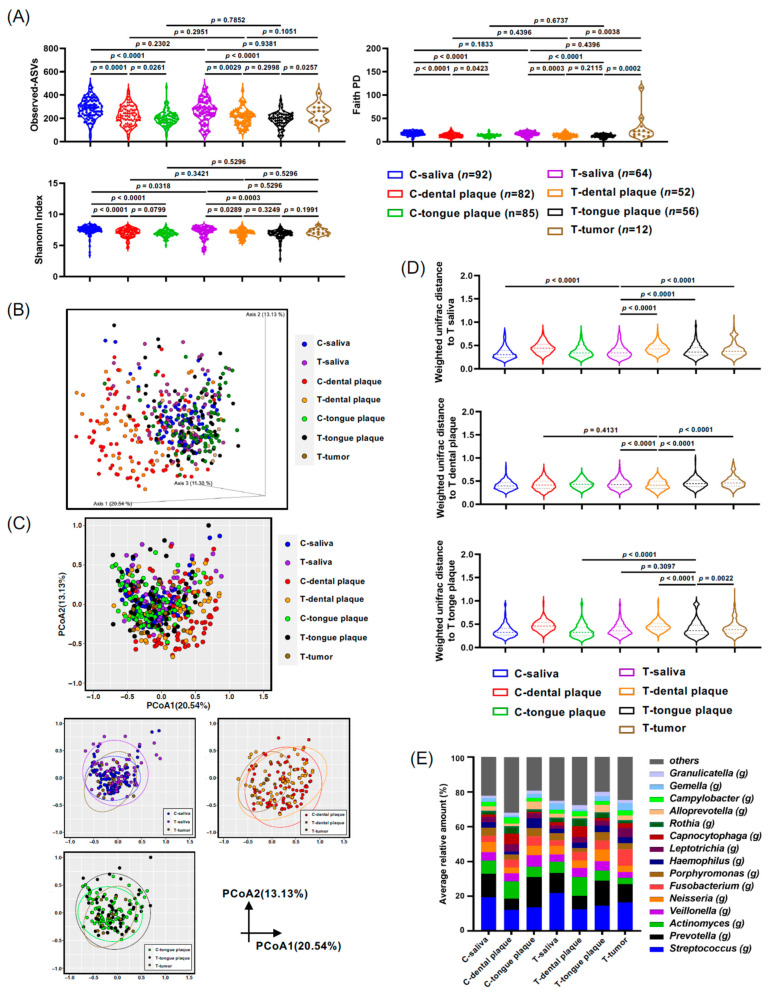
Figure 1
Figure 1
Microbiota from the saliva, dental plaque, tongue plaque, and tumor tissue of the oral cancer (T-) and control groups (C-). (A) Violin plots depicting the alpha diversity using the Shannon index and Faith PD. (B,C) Weighted UniFrac principal coordinates analysis (PCoA) of oral microbiota compared between the oral cancer and control groups (3D plot (B) and 2D plot (C)). (D) Violin plots displaying the Weighted UniFrac distances to saliva (T-saliva), dental plaque (T-dental plaque), and tongue plaque (T-tongue plaque) in oral cancer. (E) Oral microbiota composition determined through 16S rRNA gene sequencing. The genus-level taxonomic distribution of individual microbes is displayed. Data in (A,D) were compared between the two indicated groups using a pairwise Wilcoxon rank-sum test with a Benjamini–Hochberg adjustment.
Figure 2
Figure 2
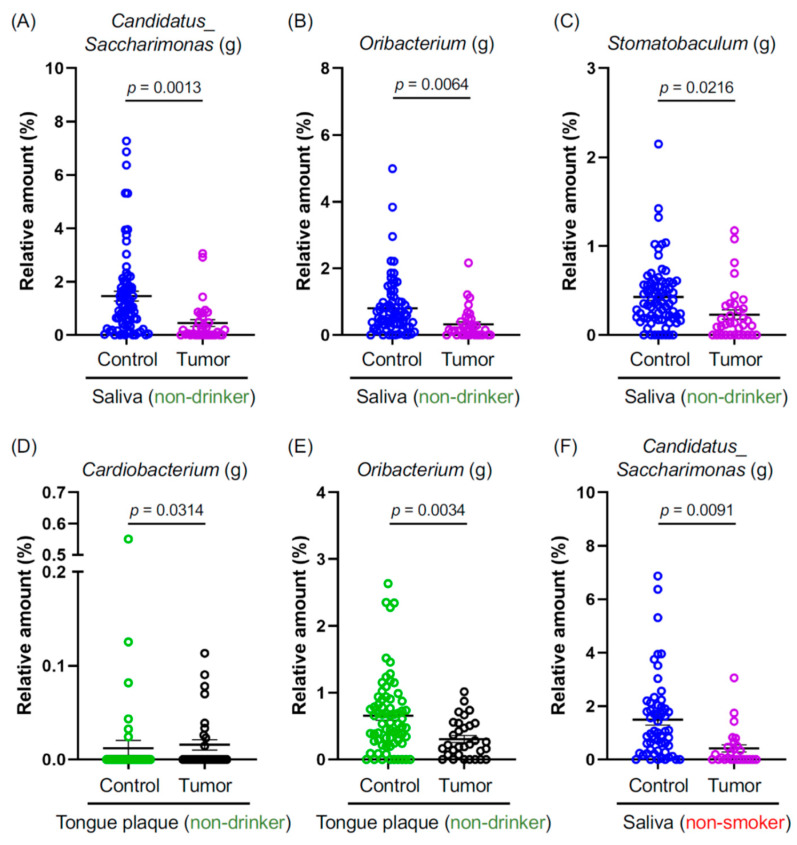
(AF) Graphs depict the relative abundance at the genus level, where genera showed significant differences between the indicated groups. Data are presented as mean ± SEM, compared between the two groups using a pairwise Wilcoxon rank-sum test with Benjamini–Hochberg adjustment. Blue: The saliva of controls. Purple: The saliva of cancer patients. Green: The tongue plaque of controls. Black: The tongue plaque of cancer patients.
Figure 3
Figure 3
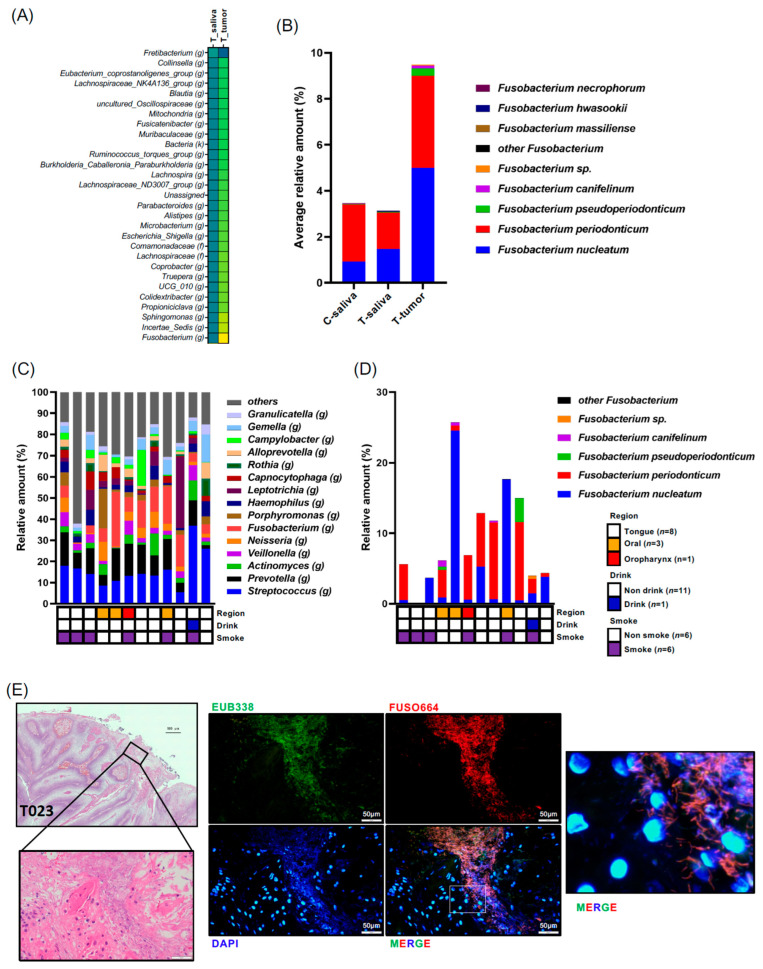
(A) Differences in microbiota composition at the genus level are illustrated using the scaling method of unit variance between saliva and tumor from patients with oral cancer. Highlighted genera were significant at an adjusted p-value < 0.05. Data in (A) were compared between the indicated groups using a pairwise Wilcoxon rank-sum test with Benjamini–Hochberg adjustment. (B) Composition of the Fusobacterium genus is displayed. (C) Tumor microbiota composition determined through 16S rRNA gene sequencing for each individual patient. The genus-level taxonomic distribution of individual microbes is displayed. (D) Composition of the Fusobacterium genus is displayed for each individual patient. (E) HE staining and FISH analysis with the EUB338 probe for all bacteria (green) and FUSO664 for Fusobacterium nucleatum (red) in the tumor region of oral cancer patients (No. T023). Nuclei were stained with DAPI (blue). Scale bar: 20 μm.
Figure 4
Figure 4
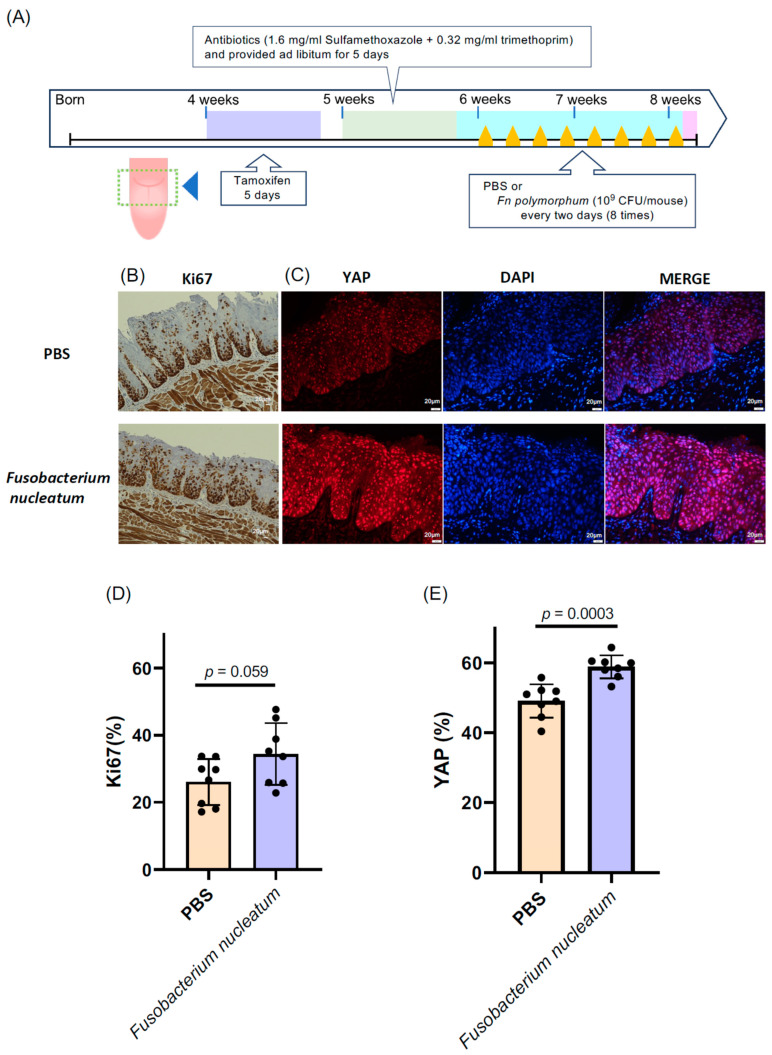
Fusobacterium nucleatum isolated from the oral cavity of oral cancer patients was applied to the tongues of epithelial cell-specific Mob1a/b DKO mice (tgMob1DKO). (A) Experimental scheme for F. nucleatum-treated tgMob1DKO mice. Tamoxifen was brushed daily for 5 days onto the tongues of 4-week-old tgMob1DKO mice. The application area of tamoxifen is illustrated in the dotted square. Mice received water containing antibiotics, sulfamethoxazole, and trimethoprim, for 5 days starting from 5 weeks old. Subsequently, mice were orally treated eight times with F. nucleatum polymorphum (n = 8) or PBS (n = 8) every two days post antibiotic administration. Mice were euthanized post treatment, and their tongue tissues were analyzed histologically. (B) Representative Ki67 immunostaining of tongue epithelium from mice in (A). Scale bar: 20 μm. (C) Representative images showcasing the immunofluorescent detection of YAP (red) in tongue epithelium from mice in (A). DAPI (blue) stains nuclei. Scale bar: 20 μm. (D) Percentages of Ki67-positive cells from sections in (B) are shown in bar plots. (E) Percentages of YAP-positive cells from sections in (C) are represented in bar plots. Data are presented as means ± SEM with Student’s t-test applied.

References

    1. Sung H., Ferlay J., Siegel R.L., Laversanne M., Soerjomataram I., Jemal A., Bray F. Global Cancer Statistics 2020: GLOBOCAN estimates of incidence and mortality worldwide for 36 cancers in 185 countries. CA Cancer J. Clin. 2021;71:209–249. doi: 10.3322/caac.21660. - DOI - PubMed
    1. Botta L., Matsuda T., Charvat H., Chiang C.J., Lee W.C., van Gestel A.J., Martin F., Geleijnse G., Cellamare M., Bonfarnuzzo S., et al. Head and neck cancers survival in Europe, Taiwan, and Japan: Results from RARECAREnet Asia based on a privacy-preserving federated infrastructure. Front. Oncol. 2023;13:1219111. doi: 10.3389/fonc.2023.1219111. - DOI - PMC - PubMed
    1. Warnakulasuriya S., Dietrich T., Bornstein M.M., Casals Peidro E., Preshaw P.M., Walter C., Wennström J.L., Bergström J. Oral health risks of tobacco use and effects of cessation. Int. Dent. J. 2010;60:7–30. - PubMed
    1. Sahingur S.E., Yeudall W.A. Chemokine function in periodontal disease and oral cavity cancer. Front. Immunol. 2015;6:214. doi: 10.3389/fimmu.2015.00214. - DOI - PMC - PubMed
    1. Sahni V. Is there an association between oral hygiene and head and neck cancer? Evid. Based Dent. 2023;24:57–58. doi: 10.1038/s41432-023-00879-3. - DOI - PubMed

LinkOut - more resources