. 2023 Dec 8;23(24):9696.
doi: 10.3390/s23249696.

Label-Free, Impedance-Based Biosensor for Kidney Disease Biomarker Uromodulin

Affiliations

Label-Free, Impedance-Based Biosensor for Kidney Disease Biomarker Uromodulin

Kunj Vora et al. Sensors (Basel). .

Abstract

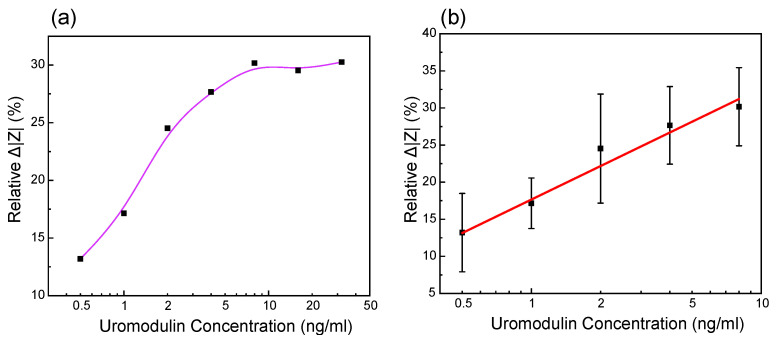
We demonstrate the development of a label-free, impedance-based biosensor by using a passivation layer of 50-nm tantalum pentoxide (Ta2O5) on interdigitated electrodes (IDE). This layer was fabricated by atomic layer deposition (ALD) and has a high dielectric constant (high-κ), which improves the capacitive property of the IDE. We validate the biosensor's performance by measuring uromodulin, a urine biomarker for kidney tubular damage, from artificial urine samples. The passivation layer is functionalized with uromodulin antibodies for selective binding. The passivated IDE enables the non-faradaic impedance measurement of uromodulin concentrations with a measurement range from 0.5 ng/mL to 8 ng/mL and with a relative change in impedance of 15 % per ng/mL at a frequency of 150 Hz (log scale). This work presents a concept for point-of-care biosensing applications for disease biomarkers.

Keywords: atomic layer deposition; chronic kidney disease; impedance spectroscopy; tantalum pentoxide; uromodulin.


Conflict of interest statement

The authors declare no conflict of interest. The funders had no role in the design of the study; in the collection, analyses, or interpretation of data; in the writing of the manuscript; or in the decision to publish the results.

Figures
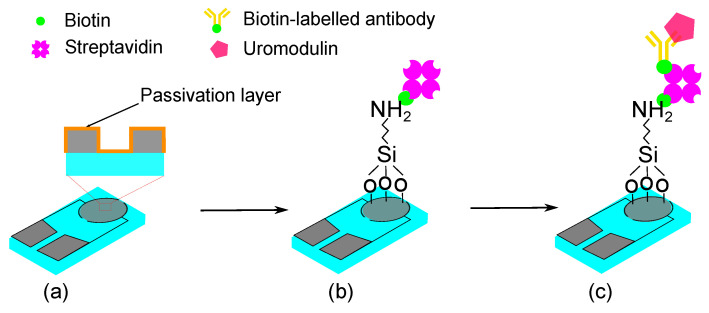
Figure 1
Figure 1
Schematic representation of the sensor concept for uromodulin detection with passivated functionalized IDE: (a) passivated IDE, (b) silanization and biotin–streptavidin immobilization, (c) biotin-labelled antibody immobilization and uromodulin immobilization.
Figure 2
Figure 2
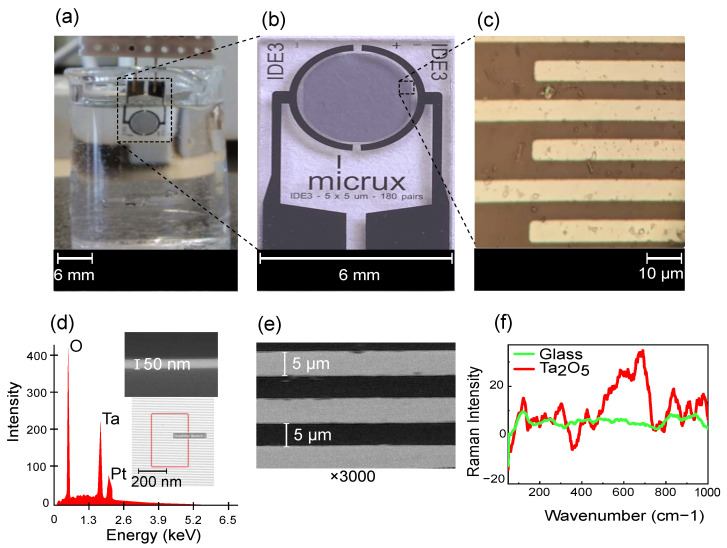
(a) Measurement setup with IDE dipped in PBS solution, (b) enlarged image of sensor element from Micrux Technologies with (c) microscopic image of the IDE fingers (w = 5 µm, g = 5 µm), (d) EDS characterization showing composition of IDE with EDS scanning area and SEM image (cross-section) of 50-nm Ta2O5 on substrate, (e) SEM characterization of IDE (top-view) with ×3000 magnification and (f) Raman spectra of the IDE substrate (glass) before and after passivation with Ta2O5 using excitation wavelength of 532 nm (baseline-corrected and smoothed spectrum).
Figure 3
Figure 3
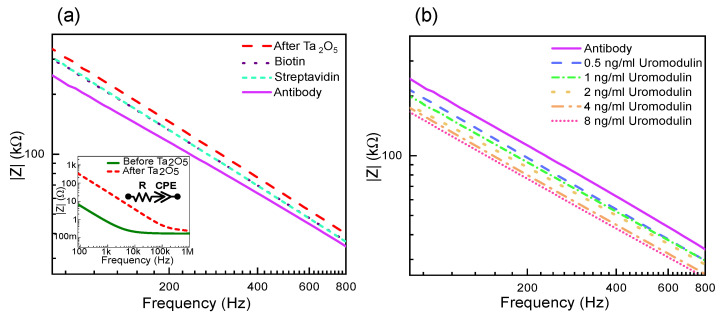
Measurement results showing absolute impedance for layer formations on IDE: (a) before and after Ta2O5 layer with the equivalent circuit (inset) followed by biotin, streptavidin and antibody layers, and (b) uromodulin concentrations in artificial urine.
Figure 4
Figure 4
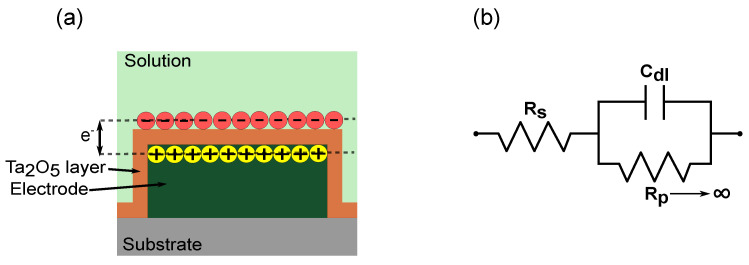
Non-faradaic principle represented by (a) schematic of electrode passivated with Ta2O5 where transfer of charges with solution is prevented and charges are accumulated at the interface instead, and (b) equivalent circuit representation of the electrochemical mechanisms, with series resistor (Rs) double-layer capacitor (Cdl) and polarization/charge transfer resistance (Rp) tending to infinity.
Figure 5
Figure 5
Measurement results of the relative change in impedance values of uromodulin in artificial urine at the frequency of 150 Hz of different IDE against different uromodulin concentrations in (a) dynamic range 0.5 ng/mL–32 ng/mL and (b) linear fitting of values in range 0.5 ng/mL–8 ng/mL (n = 3, relative Δ|Z|(%) = 17.6+15 log [uromodulin concentration], R2 = 0.976).
Figure 6
Figure 6
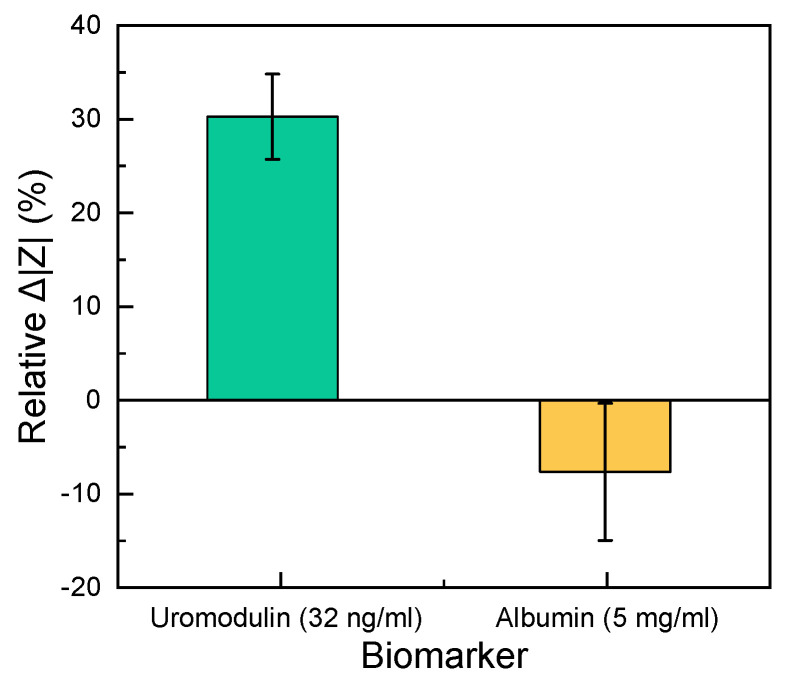
Comparison of the relative change in impedance between 32 ng/mL uromodulin and 5 mg/mL albumin in artificial urine solution (n = 3). The zero line shows the blank measurement.

References

    1. Puiu M., Nativi C., Bala C. Early detection of tumour-associated antigens: Assessment of point-of-care electrochemical immunoassays. TrAC Trends Anal. Chem. 2023;160:116981. doi: 10.1016/j.trac.2023.116981. - DOI
    1. Schneider M.E., Guillade L., Correa-Duarte M.A., Moreira F.T. Development of a biosensor for phosphorylated Tau 181 protein detection in early-stage Alzheimer’s disease. Bioelectrochemistry. 2022;145:108057. - PubMed
    1. Chu S.S., Nguyen H.A., Zhang J., Tabassum S., Cao H. Towards Multiplexed and Multimodal Biosensor Platforms in Real-Time Monitoring of Metabolic Disorders. Sensors. 2022;22:5200. doi: 10.3390/s22145200. - DOI - PMC - PubMed
    1. Rahn K.L., Peramune U., Zhang T., Anand R.K. Label-Free Electrochemical Methods for Disease Detection. Annu. Rev. Anal. Chem. 2023;16:49–69. doi: 10.1146/annurev-anchem-091622-085754. - DOI - PubMed
    1. Valera E., Kindratenko V., Jankelow A.M., Heredia J., Kim A.Y., Cowell T.W., Chen C.L., White K., Han H.S., Bashir R. Electrochemical point-of-care devices for the diagnosis of sepsis. Curr. Opin. Electrochem. 2023;39:101300. doi: 10.1016/j.coelec.2023.101300. - DOI - PMC - PubMed