


Mid-Trimester Spot Urinary Albumin/Creatinine Ratio as a Screening Tool in Prediction of Pre-eclampsia
- PMID: 38143992
- PMCID: PMC10746639
- DOI: 10.1007/s13224-023-01862-9
Mid-Trimester Spot Urinary Albumin/Creatinine Ratio as a Screening Tool in Prediction of Pre-eclampsia
Abstract
Aims and objectives: To determine utilization of spot urinary albumin/creatinine ratio (UACR) to predict subsequent development of preeclampsia, measured between 17 and 24 weeks of gestational age in asymptomatic antenatal woman and determine their maternal and neonatal outcomes.
Introduction: In preeclampsia the basic pathology is generalized endothelial dysfunction. It causes glomerular endotheliosis which leads to proteinuria, decreased glomerular filtration rate and renal blood flow. Thus microalbuminuria is an early marker which can measured to predict preeclampsia.
Materials and methods: It is a prospective observational study, carried out for one year in a cohort of asymptomatic antenatal women at 17-24 weeks of gestational age, attending hospital for routine antenatal check-up with a singleton pregnancy and no associated complications. Urine albumin and creatinine ratio (UACR) is measured at first visit, and women were followed till delivery and the maternal and foetal outcomes were recorded.
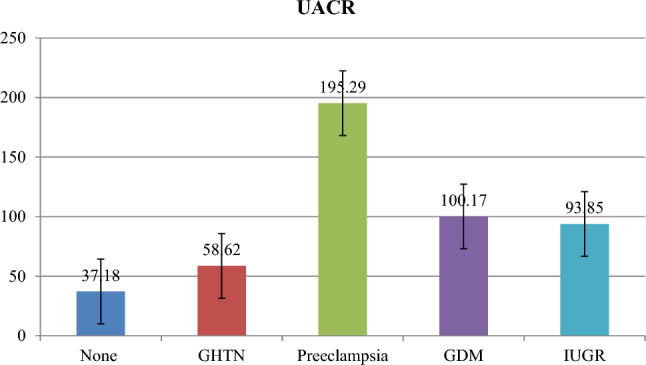
Results: Out of 81 pregnant women enrolled in the study, 58% belonged to 18-25 years, 54.3% belonged to lower middle class. There was a significant difference in mean UACR among women who developed preeclampsia (PE) and gestational diabetes mellitus (GDM) with p value < 0.05. In the study there was significant association between severe PE, PE and GDM with UACR at 22 as cut-off, with p value < 0.05. In the study among those with UACR > 22, 2.5% had IUFD, 12.5% had LBW, and 7.5% were admitted to NICU.
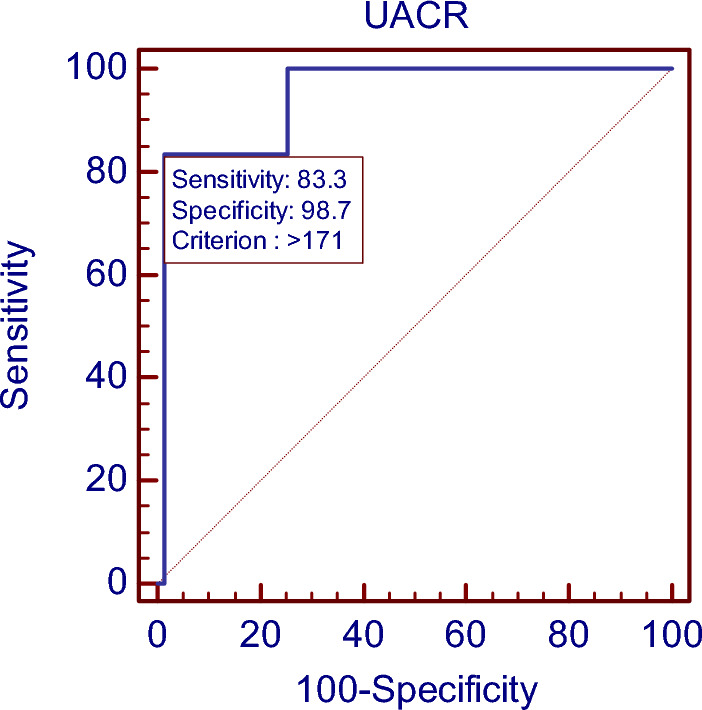
Conclusion: With the measurement of spot UACR in mid-trimester we can predict the development of preeclampsia before the onset of clinical manifestations. UACR > = 171 mg/g predicted preeclampsia well before the onset of clinical manifestations with high sensitivity of 83.3% and specificity of 98.6%.
Supplementary information: The online version contains supplementary material available at 10.1007/s13224-023-01862-9.
Keywords: Antenatal women; Gestational hypertension; Preeclampsia; Proteinuria; Spot urine albumin/creatinine ratio.
© Federation of Obstetric & Gynecological Societies of India 2023. Springer Nature or its licensor (e.g. a society or other partner) holds exclusive rights to this article under a publishing agreement with the author(s) or other rightsholder(s); author self-archiving of the accepted manuscript version of this article is solely governed by the terms of such publishing agreement and applicable law.
Conflict of interest statement
Conflicts of interestThe authors declare that there are no conflicts of interest for the present study.
Figures
References
-
- Arias F, Daftary SN, Bhide AG, et al. Hypertensive Disorders in Pregnancy. In: Arias F, Bhide AG, Arulkumaran S, Damania K, Daftary SN, et al., editors. Practical guide to high risk pregnancy and delivery. A South Asian perspective. New Delhi: Elsevier India; 2015. pp. 185–230.
LinkOut - more resources
Full Text Sources