Review
. 2024 Jan 1;7(1):012502.
doi: 10.1088/2515-7639/ad05e8. Epub 2023 Dec 21.

Roadmap on multifunctional materials for drug delivery

Affiliations
Review

Roadmap on multifunctional materials for drug delivery

Benjamin Nottelet et al. JPhys Mater. .

Abstract

This Roadmap on drug delivery aims to cover some of the most recent advances in the field of materials for drug delivery systems (DDSs) and emphasizes the role that multifunctional materials play in advancing the performance of modern DDSs in the context of the most current challenges presented. The Roadmap is comprised of multiple sections, each of which introduces the status of the field, the current and future challenges faced, and a perspective of the required advances necessary for biomaterial science to tackle these challenges. It is our hope that this collective vision will contribute to the initiation of conversation and collaboration across all areas of multifunctional materials for DDSs. We stress that this article is not meant to be a fully comprehensive review but rather an up-to-date snapshot of different areas of research, with a minimal number of references that focus upon the very latest research developments.

Keywords: drug delivery; hydrogels; multifunctional materials; nanomaterials; polymer; smart.


Figures

Figure 1.
Figure 1.
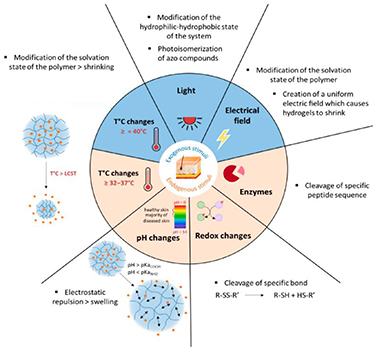
Schematic overview of stimuli and mode of action used for the design of smart drug delivery systems. Reproduced from [14]. CC BY 4.0.
Figure 2.
Figure 2.
Schematic illustration on preparation of chimaeric polymersomes from PEG-b-PAPA-b-PAsp (A) and PEG-b-PAPA-b-PLys (B) copolymers for quantitative loading of proteins and siRNA, respectively. Reprinted with permission from [33]. Copyright (2018) American Chemical Society. [34] John Wiley & Sons. © 2019 WILEY-VCH Verlag GmbH & Co. KGaA, Weinheim.
Figure 3.
Figure 3.
(A) Key historical highlights of the CP drug delivery field. (B) Number of papers published within the CP drug delivery field indexed by SCOPUS.
Figure 4.
Figure 4.
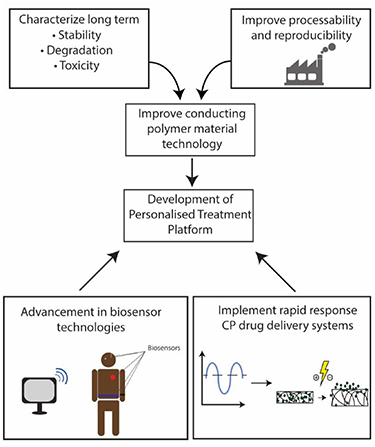
Summary of the challenges facing the field of CP drug delivery systems and the advancements needed to achieve translation into the clinic.
Figure 5.
Figure 5.
(a) Electron microscopy images of MSNs with different architectures. Reproduced from [47], with permission from Springer Nature. (b) Examples of MSN cargo loading and surface functionalization strategies. Reprinted from [48], Copyright (2020), with permission from Elsevier.
Figure 6.
Figure 6.
Impact of the structure (thickness, lateral size) and composition of graphene family nanomaterials on their in vivo safety. G: graphene, rGO: reduced graphene oxide, GO: graphene oxide, fG: functionalized graphene. (A) Impact of the mode of administration, IV: intravenous, IP: intraperitoneal. (B) Organs where the graphene family nanomaterials accumulate the most. (C) Reported reported adverse effects or not. (D) Mechanism responsible for the adverse effects. (E) Impact of the administered dose, low dose: <2 mg kg−1, medium dose: 2–10 mg kg−1, high dose: >10 mg kg−1. (F) Impact of the exposure duration, short: exposure <1 week, medium: between 1 week and 1 month, long: >1 month. Each reported graphene family nanomaterial is represented by a cube and is positioned in the graph according to the type of graphene, its average thickness and lateral dimension. Reproduced from [57] with permission from the Royal Society of Chemistry.
Figure 7.
Figure 7.
Multifunctional graphene oxide covalently conjugated to a peptide able to target cancer cells and enhance the biodegradability of the material by myeloperoxidase, and with doxorubicin adsorbed on its surface, resulting in cell apoptosis. [60] John Wiley & Sons. © 2019 WILEY-VCH Verlag GmbH & Co. KGaA, Weinheim.
Figure 8.
Figure 8.
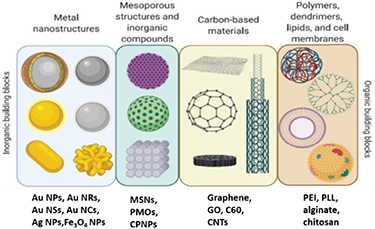
Building blocks for hybrid nanosystems. Reprinted with permission from [67]. Copyright (2021) American Chemical Society.
Figure 9.
Figure 9.
Schematic representation of a nanoparticle-hydrogel composite. Reproduced from [85]. CC BY 4.0.
Figure 10.
Figure 10.
(A) A microfluidic gradient generator with three levels of combining, mixing, and splitting, resulting in different drug ratios. Reprinted with permission from [92]. Copyright (2014) American Chemical Society. (B) A microfluidic platform where biochemical components are encapsulated in droplets stabilized by a surfactant. Reproduced from [93]. CC BY 4.0. (C) Double emulsions with four different types of inner drops: (a), (b) small numbers of inner drops and (c) high density of inner drops. Reproduced from [94] with permission from the Royal Society of Chemistry. (D) A microfluidic platform for cell localization and 3D tumour production. (a) Cell trapping. (b) 3D tumor array cultured for 2 d. Reprinted with permission from [95]. Copyright (2019) American Chemical Society.
Figure 11.
Figure 11.
(A) A microfluidic snake fang-inspired MN array for drug delivery. The integrated MN patch consists of an MN array and a PDMS chamber that has microholes through which liquid formulations can trickle out of the chamber. From [103]. Reprinted with permission from AAAS. (B) A microfluidic strain sensor embedded contact lens. Reproduced from [104] with permission from the Royal Society of Chemistry. (C) A wearable microfluidic contact lenses with potential in the ophthalmology healthcare field. Reproduced from [105]. © IOP Publishing Ltd All rights reserved.

References

    1. Tibbitt M W, Dahlman J E, Langer R. Emerging frontiers in drug delivery. J. Am. Chem. Soc. 2016;138:704–17. doi: 10.1021/jacs.5b09974. - DOI - PubMed
    1. Yun Y H, Lee B K, Park K. Controlled drug delivery: historical perspective for the next generation. J. Control. Release. 2015;219:2–7. doi: 10.1016/j.jconrel.2015.10.005. - DOI - PMC - PubMed
    1. Fenton O S, Olafson K N, Pillai P S, Mitchell M J, Langer R. Advances in biomaterials for drug delivery. Adv. Mater. 2018;30:1705328. doi: 10.1002/adma.201705328. - DOI - PMC - PubMed
    1. Makurvet F D. Biologics vs. small molecules: drug costs and patient access. Med. Drug Discov. 2021;9:100075. doi: 10.1016/j.medidd.2020.100075. - DOI
    1. Englert C, Brendel J C, Majdanski T C, Yildirim T, Schubert S, Gottschaldt M, Windhab N, Schubert U S. Pharmapolymers in the 21st century: synthetic polymers in drug delivery applications. Prog. Polym. Sci. 2018;87:107–64. doi: 10.1016/j.progpolymsci.2018.07.005. - DOI

LinkOut - more resources