


Five-Year Follow-Up of a Slowly Resorbable Biosynthetic P4HB Mesh (Phasix) in VHWG Grade 3 Incisional Hernia Repair
- PMID: 38144487
- PMCID: PMC10735126
- DOI: 10.1097/AS9.0000000000000366
Five-Year Follow-Up of a Slowly Resorbable Biosynthetic P4HB Mesh (Phasix) in VHWG Grade 3 Incisional Hernia Repair
Abstract
Objective: To assess the 5-year recurrence rate of incisional hernia repair in Ventral Hernia Working Group (VHWG) 3 hernia with a slowly resorbable mesh.
Summary background data: Incisional hernia recurs frequently after initial repair. In potentially contaminated hernia, recurrences rise to 40%. Recently, the biosynthetic Phasix mesh has been developed that is resorbed in 12-18 months. Resorbable meshes might be a solution for incisional hernia repair to decrease short- and long-term (mesh) complications. However, long-term outcomes after resorption are scarce.
Methods: Patients with VHWG grade 3 incisional midline hernia, who participated in the Phasix trial (Clinilcaltrials.gov: NCT02720042) were included by means of physical examination and computed tomography (CT). Primary outcome was hernia recurrence; secondary outcomes comprised of long-term mesh complications, reoperations, and abdominal wall pain [visual analogue score (VAS): 0-10].
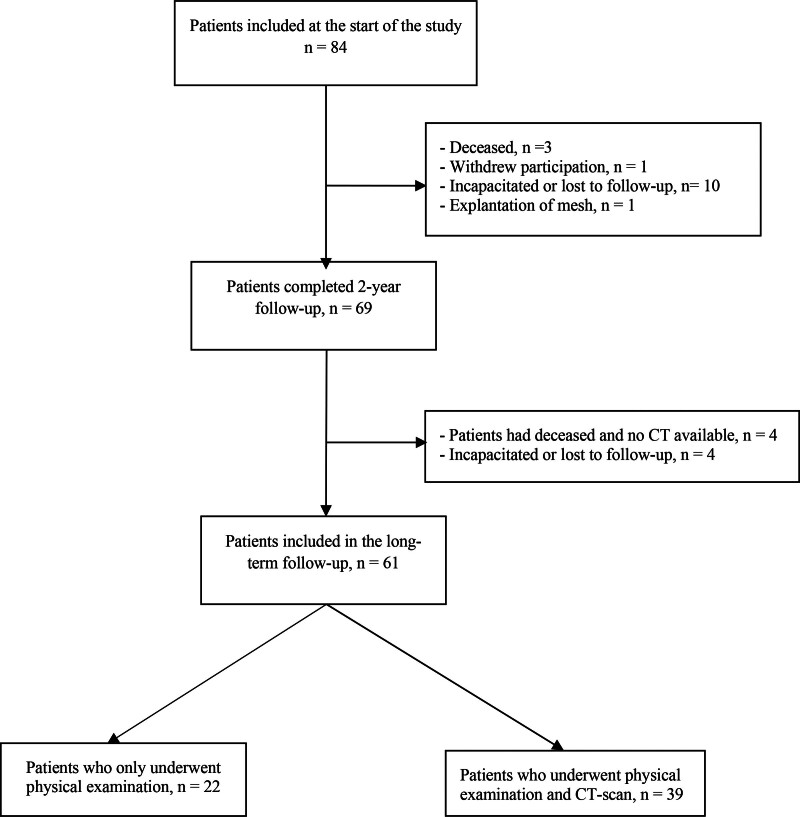
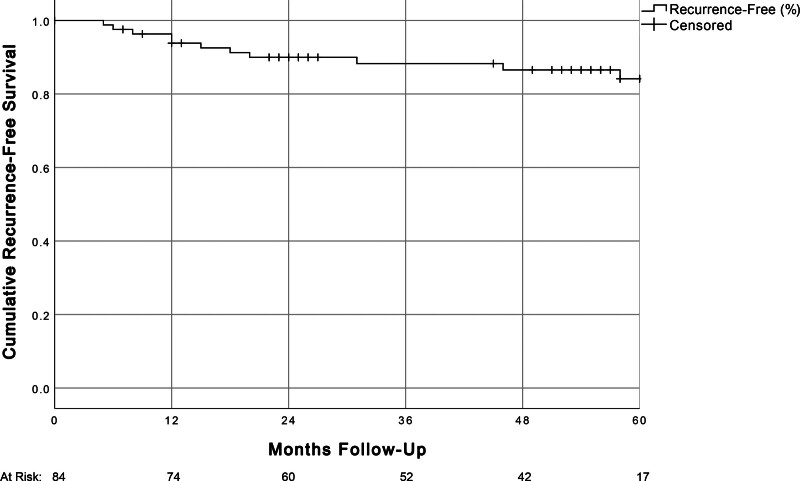
Results: In total, 61/84 (72.6%) patients were seen. Median follow-up time was 60.0 [interquartile range (IQR): 55-64] months. CT scan was made in 39 patients (68.4%). A recurrence rate of 15.9% (95% confidence interval: 6.9-24.8) was calculated after 5 years. Four new recurrences (6.6%) were found between 2 and 5 years. Two were asymptomatic. In total, 13/84 recurrences were found. No long-term mesh complications and/or interventions occurred. VAS scores were 0 (IQR: 0-2).
Conclusions: Hernia repair with Phasix mesh in high-risk patients (VHWG 3, body mass index >28) demonstrated a recurrence rate of 15.9%, low pain scores, no mesh-related complications or reoperations for chronic pain between the 2- and 5-year follow-up. Four new recurrences occurred, 2 were asymptomatic. The poly-4-hydroxybutyrate mesh is a safe mesh for hernia repair in VHWG 3 patients, which avoids long-term mesh complications like pain and mesh infection.
Keywords: CT scan; biosynthetic mesh; incisional hernia; long-term; recurrence.
Copyright © 2023 The Author(s). Published by Wolters Kluwer Health, Inc.
Conflict of interest statement
Disclosure: The authors state that they have no proprietary interest in the products named in this article.
Figures
References
-
- Dewulf M, Muysoms F, Vierendeels T, et al. Prevention of incisional hernias by prophylactic mesh-augmented reinforcement of midline laparotomies for abdominal aortic aneurysm treatment: five-year follow-up of a randomized controlled trial. Ann Surg. 2022;276:e217–e222. - PubMed
-
- Luijendijk RW, Hop WC, van den Tol MP, et al. A comparison of suture repair with mesh repair for incisional hernia. N Engl J Med. 2000;343:392–398. - PubMed
-
- Leber GE, Garb JL, Alexander AI, et al. Long-term complications associated with prosthetic repair of incisional hernias. Arch Surg. 1998;133:378–382. - PubMed
LinkOut - more resources
Full Text Sources
Miscellaneous
