


Mediators and Moderators of Active Music Engagement to Reduce Traumatic Stress Symptoms and Improve Well-being in Parents of Young Children With Cancer
- PMID: 38145309
- PMCID: PMC10750508
- DOI: 10.1177/15347354231218266
Mediators and Moderators of Active Music Engagement to Reduce Traumatic Stress Symptoms and Improve Well-being in Parents of Young Children With Cancer
Abstract
Objective: This trial examined the effects of proximal/distal mediators and moderators of an Active Music Engagement (AME) intervention on young child/parent distress, quality of life, and family function outcomes.
Methods: Child/parent dyads (n = 125) were randomized to AME or Audio-storybooks attention control condition. Each group received 3 sessions with a credentialed music therapist for 3 consecutive days with data collection at baseline, post-intervention (T2), and 30-days later (T3). Potential proximal mediators included within session child and parent engagement. Potential distal mediators included changes in perceived family normalcy, parent self-efficacy, and independent use of play materials. Potential moderators included parent/child distress with prior hospitalizations, parent traumatic stress screener (PCL-6), and child age. Outcomes included child emotional distress and quality of life; parent emotion, traumatic stress symptoms (IES-R), well-being; and family function. Mediation effects were estimated using ANCOVA, with indirect effects estimated using the percentile bootstrap approach. Moderation effects were tested by including appropriate interaction terms in models.
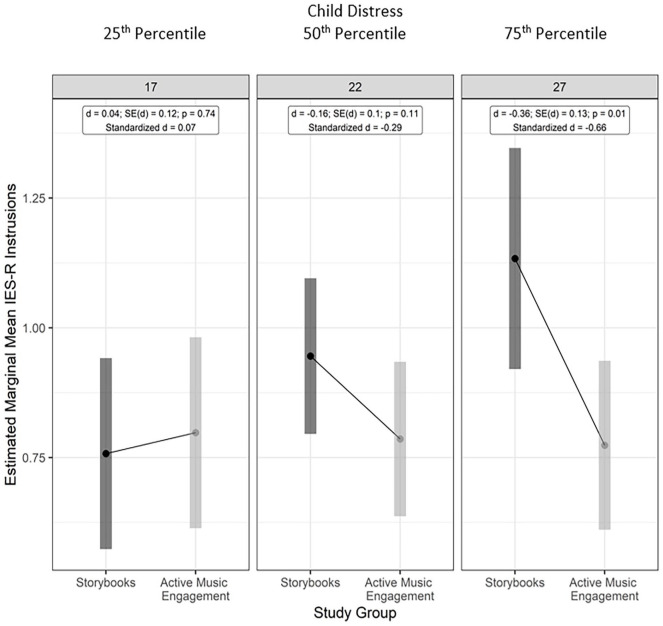
Results: No significant mediation effects were observed. Child distress with prior hospitalizations moderated AME effects for IES-R intrusion subscale scores at T2 (P = .01) and avoidance subscale scores at T3 (P = .007). Traumatic stress screener scores (PCL-6) moderated intervention effects for IES-R hyperarousal subscale scores at T2 (P = .01). There were no moderation effects for child age.
Conclusions: AME is a promising intervention for mitigating traumatic stress symptoms and supporting well-being in parents of children with cancer, particularly for parents who screen high for traumatic stress and whose children are more highly distressed with hospitalization.
Trial registration: ClinicalTrials.gov NCT03085927.
Keywords: cancer; child; hospitalization; music therapy; neoplasms; parents; psychological distress; quality of life.
Conflict of interest statement
Declaration of Conflicting InterestsThe author(s) declared no potential conflicts of interest with respect to the research, authorship, and/or publication of this article.
Figures

References
-
- Kazak AE, Baxt C. Families of infants and young children with cancer: a post-traumatic stress framework. Pediatr Blood Cancer. 2007;49:1109-1113. - PubMed
-
- Graf A, Bergstraesser E, Landolt MA. Posttraumatic stress in infants and preschoolers with cancer. Psycho Oncol. 2013;22:1543-1548. - PubMed
-
- Pai AL, Kazak AE, Pai ALH, Kazak AE. Pediatric medical traumatic stress in pediatric oncology: family systems interventions. Curr Opin Pediatr. 2006;18:558-562. - PubMed
-
- Price J, Kassam-Adams N, Alderfer MA, Christofferson J, Kazak AE. Systematic review: a reevaluation and update of the integrative (trajectory) model of pediatric medical traumatic stress. J Pediatr Psychol. 2016;41:86-97. - PubMed
-
- Myant KA, Williams JM, Myant KA, Williams JM. Children's concepts of health and illness: understanding of contagious illnesses, non-contagious illnesses and injuries. J Health Psychol. 2005;10:805-819. - PubMed
Publication types
MeSH terms
Associated data
Grants and funding
LinkOut - more resources
Full Text Sources
Medical
