


A prospective cohort study of periostin as a serum biomarker in patients with idiopathic pulmonary fibrosis treated with nintedanib
- PMID: 38151520
- PMCID: PMC10752870
- DOI: 10.1038/s41598-023-49180-4
A prospective cohort study of periostin as a serum biomarker in patients with idiopathic pulmonary fibrosis treated with nintedanib
Abstract
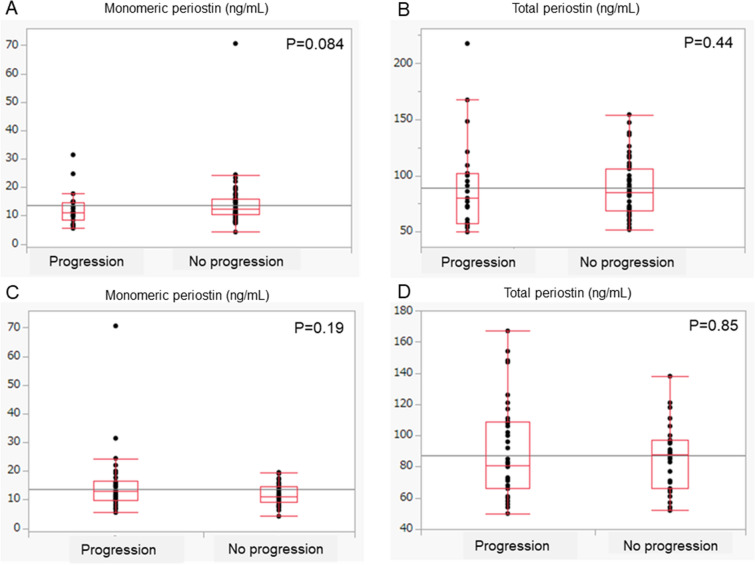
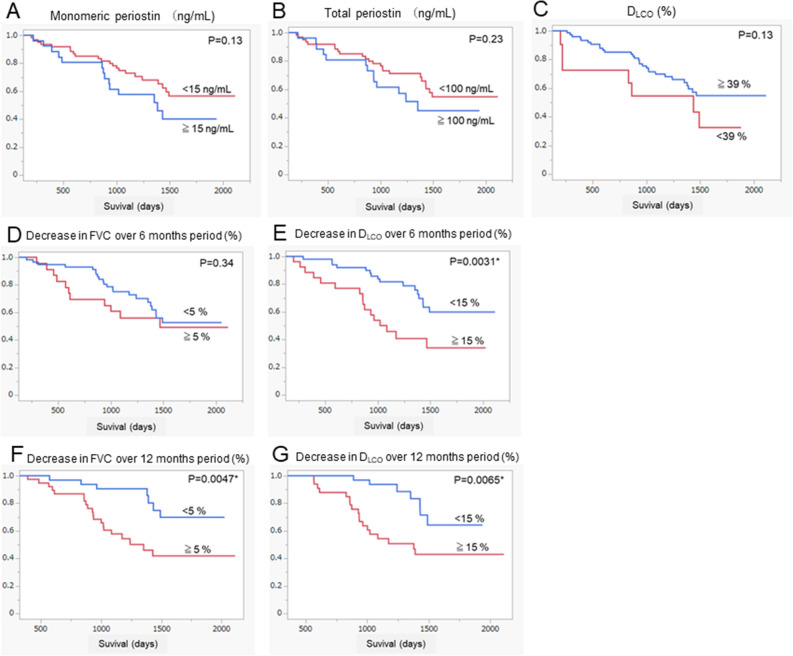
This study investigated the utility of periostin, a matricellular protein, as a prognostic biomarker in patients with idiopathic pulmonary fibrosis (IPF) who received nintedanib. Monomeric and total periostin levels were measured by enzyme-linked immunosorbent assay in 87 eligible patients who participated in a multicenter prospective study. Forty-three antifibrotic drug-naive patients with IPF described in previous studies were set as historical controls. Monomeric and total periostin levels were not significantly associated with the change in forced vital capacity (FVC) or diffusing capacity of the lungs for carbon monoxide (DLCO) during any follow-up period. Higher monomeric and total periostin levels were independent risk factors for overall survival in the Cox proportional hazard model. In the analysis of nintedanib effectiveness, higher binarized monomeric periostin levels were associated with more favorable suppressive effects on decreased vital capacity (VC) and DLCO in the treatment group compared with historical controls. Higher binarized levels of total periostin were associated with more favorable suppressive effects on decreased DLCO but not VC. In conclusion, higher periostin levels were independently associated with survival and better therapeutic effectiveness in patients with IPF treated with nintedanib. Periostin assessments may contribute to determining therapeutic strategies for patients with IPF.
© 2023. The Author(s).
Conflict of interest statement
Masaki Okamoto, Hiroshi Mukae, Yasunari Miyazaki, Tomohiro Handa, Naoki Hamada, and Tomoaki Hoshino received more than 1,000,000 JPY as research funding from Nippon Boehringer-Ingelheim, co., ltd. Kiminori Fujimoto received more than 1,000,000 JPY as research funding from Micron KK. Satoshi Ikeda received more than 1,000,000 JPY as research funding from Chugai pharmaceutical co., ltd. and AstraZeneca pharmaceuticals co., ltd. Kazuhiro Yatera received more than 1,000,000 JPY as research funding from FUJIFILM, co., ltd., Taiho pharmaceuticals co., ltd., GlaxoSmithKline K.K., Insmed Inc., Bayer pharmaceuticals co., ltd. Hirotaka Nishikiori received more than 1,000,000 JPY as research funding from Nippon Nippon Boehringer-Ingelheim, co., ltd. and M3, Inc., Tokyo. Yoshinori Tanino received more than 1,000,000 JPY as research funding from Nippon Boehringer-Ingelheim, co., ltd. and StemRIM Inc. Hironao Hozumi received more than 1,000,000 JPY as research funding from TERUMO LIFE SCIENCE FOUNDATION. Tomohiro Handa received more than 1,000,000 JPY as research funding from FUJIFILM, co., ltd. Hiroshi Ishii received more than 1,000,000 JPY as research funding from Shionogi pharmaceuticals co., ltd. Kenji Izuhara received more than 1,000,000 JPY as research funding from Shino test co., ltd., AstraZeneca pharmaceuticals co., ltd., and Torii Pharmaceutical co., ltd. Masaki Okamoto, Hiroshi Mukae, Noriho Sakamoto, Takashi Ogura, Yoshikazu Inoue, Yasunari Miyazaki, Motoyasu Kato, Hiroshi Ishii, Satoshi Konno, Arata Azuma and Takafumi Suda received more than 500,000 JPY as honoraria from Nippon Boehringer-Ingelheim, co., ltd. Takeshi Johkoh received more than 500,000 JPY as honoraria from Nippon Boehringer-Ingelheim, co., ltd., Kyorin Pharmaceutical co., ltd., and AstraZeneca pharmaceuticals co., ltd. Satoshi Ikeda received more than 500,000 JPY as honoraria from Ono Pharmaceutical co., ltd., Chugai pharmaceutical co., ltd., Pfizer Japan inc., AstraZeneca pharmaceuticals co., ltd., Bristol-Myers Squibb Company. Yasuhiro Kondoh and Yasuhiko Yamano received more than 500,000 JPY as honoraria from Nippon Boehringer-Ingelheim, co., ltd. and Bristol-Myers Squibb, co., ltd. Kosaku Komiya received more than 500,000 JPY as honoraria from Nippon Boehringer-Ingelheim, co., ltd. and Kyorin Pharmaceutical, co., ltd. Kazuhiro Yatera received more than 500,000 JPY as honoraria from Nippon Boehringer-Ingelheim, co., ltd., AstraZeneca pharmaceuticals co., ltd., GlaxoSmithKline K.K., Novartis Pharma, co., ltd., Kyorin Pharmaceutical, co., ltd. Toru Tsuda received more than 500,000 JPY as honoraria from AstraZeneca pharmaceuticals co., ltd. Hiroshi Ohnishi received more than 500,000 JPY as honoraria from Novartis Pharma, co., ltd. Noboru Hattori received more than 500,000 JPY as honoraria from Nippon Boehringer-Ingelheim, co., ltd., and AstraZeneca pharmaceuticals co., ltd. Takafumi Suda received more than 500,000 JPY as honoraria from Nippon Boehringer-Ingelheim, co., ltd. and AstraZeneca pharmaceuticals co., ltd. Takashi Ogura and Toru Tsuda received more than 500,000 JPY as manuscript fees from Nippon Boehringer-Ingelheim, co., ltd. Noriho Sakamoto, Yasunari Miyazaki, and Satoshi Konno received more than 1,000,000 JPY as donations from Nippon Boehringer-Ingelheim m, co., ltd. Kazuhiro Yatera received more than 1,000,000 JPY as donations from TEIJIN PHARMA co., ltd. and Taiho pharmaceuticals co., ltd. Kenji Izuhara received more than 1,000,000 JPY as donations from Shino test co., ltd. Tomohiro Handa belongs to an endowed department sponsored by TEIJIN PHARMA., co., ltd. Satoshi Konno belongs to an endowed department sponsored by Nippon Boehringer-Ingelheim m, co., ltd. Yoshikazu Inoue is a clinical trial advisor of Boehringer Ingelheim, Inc, Taiho Pharma, Kyorin Pharmaceutical co.ltd., Roche/Promedior co.ltd., Galapagos, CSL Behring, Vicore Pharma AB, Savara Inc. The enzyme-linked immunosorbent assay of periostin in the present study was performed free of charge by Shino-Test Co., Ltd. Other co-authors have no potential conflict of interest.
Figures



References
-
- Raghu G, Remy-Jardin M, Richeldi L, Thomson CC, Inoue Y, Johkoh T, et al. Idiopathic pulmonary fibrosis (an Update) and progressive pulmonary fibrosis in adults: An Official ATS/ERS/JRS/ALAT clinical practice guideline. Am. J. Respir. Crit. Care Med. 2022;205:e18–e47. doi: 10.1164/rccm.202202-0399ST. - DOI - PMC - PubMed
Publication types
MeSH terms
Substances
Grants and funding
LinkOut - more resources
Full Text Sources
