. 2023 Oct 5:22:132-141.
doi: 10.1016/j.xjtc.2023.08.030. eCollection 2023 Dec.

The cervical branch-first technique in complex resternotomy

Affiliations

The cervical branch-first technique in complex resternotomy

Michelle Ng et al. JTCVS Tech. .

Abstract

Background: Branch-first total aortic arch repair is a paradigm shift in the technical approach for uninterrupted neuroprotection during open aortic surgery. This technique is further modified to instigate hazardous sternal reentry in patients with hostile mediastinal anatomy at risk of aortic injury.

Methods: Intraoperative preparation and the illustrated operative technique of the cervical branch-first technique are described. The accompanying case series narrates the experiences and outcomes of 4 patients who underwent successful complex reoperative aortic surgery utilizing this technique.

Results: The indications for resternotomy included a sixth reoperation for recurrent mycotic aortic pseudoaneurysm, a third reoperation for extensive infective endocarditis, a reoperation for complete Bentall graft dehiscence with contained aortic rupture, and a third reoperation for residual type A dissection. All patients survived their proposed surgery. Two patients were operated on in an emergency setting. Two patients separated from cardiopulmonary bypass with extracorporeal support. None experienced permanent neurological sequelae, gut ischemia, peripheral arterial complications, or in-hospital mortality. One mortality due to decompensated heart failure was reported at 6 months postoperatively.

Conclusions: The cervical branch-first technique offers unparalleled advantage in neuroprotection from an early stage of complex reoperative aortic surgery. It provides an independent circuit for complete antegrade cerebral perfusion, irrespective of suspension to circulatory flows to the rest of the body during complex reentry into hostile chests. Our experience to date has demonstrated promising outcomes and further refinements will guide patient selection best suited for this technique.

Keywords: branch-first total arch repair; complex redo sternotomy; redo open aortic surgery.


Conflict of interest statement

The authors reported no conflicts of interest. The Journal policy requires editors and reviewers to disclose conflicts of interest and to decline handling manuscripts for which they may have a conflict of interest. The editors and reviewers of this article have no conflicts of interest.

Figures

None
Graphical abstract
None
The cervical branch-first technique performed at the level of the neck.
Figure 1
Figure 1
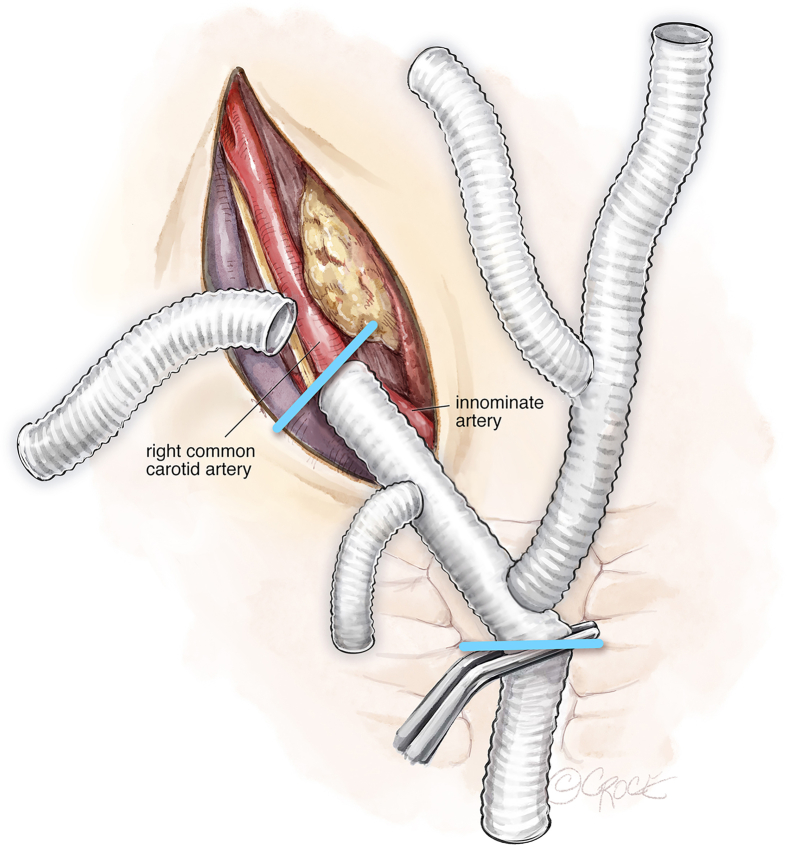
The V-shaped cervical incision allows for access to the innominate artery, left common carotid artery, and left subclavian artery for supra-aortic debranching.
Figure 2
Figure 2
The distance of each graft from the manubriosternal angle to the level of the proposed anastomosis is measured at the stretched length of each graft limb.
Figure 3
Figure 3
The innominate artery is anastomosed to the first limb of the trifurcation graft.
Figure 4
Figure 4
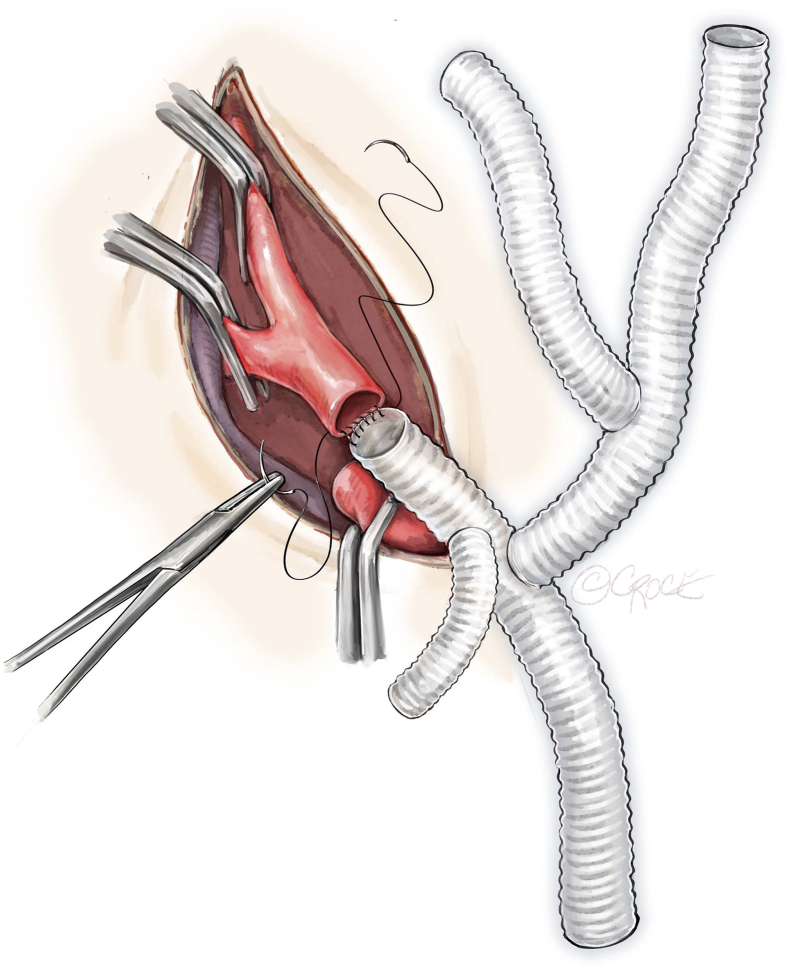
The left common carotid artery is the next sequential branch anastomosed to the second limb of the trifurcation graft. Vascular clamps are applied between the first and second limbs to allow for the commencement of antegrade cerebral perfusion via the innominate artery by the head circuit.
Figure 5
Figure 5
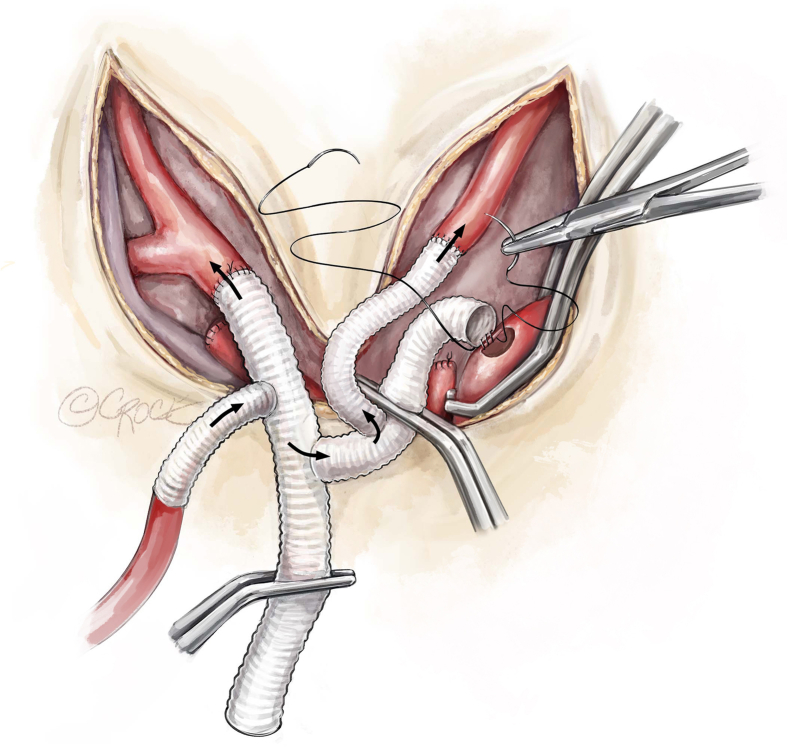
The left subclavian artery is anastomosed to the final limb of the trifurcation graft via an end-to-side anastomosis if adequate access to the left subclavian artery is not achieved. Antegrade cerebral perfusion continues via the reconstructed innominate artery and left common carotid artery to the head circuit.
Figure 6
Figure 6
Continuous antegrade cerebral perfusion via the head circuit is established at the level of the neck before resternotomy is performed.
Figure 7
Figure 7
Reconstruction of the aorta is performed as necessary. The common limb of the trifurcation graft is anastomosed end-to-side to the ascending aorta graft as the final step of the aortic repair.
Figure 8
Figure 8
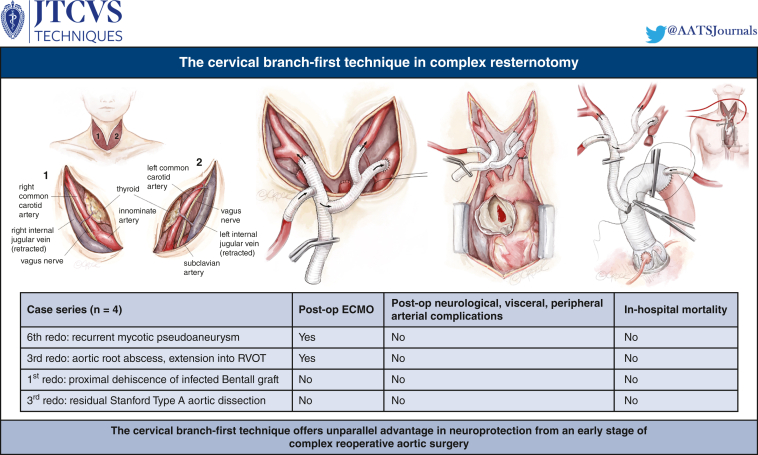
Illustrated operative technique and operative outcomes for the cervical branch-first technique in complex redo sternotomies. ECMO, Extracorporeal membrane oxygenation; RVOT, right ventricular outflow tract.
Figure E1
Figure E1
A V-shaped incision is made along the medial borders of sternocleidomastoid muscles bilaterally, adjoining the midline sternotomy skin incision.
Figure E2
Figure E2
A heavy silk tie is used to occlude the left subclavian artery below the level of the left vertebral artery and left internal thoracic artery.
Figure E3
Figure E3
A large Foley catheter is placed beyond the aortic breach for balloon occlusion of the aortic lumen. Direct ostial cannulation is inserted for antegrade cardioplegia.

References

    1. Kim M., Matalanis G. Technique and rationale for branch-first total aortic arch repair. J Thorac Cardiovasc Surg Tech. 2020;4:1–4. - PMC - PubMed
    1. Kim M., Matalanis G. Illustrated technique of “branch-first” total aortic arch replacement. Operative Technique Thorac Cardiovasc Surg. 2020;27:23–38.
    1. McGiffin D. LV vent. https://ecmo.icu/procedures-lv-vent
    1. Keeling W.B., Leshnower B.G., Thourani V.H., Kilgo P.S., Chen E.P. Outcomes following redo sternotomy for aortic surgery. Interact Cardiovasc Thorac Surg. 2012;15:63–68. - PMC - PubMed
    1. Ramaiah C. Reoperations on thoracic aorta and aortic root: surgical technique and pitfalls. Int J Angiol. 2018;27:138–143. - PMC - PubMed

LinkOut - more resources