


Polychaete (Alitta virens) meal inclusion as a dietary strategy for modulating gut microbiota of European seabass (Dicentrarchus labrax)
- PMID: 38152403
- PMCID: PMC10752597
- DOI: 10.3389/fimmu.2023.1266947
Polychaete (Alitta virens) meal inclusion as a dietary strategy for modulating gut microbiota of European seabass (Dicentrarchus labrax)
Abstract
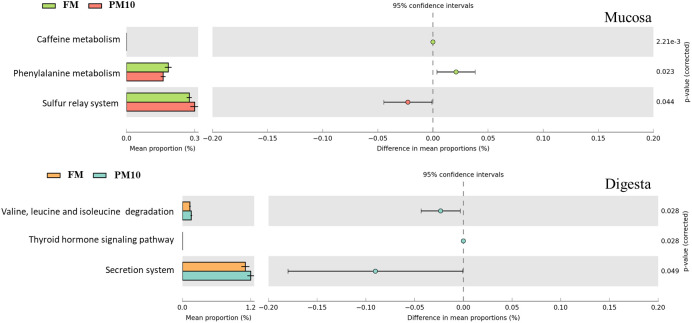
Recent research has revealed the significant impact of novel feed ingredients on fish gut microbiota, affecting both the immune status and digestive performance. As a result, analyzing the microbiota modulatory capabilities may be a useful method for assessing the potential functionality of novel ingredients. Therefore, this study aimed to evaluate the effects of dietary polychaete meal (PM) from Alitta virens on the autochthonous and allochthonous gut microbiota of European seabass (Dicentrarchus labrax). Two diets were compared: a control diet with 25% fishmeal (FM) and a diet replacing 40% of fishmeal with PM, in a 13-week feeding trial with juvenile fish (initial weight of 14.5 ± 1.0 g). The feed, digesta, and mucosa-associated microbial communities in fish intestines were analyzed using high-throughput sequencing of the 16S rRNA gene on the Illumina MiSeq platform. The results of feed microbiota analyses showed that the PM10 feed exhibited a higher microbial diversity than the FM diet. However, these feed-associated microbiota differences were not mirrored in the composition of digesta and mucosal communities. Regardless of the diet, the digesta samples consistently exhibited higher species richness and diversity than the mucosa samples. Overall, digesta samples were characterized by a higher abundance of Firmicutes in PM-fed fish. In contrast, at the gut mucosa level, the relative abundances of Mycobacterium, Taeseokella and Clostridium genera were lower in the group fed the PM10 diet. Significant differences in metabolic pathways were also observed between the FM and PM10 groups in both mucosa and digesta samples. In particular, the mucosal pathways of caffeine metabolism, phenylalanine metabolism, and sulfur relay system were significantly altered by PM inclusion. The same trend was observed in the digesta valine, leucine, and isoleucine degradation and secretion pathways. These findings highlight the potential of PM as an alternative functional ingredient in aquafeeds with microbiota modulatory properties that should be further explored in the future.
Keywords: aquaculture; functional feeds; gut microbiota; low-trophic organisms; next generation sequencing.
Copyright © 2023 Monteiro, Rimoldi, Costa, Kousoulaki, Hasan, Valente and Terova.
Conflict of interest statement
The authors declare that the research was conducted in the absence of any commercial or financial relationships that could be construed as a potential conflict of interest. The reviewer FM declared a past collaboration with one of the author GT to the handling editor.
Figures
Similar articles
-
Assessment of dietary supplementation with galactomannan oligosaccharides and phytogenics on gut microbiota of European sea bass (Dicentrarchus Labrax) fed low fishmeal and fish oil based diet.PLoS One. 2020 Apr 16;15(4):e0231494. doi: 10.1371/journal.pone.0231494. eCollection 2020. PLoS One. 2020. PMID: 32298317 Free PMC article.
-
Gut microbiota dynamics in carnivorous European seabass (Dicentrarchus labrax) fed plant-based diets.Sci Rep. 2021 Jan 11;11(1):447. doi: 10.1038/s41598-020-80138-y. Sci Rep. 2021. PMID: 33432059 Free PMC article.
-
Alternative Protein Sources in the Diet Modulate Microbiota and Functionality in the Distal Intestine of Atlantic Salmon (Salmo salar).Appl Environ Microbiol. 2017 Feb 15;83(5):e02615-16. doi: 10.1128/AEM.02615-16. Print 2017 Mar 1. Appl Environ Microbiol. 2017. PMID: 27986728 Free PMC article.
-
Sustainable Fish Feeds with Insects and Probiotics Positively Affect Freshwater and Marine Fish Gut Microbiota.Animals (Basel). 2023 May 14;13(10):1633. doi: 10.3390/ani13101633. Animals (Basel). 2023. PMID: 37238063 Free PMC article. Review.
-
Insect meal in aquafeeds: A sustainable path to enhanced mucosal immunity in fish.Fish Shellfish Immunol. 2024 Jul;150:109625. doi: 10.1016/j.fsi.2024.109625. Epub 2024 May 11. Fish Shellfish Immunol. 2024. PMID: 38740231 Review.
Cited by
-
Influence of Herba Houttuyniae added to fodder on the morphological structure of the intestinal tract, the digestive enzymes, the intestinal flora, and immune function of koi carp (Cyprinus carpio) infected with Aeromonas veronii.Fish Physiol Biochem. 2024 Aug;50(4):1495-1512. doi: 10.1007/s10695-024-01352-3. Epub 2024 May 2. Fish Physiol Biochem. 2024. PMID: 38696022
-
Exploration of Response Mechanisms in the Gills of Pacific Oyster (Crassostrea gigas) to Cadmium Exposure through Integrative Metabolomic and Transcriptomic Analyses.Animals (Basel). 2024 Aug 9;14(16):2318. doi: 10.3390/ani14162318. Animals (Basel). 2024. PMID: 39199852 Free PMC article.
References
-
- Klinger D, Naylor R. Searching for solutions in aquaculture: charting a sustainable course. Annu Rev Environ Resour (2012) 37:247–76. doi: 10.1146/annurev-environ-021111-161531 - DOI
-
- FAO . The state of aquaculture and fisheries, in Towards blue transformation. Rome, Italy. p. 2–4. (2022).
-
- Turchini GM, Trushenski JT, Glencross BD. Thoughts for the future of aquaculture nutrition: realigning perspectives to reflect contemporary issues related to judicious use of marine resources in aquafeeds. N Am J Aquac (2019) 81:13–39. doi: 10.1002/NAAQ.10067 - DOI
-
- Colombo SM, Roy K, Mraz J, Wan AHL, Davies SJ, Tibbetts SM, et al. . Towards achieving circularity and sustainability in feeds for farmed blue foods. Rev Aquac (2022) 15(3):1115–41. doi: 10.1111/RAQ.12766 - DOI
Publication types
MeSH terms
Substances
LinkOut - more resources
Full Text Sources
Research Materials
