


Associations between early trajectories of amygdala development and later school-age anxiety in two longitudinal samples
- PMID: 38154378
- PMCID: PMC10792190
- DOI: 10.1016/j.dcn.2023.101333
Associations between early trajectories of amygdala development and later school-age anxiety in two longitudinal samples
Abstract
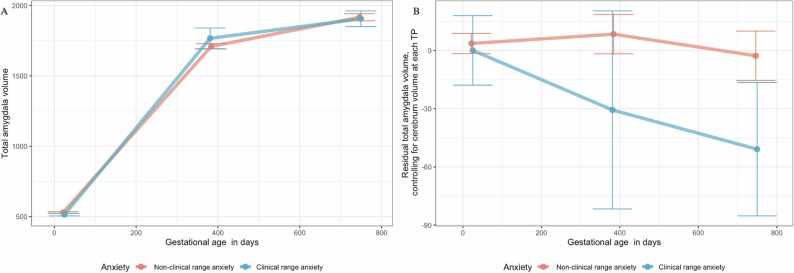
Amygdala function is implicated in the pathogenesis of autism spectrum disorder (ASD) and anxiety. We investigated associations between early trajectories of amygdala growth and anxiety and ASD outcomes at school age in two longitudinal studies: high- and low-familial likelihood for ASD, Infant Brain Imaging Study (IBIS, n = 257) and typically developing (TD) community sample, Early Brain Development Study (EBDS, n = 158). Infants underwent MRI scanning at up to 3 timepoints from neonate to 24 months. Anxiety was assessed at 6-12 years. Linear multilevel modeling tested whether amygdala volume growth was associated with anxiety symptoms at school age. In the IBIS sample, children with higher anxiety showed accelerated amygdala growth from 6 to 24 months. ASD diagnosis and ASD familial likelihood were not significant predictors. In the EBDS sample, amygdala growth from birth to 24 months was associated with anxiety. More anxious children had smaller amygdala volume and slower rates of amygdala growth. We explore reasons for the contrasting results between high-familial likelihood for ASD and TD samples, grounding results in the broader literature of variable associations between early amygdala volume and later anxiety. Results have the potential to identify mechanisms linking early amygdala growth to later anxiety in certain groups.
Keywords: Amygdala; Anxiety; Autism spectrum disorder (ASD); Magnetic resonance imaging (MRI); Reproducibility.
Copyright © 2023 The Authors. Published by Elsevier Ltd.. All rights reserved.
Conflict of interest statement
Declaration of Competing Interest The authors report no financial or personal relationships that influenced their work.
Figures


References
-
- Achenbach, T.M. (1999). The Child Behavior Checklist and related instruments.
-
- Akaike H. In: Mehra R.K., Lainiotis D.G., editors. Vol. 126. Elsevier; 1976. Canonical Correlation Analysis of Time Series and the Use of an Information Criterion; pp. 27–96. (Mathematics in Science and Engineering). - DOI
-
- Albaugh M.D., Nguyen T.-V., Ducharme S., Collins D.L., Botteron K.N., D’Alberto N., Evans A.C., Karama S., Hudziak J.J. Age-related volumetric change of limbic structures and subclinical anxious/depressed symptomatology in typically developing children and adolescents. Biol. Psychol. 2017;124:133–140. doi: 10.1016/j.biopsycho.2017.02.002. - DOI - PubMed
-
- Amaral D.G., Schumann C.M., Nordahl C.W. Neuroanatomy of autism. Trends Neurosci. 2008;31(3):137–145. - PubMed
Publication types
MeSH terms
Grants and funding
- K23 HD112507/HD/NICHD NIH HHS/United States
- K01 MH122779/MH/NIMH NIH HHS/United States
- P50 HD103573/HD/NICHD NIH HHS/United States
- P50 HD105354/HD/NICHD NIH HHS/United States
- T32 HD040127/HD/NICHD NIH HHS/United States
- P50 HD103525/HD/NICHD NIH HHS/United States
- R01 HD055741/HD/NICHD NIH HHS/United States
- T32 MH015755/MH/NIMH NIH HHS/United States
- K12 HD055887/HD/NICHD NIH HHS/United States
- U54 HD086984/HD/NICHD NIH HHS/United States
- U54 HD079124/HD/NICHD NIH HHS/United States
- R01 MH118362/MH/NIMH NIH HHS/United States
LinkOut - more resources
Full Text Sources
Medical
