


Spatiotemporal modulation of growth factors directs the generation of multilineage mouse embryonic stem cell-derived mammary organoids
- PMID: 38159568
- PMCID: PMC10872289
- DOI: 10.1016/j.devcel.2023.12.003
Spatiotemporal modulation of growth factors directs the generation of multilineage mouse embryonic stem cell-derived mammary organoids
Abstract
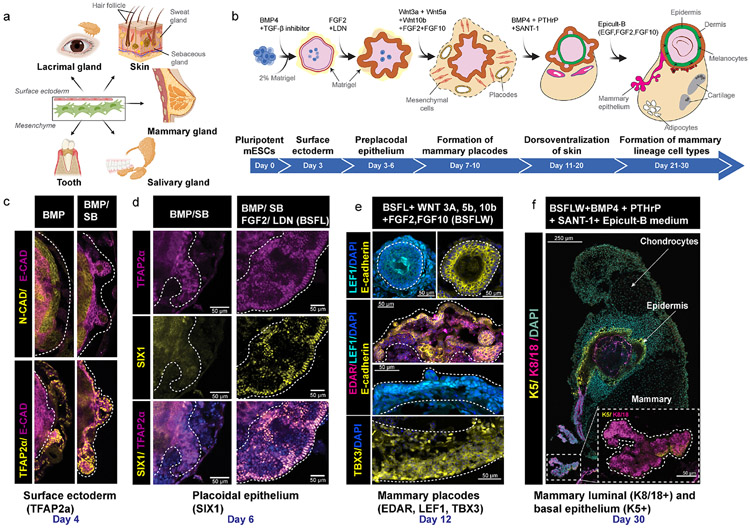
Ectodermal appendages, such as the mammary gland (MG), are thought to have evolved from hair-associated apocrine glands to serve the function of milk secretion. Through the directed differentiation of mouse embryonic stem cells (mESCs), here, we report the generation of multilineage ESC-derived mammary organoids (MEMOs). We adapted the skin organoid model, inducing the dermal mesenchyme to transform into mammary-specific mesenchyme via the sequential activation of Bone Morphogenetic Protein 4 (BMP4) and Parathyroid Hormone-related Protein (PTHrP) and inhibition of hedgehog (HH) signaling. Using single-cell RNA sequencing, we identified gene expression profiles that demonstrate the presence of mammary-specific epithelial cells, fibroblasts, and adipocytes. MEMOs undergo ductal morphogenesis in Matrigel and can reconstitute the MG in vivo. Further, we demonstrate that the loss of function in placode regulators LEF1 and TBX3 in mESCs results in impaired skin and MEMO generation. In summary, our MEMO model is a robust tool for studying the development of ectodermal appendages, and it provides a foundation for regenerative medicine and disease modeling.
Keywords: ectodermal appendages; embryonic stem cell; mammary gland; organoid; single-cell transcriptomics.
Published by Elsevier Inc.
Conflict of interest statement
Declaration of interests The authors declare no competing interests.
Figures


References
-
- Oftedal OT (2002). evolutionary origin of mammary gland. Journal of Mammary Gland Biology and Neoplasia 7, 225–252. - PubMed
Publication types
MeSH terms
Substances
Grants and funding
LinkOut - more resources
Full Text Sources
Research Materials
