


Prevalence of Retinopathy in Prediabetic Populations: A Systematic Review and Meta-Analysis
- PMID: 38161917
- PMCID: PMC10755086
- DOI: 10.7759/cureus.49602
Prevalence of Retinopathy in Prediabetic Populations: A Systematic Review and Meta-Analysis
Abstract
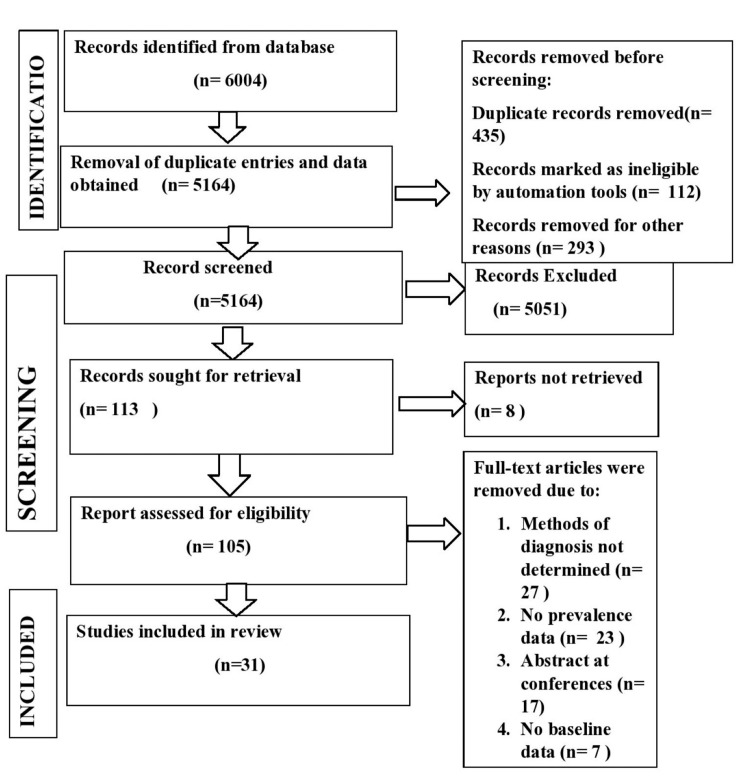
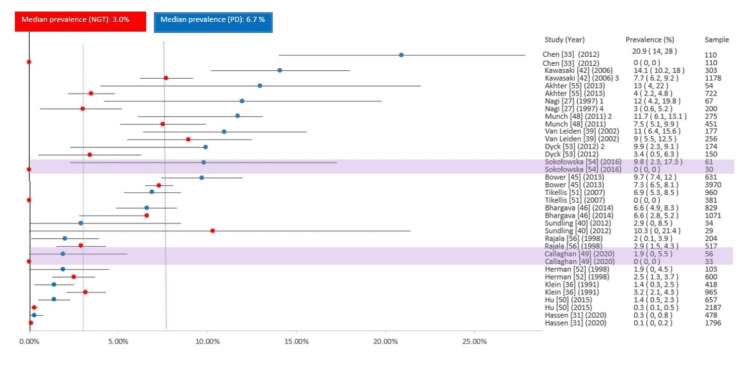
Among the leading causes of vision impairment and blindness globally, diabetic retinopathy (DR) is one of the most important causes. There is increasing evidence of DR prevalence in the prediabetic population. This systematic review presents collective data on retinopathy in the prediabetic population. This review article aimed to estimate the reported prevalence of retinopathy in prediabetes, impaired glucose tolerance test (GTT) without diabetes mellitus, and the risk factors involved and to summarize it. Literature searches were done using the Web of Science, CINAHL, Google Scholar, Cochrane, EMBASE, and PubMed databases from inception to April 2023. Our search included the words prediabetes, DR, and risk factors. All searches were looked at for methodological quality and evidence. Thirty-one studies were included after the screening. Population-based data were used in 23 studies (82.1%). The prediabetic population screened was 10,539. The prevalence of retinopathy ranged between 0.3% and 20.9%, showing a median of 8.1% with an interquartile range (IQR) of 4.2-11%, showing great variance in estimates due to the use of different screening methods, methods used for retinopathy grading, and study populations. Several studies compared the population with normal GTT with impaired glucose tolerance (IGT) and inferred that there was a lower prevalence of retinopathy in the normal GTT population (3.0%, IQR 0.3-7.4%) than prediabetes (6.7%, IQR 1.9-10.1%). According to this data, a greater retinopathy prevalence was found in prediabetic populations.
Keywords: diabetic retinopathy; impaired fasting glucose; impaired glucose tolerance; prediabetes; prevalence.
Copyright © 2023, Sune et al.
Conflict of interest statement
The authors have declared that no competing interests exist.
Figures

Similar articles
-
The prevalence of cardiac autonomic neuropathy in prediabetes: a systematic review.Diabetologia. 2021 Feb;64(2):288-303. doi: 10.1007/s00125-020-05316-z. Epub 2020 Nov 9. Diabetologia. 2021. PMID: 33164108 Free PMC article.
-
Prevalence of retinopathy in prediabetes: protocol for a systematic review and meta-analysis.BMJ Open. 2021 Jan 7;11(1):e040997. doi: 10.1136/bmjopen-2020-040997. BMJ Open. 2021. PMID: 33414145 Free PMC article.
-
Global Prevalence of Diabetic Retinopathy in Pediatric Type 2 Diabetes: A Systematic Review and Meta-analysis.JAMA Netw Open. 2023 Mar 1;6(3):e231887. doi: 10.1001/jamanetworkopen.2023.1887. JAMA Netw Open. 2023. PMID: 36930156 Free PMC article.
-
Prognostic factors for the development and progression of proliferative diabetic retinopathy in people with diabetic retinopathy.Cochrane Database Syst Rev. 2023 Feb 22;2(2):CD013775. doi: 10.1002/14651858.CD013775.pub2. Cochrane Database Syst Rev. 2023. PMID: 36815723 Free PMC article. Review.
-
Prevalence of diabetic retinopathy in Iran: a systematic review and Meta-analysis.Int J Ophthalmol. 2017 May 18;10(5):782-789. doi: 10.18240/ijo.2017.05.21. eCollection 2017. Int J Ophthalmol. 2017. PMID: 28546938 Free PMC article.
Cited by
-
The prevention opportunities of retinopathy in diabetic patients - position paper endorsed by the Polish Lipid Association.Arch Med Sci. 2024 Dec 13;20(6):1754-1769. doi: 10.5114/aoms/197331. eCollection 2024. Arch Med Sci. 2024. PMID: 39967951 Free PMC article.
-
Prediabetes.Nat Rev Dis Primers. 2025 Jul 17;11(1):49. doi: 10.1038/s41572-025-00635-0. Nat Rev Dis Primers. 2025. PMID: 40676018 Review.
-
Long-term Cumulative Incidence of Clinically Diagnosed Retinopathy in the Finnish Diabetes Prevention Study.J Clin Endocrinol Metab. 2025 Feb 18;110(3):e615-e621. doi: 10.1210/clinem/dgae287. J Clin Endocrinol Metab. 2025. PMID: 38661084 Free PMC article. Clinical Trial.
-
Fermented beetroot modulates gut microbial carbohydrate metabolism in prediabetes and prevents high-fat diet induced hyperglycemia in a prediabetic model.Curr Res Food Sci. 2025 Apr 12;10:101052. doi: 10.1016/j.crfs.2025.101052. eCollection 2025. Curr Res Food Sci. 2025. PMID: 40290372 Free PMC article.
References
-
- Definition, diagnosis and classification of diabetes mellitus and its complications. Part 1: diagnosis and classification of diabetes mellitus provisional report of a WHO consultation. Alberti KG, Zimmet PZ. Diabet Med. 1998;15:539–553. - PubMed
-
- Harmonizing the metabolic syndrome: a joint interim statement of the International Diabetes Federation Task Force on Epidemiology and Prevention; National Heart, Lung, and Blood Institute; American Heart Association; World Heart Federation; International Atherosclerosis Society; and International Association for the Study of Obesity. Alberti KG, Eckel RH, Grundy SM, et al. Circulation. 2009;120:1640–1645. - PubMed
-
- 2. Classification and diagnosis of diabetes: standards of medical care in diabetes-2018. Diabetes Care. 2018;41:0–27. - PubMed
-
- Report of the expert committee on the diagnosis and classification of diabetes mellitus. Diabetes Care. 1997;20:1183–1197. - PubMed
Publication types
LinkOut - more resources
Full Text Sources
Miscellaneous